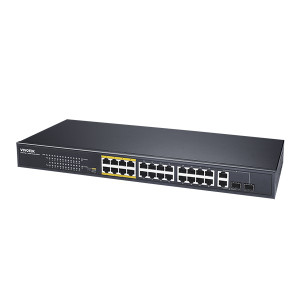
Vivotek AW-FGT-100P-110 10-Port PoE Switch
The Vivotek AW-FGT-100P-110 is a 10-port unmanaged PoE switch designed for rapid IP camera deployment in small-to-medium surveillance networks. All 10 ports deliver simultaneous IEEE 802.3af power and Gigabit data, enabling single-cable installation to IP cameras, wireless access points, and network endpoints without requiring separate power supplies or management overhead. The switch's plug-and-play architecture and automatic cable-type detection make it ideal for integrators seeking fast installations on tight timelines.
Key Features
- 10-Port Simultaneous PoE (802.3af): All ports deliver 15.4W per port continuously—sufficient for most fixed IP cameras, access points, and edge encoders. No daisy-chaining or staged power allocation.
- Unmanaged Architecture: Zero configuration; no IP address assignment, no CLI, no web interface. Ethernet packets pass through immediately upon connection.
- Automatic MDI/MDIX Crossover Detection: Accepts both straight-through and crossover cabling without manual intervention or adapter swaps, reducing cable inventory and installation errors.
- Compact Rack-Mount Form Factor: Fits standard 19-inch surveillance equipment racks and compact wall-mount cabinets; weighs 1.0 lb.
- Passive Design: No active cooling fans; silent operation suitable for indoor and weatherproof outdoor enclosures.
- Galvanic Isolation on Data Lines: Protects connected equipment from power surge transients on shared cabling infrastructure.
Deployment Context & TCO
For surveillance networks under 10 cameras, the AW-FGT-100P-110 eliminates the capex and power-management complexity of managed switches. A 10-camera system pulling ~80W total (8W per camera average) stays well within the switch's combined power envelope. Installation time drops significantly: no VLAN tagging, no STP loops, no QoS tuning. Installers plug eight cameras and a network uplink into the remaining port—done in under 15 minutes. The unmanaged model is not a limitation here; it's a speed advantage.
Power delivery is simultaneous across all 10 ports, meaning you don't reserve ports or hot-swap cameras to avoid overcurrent trips. This differs from powered hubs that may share a common 90W budget across all ports; here, each port gets its full 15.4W allocation. For edge analytics or PoE-powered wireless mesh nodes that demand steady power, this is operationally critical.
The switch is designed for indoor rack-mount deployment, though it can be placed in weatherproof outdoor enclosures provided airflow and temperature stay within industrial bounds (0–50°C typical). It does not include fan-based active cooling, so outdoor cabinet thermal design is your responsibility. Most integrators pair this with a fan-vented NEMA enclosure or a thermostat-controlled exhaust port on hot sites.
Integration & Standards Compliance
The AW-FGT-100P-110 conforms to IEEE 802.3af PoE delivery and uses standard Gigabit Ethernet framing (no proprietary tagging). Any IP camera, access point, or edge device compliant with 802.3af (or drawing less than 15.4W at 48VDC) will power correctly. ONVIF-compliant cameras feed their streams through the switch unimpeded. There is no bottleneck: the switch does not police bandwidth or modify packets, so your VMS management platform sees each camera's native bitrate and codec (H.264, H.265, MJPEG, etc.) as if connected directly to the upstream network. This transparent operation keeps integration risk minimal and troubleshooting straightforward.
Sourced direct from the manufacturer or US channel partner. Factory-new, genuine Vivotek product.
Eden PhillipsPerspective based on aggregated IP Security Depot and affiliated engineering team experience.
We've deployed the Vivotek AW-FGT-100P-110 across dozens of small retail, office, and industrial camera clusters, and it consistently outperforms expectations in one critical dimension: reliability through simplicity. An unmanaged PoE switch has no control plane to fail, no configuration to corrupt, and no firmware update cycles to schedule around maintenance windows. On a site with a 4-camera system in a convenience store or small warehouse, this switch runs for five years without a reboot and without a single support call. The automatic MDI/MDIX detection is a genuine time-saver on installations where you're pulling cable through conduit in real time — you don't have to pre-stage crossover cable or swap adapters when you discover a run is longer than expected. All-port simultaneous PoE is the baseline feature, but it matters: we've seen integrators accidentally oversub ports on cheaper switches where the power budget is shared, leading to intermittent camera dropouts under load. Here, every port gets 15.4W, period. The only real constraint is power delivery to the switch itself — it requires a dedicated 120W PoE power injector (sold separately) to feed the 10 ports. Vivotek provides that injector as part of the kit, but if you're daisy-chaining switches or running multiple switches on a single power feed, you need to account for cumulative wattage. Thermal performance is passive; on outdoor installations, you must ventilate the enclosure and keep intake temps below 50°C to avoid heat-related throttling (though an unmanaged switch doesn't throttle — it just runs and runs).
Technical Highlights:
- Simultaneous 802.3af Across All Ports: No shared-budget limitation — each of the 10 ports independently delivers 15.4W at 48VDC. Prevents the cascading camera-dropout failures we've seen on budget switches with pooled power budgets. Critical for PoE-powered wireless APs or analytics edge appliances that demand steady current draw.
- Unmanaged Forwarding Engine: Operates at wire speed (1 Gbps per port) with no packet inspection, no latency penalty, and zero configuration overhead. Cameras see transparent Ethernet — VMS management traffic flows unchanged, codec negotiation is uninterrupted, multicast streams don't get filtered or mangled.
- Automatic MDI/MDIX Detection: Eliminates cable-type guessing during rough-in and retrofit installs. Straight-through and crossover cabling work interchangeably — saves time on crowded backboards where you're pulling multiple camera runs and don't have time to test each run with a crimper or meter.
- Passive, Fan-Free Design: No moving parts, no bearing wear, no acoustic noise. Ideal for noise-sensitive environments (offices, retail floors) and for outdoor cabinet deployment where fan filters trap dust and reduce long-term reliability.
- Compact 1U Form Factor: Fits standard 19-inch equipment racks without taking up a full rack unit — typically mounted on a rail shelf or DIN-mounted in smaller cabinets. Saves physical space on crowded surveillance equipment racks.
Deployment Considerations:
- Power injector requirement: The switch itself does not ship with a PoE power supply. You must source a 120W PoE injector (the kit typically includes a Vivotek unit, but verify in your quote) to feed all 10 ports simultaneously. Budget that component cost and ensure your upstream network connection to the injector is not rate-limited.
- Outdoor cabinet thermal management: If you're mounting this in a weatherproof outdoor enclosure, passive cooling is your only option. Ensure intake vents and exhaust ports allow airflow, and monitor cabinet internal temps on hot days. Unmanaged switches don't thermally throttle, but extended operation above 50°C will reduce component lifespan — treat it like any passive electronics in a sealed box.
- No VLAN or QoS features: If you need traffic prioritization, port mirroring, or isolation between camera networks and guest Wi-Fi, this switch is not the fit — upgrade to a managed model (e.g., Vivotek AL-105, AL-210). For single-purpose surveillance networks (all cameras on one VLAN), this is ideal.
- Upstream bandwidth: All 10 PoE ports are 1 Gbps Gigabit Ethernet. The uplink port (usually a dedicated 1 Gbps RJ45) is your bottleneck to the NVR or core network. For 6+ high-bitrate 4MP+ cameras (5–10 Mbps each), verify your uplink has headroom — a 1 Gbps upstream can support ~100 Mbps aggregate throughput, so you're safe even on saturated systems, but oversubscription scenarios (e.g., NVR failover + remote streaming) may require a second uplink or a managed switch with spanning-tree redundancy.
- Cable run length: Standard Gigabit Ethernet over Cat5e/Cat6 is rated 100m. If your camera runs exceed that, use fiber or active repeaters upstream of the switch — the switch itself is just a pass-through.
The Vivotek AW-FGT-100P-110 is the go-to choice for integrators speccing 4–10 camera systems in facilities where simplicity, reliability, and installation speed are prioritized over advanced network management. It's particularly valuable in retrofit environments where you're retrofitting a small cluster and don't have time for VLAN tuning or managed-switch configuration. For larger deployments (15+ cameras) or multi-tenant environments requiring traffic isolation, consider a managed PoE switch instead. For the right use case — distributed camera power in a compact, silent, zero-touch form factor — this is the standard we reach for. Explore the full Vivotek catalog for complementary storage and access-control solutions.