
TP-Link SG2210MP vs Speco Technologies P8S10G: Specification Comparison
The TP-Link SG2210MP and Speco Technologies P8S10G are both 10-port Gigabit PoE switches designed for small-to-medium IP security deployments. Each provides eight PoE-capable copper ports plus two uplink ports, full gigabit throughput on all interfaces, and support for 802.3at PoE+. This comparison evaluates how they differ across the three dimensions that matter most to installers specifying switches for IP camera systems: available PoE power, management and fiber connectivity, and physical installation footprint and warranty terms.
In This Guide
- How do port layout, PoE budget, and per-port power ceiling compare?
- How do management depth, fiber uplink options, and integration capabilities differ?
- How do physical form factor, environmental ratings, and warranty coverage compare?
- Which should you choose: the SG2210MP or the P8S10G?
- Side-by-Side Specs
- FAQ
How do port layout, PoE budget, and per-port power ceiling compare?
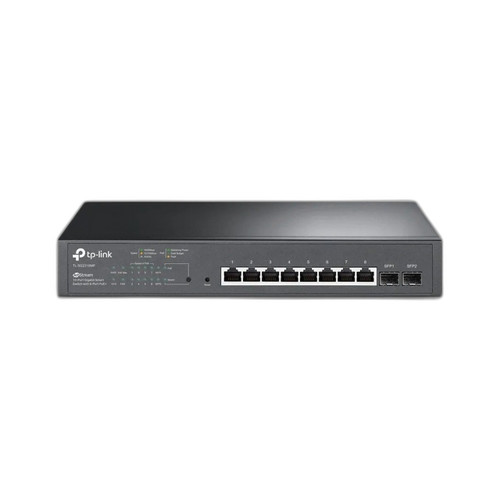
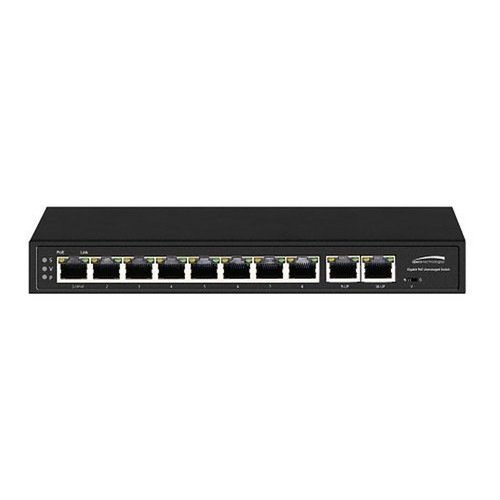
The SG2210MP provides 8 PoE+ Gigabit copper ports plus 2 SFP fiber uplinks, with a total PoE budget of 150W and per-port ceiling of 30W under 802.3at. The P8S10G also delivers 8 PoE ports plus 2 uplinks, but its uplinks are copper RJ45 rather than fiber, and its total PoE budget is 110W. The P8S10G supports both 802.3af (15.4W per port) and 802.3at (30W per port), matching the SG2210MP on per-port maximum but falling 40W short on aggregate budget. In a fully loaded 8-camera deployment, the SG2210MP sustains 18.75W average per port before hitting its ceiling; the P8S10G allows 13.75W average, which constrains deployments mixing high-draw PTZ cameras or door controllers drawing close to 30W each.
How do management depth, fiber uplink options, and integration capabilities differ?
The SG2210MP is described as a managed smart switch and supports both multi-mode and single-mode SFP fiber via its two SFP slots, allowing long-distance or inter-building fiber runs without a separate media converter. Specific management feature set beyond 'managed smart' is not detailed in the provided specifications. The P8S10G documents VLAN segmentation, QoS prioritization, and per-port management, and adds a PoE watchdog function that automatically recovers ports experiencing faults — a meaningful feature for unattended camera deployments where a hung device would otherwise require physical intervention. The P8S10G's two uplinks are copper RJ45 at 1Gbps, providing no native fiber connectivity. The SG2210MP does not list a PoE watchdog capability in the provided specifications.
How do physical form factor, environmental ratings, and warranty coverage compare?
The SG2210MP occupies a 13-inch, 1U rack footprint, making it a direct fit for standard 19-inch security rack enclosures. Its operating temperature range is 0°C to 40°C; no warranty term is specified in the provided data. The P8S10G measures 10.4 x 8.7 x 2.7 inches and weighs 2.5 lbs, suggesting a desktop or wall-mount profile rather than a rack-mount form. It carries an identical operating temperature range of 0°C to 40°C (32°F–104°F) and extends to a storage temperature of -40°F to 150°F. The P8S10G includes a documented 2-year warranty; no equivalent warranty term is provided for the SG2210MP. Housing color for the P8S10G is white; the SG2210MP color is not specified in the provided specs.
Which should you choose: the SG2210MP or the P8S10G?
Our take: The SG2210MP is the stronger choice when aggregate PoE power or fiber uplink connectivity is the primary constraint, while the P8S10G is preferable for desktop or wall-mount installations requiring documented warranty coverage and built-in PoE watchdog. The SG2210MP's 150W budget exceeds the P8S10G's 110W by 40W — enough headroom for roughly one to two additional 30W PTZ or access-control devices. Its dual SFP slots accommodate both multi-mode and single-mode fiber, enabling inter-building runs the P8S10G's copper-only uplinks cannot support. Conversely, the P8S10G documents VLAN, QoS, and a PoE auto-recovery watchdog that are not confirmed in the SG2210MP's provided specs, and it ships with a stated 2-year warranty the SG2210MP does not list. Specify the SG2210MP for rack-mounted, fiber-uplinked camera risers; specify the P8S10G for surface-mount closet installations where watchdog reliability and warranty assurance are prioritized.
Side-by-Side Comparison
Spec-for-spec, from manufacturer data.
| Specification | TP-Link SG2210MP | Speco Technologies P8S10G |
|---|---|---|
| Total Ports | 10 | 10 |
| PoE Copper Ports | 8 | 8 |
| Uplink Ports | 2x SFP (fiber) | 2x RJ45 (copper) |
| PoE Budget | 150W | 110W |
| PoE Standard | 802.3at (30W max) | 802.3af / 802.3at (15.4W / 30W) |
| Data Rate | 1 Gbps all ports | 1 Gbps all ports |
| SFP / Fiber Slots | 2 (multi-mode & single-mode) | — |
| Management | Managed Smart Switch | VLAN, QoS, port management |
| PoE Watchdog | — | Yes (auto-recovery) |
| Form Factor | 1U rack-mount (13-in) | Desktop / wall-mount |
| Dimensions | 13-in 1U | 10.4 x 8.7 x 2.7 in |
| Weight | — | 2.5 lbs |
| Operating Temp | 0°C to 40°C | 0°C to 40°C (32°F–104°F) |
| Storage Temp | — | -40°F to 150°F |
| Housing Color | — | White |
| Warranty | — | 2-year |
Frequently Asked Questions
Which should you choose: the SG2210MP or the P8S10G?
The SG2210MP is the stronger choice when aggregate PoE power or fiber uplink connectivity is the primary constraint, while the P8S10G is preferable for desktop or wall-mount installations requiring documented warranty coverage and built-in PoE watchdog. The SG2210MP's 150W budget exceeds the P8S10G's 110W by 40W — enough headroom for roughly one to two additional 30W PTZ or access-control devices. Its dual SFP slots accommodate both multi-mode and single-mode fiber, enabling inter-building runs the P8S10G's copper-only uplinks cannot support. Conversely, the P8S10G documents VLAN, QoS, and a PoE auto-recovery watchdog that are not confirmed in the SG2210MP's provided specs, and it ships with a stated 2-year warranty the SG2210MP does not list. Specify the SG2210MP for rack-mounted, fiber-uplinked camera risers; specify the P8S10G for surface-mount closet installations where watchdog reliability and warranty assurance are prioritized.
Can either switch power a 30W PTZ camera on every PoE port simultaneously?
Neither switch can sustain 30W on all 8 ports at once. The SG2210MP's 150W budget caps average delivery at 18.75W per port across all 8; the P8S10G's 110W budget caps it at 13.75W per port. Both support 802.3at 30W per-port maximums, but total draw must stay within the aggregate budget.
Does either switch support a fiber uplink to a core switch or NVR closet?
Only the SG2210MP includes fiber uplinks — two SFP slots supporting both multi-mode and single-mode transceivers. The P8S10G provides two 1Gbps RJ45 copper uplinks only; a separate media converter would be required for fiber connectivity.
Which switch offers better protection against a camera locking up and losing network connectivity?
The P8S10G includes a documented PoE watchdog that automatically detects port faults and cycles power to recover a hung device. This feature is not listed in the provided specifications for the SG2210MP. For unattended or hard-to-access camera locations, the watchdog capability is a meaningful operational advantage.
More Network Switch Comparisons
- TP-Link SG2210MP vs Lantronix SISPM1242-582-LRT
- TP-Link SG2210MP vs Vivotek FGT-100P-110
- TP-Link SG2210MP vs TP-Link SG1210MPE
- Lantronix SISPM1242-582-LRT vs TP-Link SG1210MPE
- Lantronix SISPM1242-582-LRT vs Vivotek FGT-100P-110
- Lantronix SISPM1242-582-LRT vs Speco Technologies P8S10G
Network Switch Buying Guides
Get a Second Opinion on Your Camera Choice
Share your site layout, coverage goals, and budget. Our team will validate the camera selection, flag anything we would change, and recommend products that match the use case.