
Vertiv GXT5LI-1500LVRT2UXL vs Vertiv GXT5-1500LVRT2UXL: Specification Comparison
Both the GXT5LI-1500LVRT2UXL and GXT5-1500LVRT2UXL are Vertiv Liebert GXT5-series 1500VA / 1350W online double-conversion rack/tower UPS units designed for 120VAC environments. The primary differentiator is battery chemistry: the GXT5LI carries lithium-ion cells, while the GXT5 uses the traditional valve-regulated lead-acid (VRLA) chemistry implied by its heavier weight and hot-swap module language. Both target the same 2U rack footprint and share identical output capacity, making them genuine cross-shop candidates for IT buyers evaluating battery-technology trade-offs.
In This Guide
- How does battery chemistry affect weight, runtime, and serviceability?
- Which unit delivers better efficiency and more flexible input/output conditioning?
- Which unit offers stronger management integration, compliance credentials, and warranty coverage?
- Which should you choose: the GXT5LI-1500LVRT2UXL or the GXT5-1500LVRT2UXL?
- Side-by-Side Specs
- FAQ
How does battery chemistry affect weight, runtime, and serviceability?
The GXT5LI-1500LVRT2UXL uses lithium-ion cells, which accounts for its significantly lower weight of 39.7 lbs versus the GXT5-1500LVRT2UXL at 46.2 lbs — a 6.5 lb difference in an identical 2U chassis. Lithium-ion chemistry typically supports a longer calendar life and more discharge cycles than VRLA, though neither datasheet explicitly states cycle count or design life in the provided specs.
The GXT5-1500LVRT2UXL specifies hot-swappable, user-replaceable battery modules; the GXT5LI-1500LVRT2UXL's specs do not explicitly state hot-swap capability for its lithium-ion pack. Buyers with strict no-bypass-maintenance requirements should confirm hot-swap availability for the LI variant directly with Vertiv before purchasing.
Neither spec sheet provides a runtime curve or Ah rating in the data supplied, so a direct runtime comparison at specific loads cannot be made from the available specs alone.
Which unit delivers better efficiency and more flexible input/output conditioning?
Both units are rated at 1500VA / 1350W with online double-conversion topology, meaning zero transfer time to battery in both cases. The GXT5LI-1500LVRT2UXL specifies up to 92% efficiency in online mode and up to 98% in Active ECO Mode. The GXT5-1500LVRT2UXL lists up to 98% efficiency in ECO mode but does not state an online-mode efficiency figure in the provided specs.
Input voltage range is broader on the GXT5LI: it accepts 60–150VAC at maximum range and 102–150VAC at full load nominal, versus the GXT5's stated 60–150VAC operating range without a separate full-load nominal figure. Both units output a pure sinewave; the GXT5LI lists 100/110/115/120/125VAC as user-configurable output voltages, while the GXT5 lists 110/115/120/125VAC ±3%.
The GXT5LI explicitly certifies Energy Star 2.0 and carries UL 1778, UL 1973, UL 1642, RoHS, WEEE, and REACH listings. The GXT5 cites Energy Star 2.0 and TAA Compliance. TAA compliance is listed only for the GXT5, not the GXT5LI in the provided specs — a potentially critical distinction for U.S. federal and SLED procurement.
Which unit offers stronger management integration, compliance credentials, and warranty coverage?
Both units share the same connectivity foundation: USB, serial (RS232/DB9), and an optional Intellislot network card for SNMP/web management via the Vertiv Liebert RDU120 or equivalent card. The GXT5LI additionally lists a Dry-Contact Terminal Block as a discrete interface option; the GXT5 spec does not separately call this out, though it may be present.
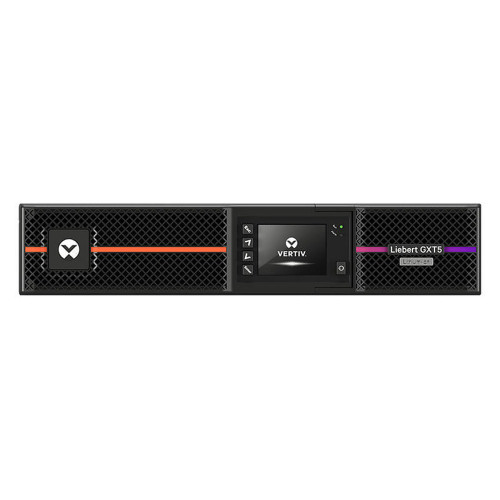
The GXT5LI specifies a color graphic LCD with gravity-sensing orientation — useful for units deployed in both rack and tower orientations. The GXT5 spec does not describe its display in the provided data. The GXT5LI also explicitly lists EPO (Emergency Power Off) and Input Circuit Breaker under features; the GXT5 lists EPO, Input Circuit Breaker, Surge Protection, and Generator Friendly.
Warranty coverage is stated only for the GXT5: a 3-Year Advanced Replacement warranty. No warranty term is provided in the GXT5LI specs. The GXT5 holds TAA Compliance, which the GXT5LI does not list — buyers on GSA schedules or federal contracts must confirm TAA status for the LI model independently.
Which should you choose: the GXT5LI-1500LVRT2UXL or the GXT5-1500LVRT2UXL?
Our take: The GXT5LI-1500LVRT2UXL is the stronger choice when weight reduction, lithium-ion battery longevity, and broader output-voltage configurability are the primary drivers. It weighs 6.5 lbs less (39.7 vs 46.2 lbs), explicitly states a 92% online-mode efficiency figure absent from the GXT5 spec, and adds a 100VAC output-voltage option the GXT5 does not list. Conversely, the GXT5-1500LVRT2UXL is the clearer choice for U.S. government or SLED buyers: it is the only model of the two that lists TAA Compliance in the provided specs. The GXT5 also explicitly documents a 3-Year Advanced Replacement warranty and confirmed hot-swappable battery modules — two specs not stated for the LI variant. For commercial IT deployments where lithium-ion's lighter weight and cycle life are valued over government-procurement compliance, the LI model is the better fit; for regulated or federal environments, the standard GXT5 is the verifiable choice.
Side-by-Side Comparison
Spec-for-spec, from manufacturer data.
| Specification | Vertiv GXT5LI-1500LVRT2UXL | Vertiv GXT5-1500LVRT2UXL |
|---|---|---|
| Model | GXT5LI-1500LVRT2UXL | GXT5-1500LVRT2UXL |
| Battery Chemistry | Lithium-Ion | Not specified (VRLA implied by weight) |
| Power Rating | 1500VA / 1350W | 1500VA / 1350W |
| Topology | Online Double Conversion (implied) | Online Double Conversion |
| Transfer Time | — | Zero (continuous online conversion) |
| Output Waveform | — | Pure Sinewave |
| Form Factor | 2U Rack/Tower | 2U Rack/Tower Convertible |
| Weight | 39.7 lbs | 46.2 lbs |
| Dimensions (W × D × H) | 16.9 × 18.7 × 3.4 in | 16.9 × 18.6 × 3.4 in |
| Input Voltage Range | Nominal: 102–150VAC; Max: 60–150VAC | 60–150VAC operating range |
| Output Voltage (Configurable) | 100/110/115/120/125VAC | 110/115/120/125VAC ±3% |
| Efficiency (Online Mode) | Up to 92% | Not specified |
| Efficiency (ECO Mode) | Up to 98% | Up to 98% |
| Outlets | 6 × NEMA 5-15R | 6 × NEMA 5-15R (programmable groups) |
| Input Plug | NEMA 5-15P | Not specified |
| Connectivity | USB, RS232, Dry-Contact Terminal Block, Intellislot | USB, Serial (DB9), optional Intellislot |
| Display | Color graphic LCD (gravity-sensing orientation) | Not specified |
| Hot-Swap Battery | Not specified | Yes |
| Operating Temperature | 32–104°F (0–40°C) | 32–104°F (0–40°C) |
| TAA Compliant | Not listed | Yes |
| Warranty | Not specified | 3-Year Advanced Replacement |
| Certifications | UL 1778, UL 1973, UL 1642, Energy Star 2.0, RoHS, WEEE, REACH | TAA Compliant, Energy Star 2.0 |
Frequently Asked Questions
Which should you choose: the GXT5LI-1500LVRT2UXL or the GXT5-1500LVRT2UXL?
The GXT5LI-1500LVRT2UXL is the stronger choice when weight reduction, lithium-ion battery longevity, and broader output-voltage configurability are the primary drivers. It weighs 6.5 lbs less (39.7 vs 46.2 lbs), explicitly states a 92% online-mode efficiency figure absent from the GXT5 spec, and adds a 100VAC output-voltage option the GXT5 does not list. Conversely, the GXT5-1500LVRT2UXL is the clearer choice for U.S. government or SLED buyers: it is the only model of the two that lists TAA Compliance in the provided specs. The GXT5 also explicitly documents a 3-Year Advanced Replacement warranty and confirmed hot-swappable battery modules — two specs not stated for the LI variant. For commercial IT deployments where lithium-ion's lighter weight and cycle life are valued over government-procurement compliance, the LI model is the better fit; for regulated or federal environments, the standard GXT5 is the verifiable choice.
Is the GXT5LI-1500LVRT2UXL or GXT5-1500LVRT2UXL better for a U.S. federal or government deployment?
Based on the provided specs, only the GXT5-1500LVRT2UXL lists TAA Compliance. TAA Compliance is not stated for the GXT5LI-1500LVRT2UXL in its available specs. Federal and SLED buyers who require TAA-compliant products should select the GXT5 or independently verify the LI model's TAA status with Vertiv before purchasing.
Can I replace the batteries myself without taking the UPS offline?
The GXT5-1500LVRT2UXL explicitly specifies hot-swappable, user-replaceable battery modules. The GXT5LI-1500LVRT2UXL's provided specs do not state whether its lithium-ion pack supports hot-swap replacement. Buyers for whom zero-downtime battery service is a requirement should confirm this capability for the LI model directly with Vertiv prior to purchase.
Which model is lighter and easier to install in a 2U rack slot?
The GXT5LI-1500LVRT2UXL is lighter at 39.7 lbs versus the GXT5-1500LVRT2UXL at 46.2 lbs — a 6.5 lb difference. Both units occupy the same 2U rack space (16.9 in W × 3.4 in H) with nearly identical depth (18.7 in vs 18.6 in). The lithium-ion model's weight advantage can be meaningful in high-density deployments or when a single technician is performing the installation.
More UPS Comparisons
- APC by Schneider Electric SMX1500RMI2U vs CyberPower PRL1500RT2UC
- APC by Schneider Electric SMX1500RMI2U vs CyberPower BRG1500AVRLCD2
- APC by Schneider Electric SMX1500RMI2U vs CyberPower PR1500LCD
- APC by Schneider Electric SMX1500RMI2U vs APC by Schneider Electric BR1500MS2
- APC by Schneider Electric SMX1500RMI2U vs APC by Schneider Electric SMTL1500RM3UCUS
- CyberPower PRL1500RT2UC vs APC by Schneider Electric BR1500MS2
UPS Buying Guides
Get a Second Opinion on Your Camera Choice
Share your site layout, coverage goals, and budget. Our team will validate the camera selection, flag anything we would change, and recommend products that match the use case.