
Vertiv GXT5-1000LVRT2UXL vs APC by Schneider Electric SMT1000CUS: Specification Comparison
Both the Vertiv Liebert GXT5-1000LVRT2UXL and the APC Smart-UPS SMT1000CUS are 1000 VA, 120 V single-phase uninterruptible power supplies aimed at protecting IT equipment in small-to-medium rack or tower deployments. The comparison centers on topology and power quality, outlet count and usable watt capacity, and runtime scalability with communications options — the three axes that most directly drive purchasing decisions in this UPS class.
In This Guide
- Which UPS topology and output power quality better protects sensitive loads?
- How do rated watt capacity and outlet configuration compare at 1000 VA?
- Which unit offers better runtime scalability and remote management capabilities?
- Which should you choose: the GXT5-1000LVRT2UXL or the SMT1000CUS?
- Side-by-Side Specs
- FAQ
Which UPS topology and output power quality better protects sensitive loads?
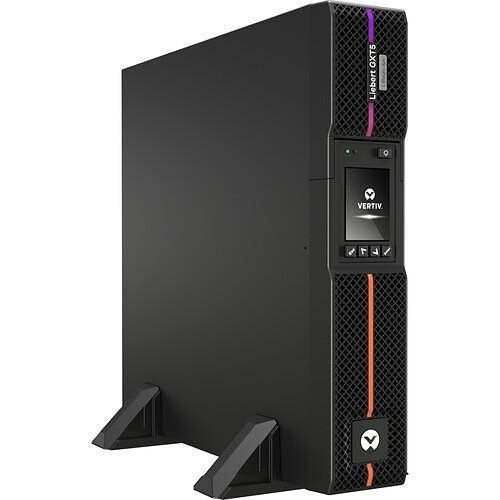
The GXT5-1000LVRT2UXL uses online double-conversion topology, meaning utility power is continuously rectified to DC and re-inverted to AC before reaching the load. Transfer time is zero milliseconds — the load never sees raw utility power. Output is a pure sinewave regulated to ±3% at 110, 115, 120, or 125 VAC (user-configurable). This topology also provides complete galvanic isolation from the utility, eliminating sags, swells, harmonics, and frequency deviations before they reach connected equipment.
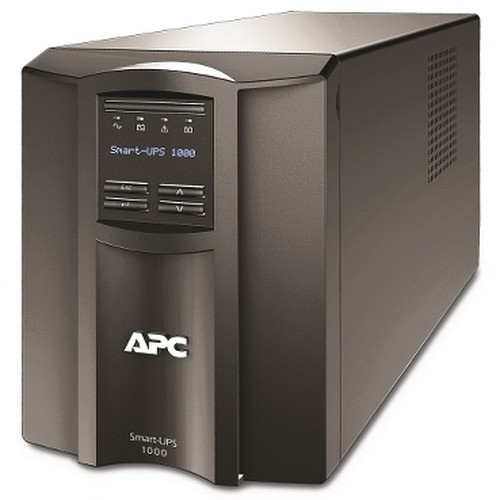
The SMT1000CUS uses line-interactive topology. Under normal utility conditions the inverter supplements voltage via auto-transformer (AVR) but does not re-generate the waveform. The spec sheet lists output waveform as 'sine wave,' which on line-interactive APC Smart-UPS units refers to inverter-generated sine during battery operation; on-utility waveform quality passes through and is conditioned but not fully regenerated. There is no configurable output voltage noted in the provided specs. Transfer time on utility failure is not specified in the provided data.
For loads sensitive to waveform distortion, frequency variation, or tight voltage tolerance — such as variable-speed drives, high-density servers with active PFC power supplies, or medical/industrial equipment — the GXT5's double-conversion architecture provides a categorically higher level of power conditioning. The SMT1000CUS topology is appropriate for general IT loads where brief transfer times and conditioned (not regenerated) power are acceptable.
How do rated watt capacity and outlet configuration compare at 1000 VA?
Despite identical 1000 VA ratings, the two units deliver materially different real-power capacity. The GXT5-1000LVRT2UXL is specified at 1000 W, yielding a unity (1.0) power factor. The SMT1000CUS is rated at 700 W, corresponding to a 0.7 power factor. In practical terms, a load drawing 800 W would be within the Vertiv's rating but would exceed the APC's 700 W ceiling — a 43% real-power gap at the same VA rating.
On outlets, the SMT1000CUS provides 8 × NEMA 5-15R receptacles. The GXT5-1000LVRT2UXL provides 6 × NEMA 5-15R. The APC therefore supports two additional connected devices without a PDU. The Vertiv's 6 outlets are organized into programmable groups, enabling sequenced load shedding or shutdown priority — a feature not specified in the APC's provided data.
Buyers with high-power-factor loads (modern servers, storage arrays) gain meaningful headroom from the Vertiv's 1000 W rating. Buyers connecting a larger number of lower-draw peripherals may find the APC's 8-outlet layout more convenient without additional distribution hardware.
Which unit offers better runtime scalability and remote management capabilities?
The GXT5-1000LVRT2UXL supports daisy-chained external battery cabinets — up to 3 units — allowing runtime extension beyond what internal batteries alone provide. Battery replacement is hot-swappable and front-accessible without tools. The SMT1000CUS specifies 'Extendable Runtime: 0' in the provided data and identifies its replacement battery as RBC6; no external battery cabinet support is stated in the provided specifications.
For communications, the GXT5 provides USB, RS-232 serial, and an optional Intellislot expansion slot for a network management card (NMC), enabling SNMP/HTTP remote monitoring. A front-panel LCD displays load percentage, runtime remaining, input/output voltage, and status. The SMT1000CUS lists USB, a serial port, a SmartConnect port, and one available expansion slot. SmartConnect provides cloud-based monitoring via APC's platform. Both units therefore support NMC-style expansion, but runtime scalability is a Vertiv-only capability per the specs provided.
The 2U rack/tower convertible form factor of the GXT5 is explicit in its specifications; the SMT1000CUS is specified as tower-only with 0U rack units noted. Organizations planning rack-mount deployments must account for this distinction.
Which should you choose: the GXT5-1000LVRT2UXL or the SMT1000CUS?
Our take: The GXT5-1000LVRT2UXL is the stronger choice when load criticality, real-power headroom, or rack-mount form factor are requirements. Three concrete spec deltas drive this: (1) topology — double-conversion with zero transfer time versus line-interactive with unspecified transfer time; (2) real-power capacity — 1000 W (unity PF) versus 700 W (0.7 PF), a 300 W difference that matters for modern active-PFC server loads; and (3) runtime scalability — the Vertiv supports up to 3 external battery cabinets while the APC specifies no extendable runtime. The SMT1000CUS holds advantages in outlet count (8 vs. 6) and, based on provided specs, likely a lower acquisition cost — making it a reasonable fit for non-critical general office IT loads in a tower deployment where waveform regeneration and extended runtime are not required. The GXT5 targets data-center-grade rack environments; the SMT1000CUS targets desktop or small-office tower use.
Side-by-Side Comparison
Spec-for-spec, from manufacturer data.
| Specification | Vertiv GXT5-1000LVRT2UXL | APC by Schneider Electric SMT1000CUS |
|---|---|---|
| UPS Topology | Online double-conversion | Line-interactive |
| Capacity (VA) | 1000 VA | 1000 VA |
| Capacity (Watts) | 1000 W | 700 W |
| Power Factor | 1.0 (unity) | 0.7 |
| Output Waveform | Pure sinewave | Sine wave |
| Output Voltage (configurable) | 110 / 115 / 120 / 125 VAC (±3%) | 120 VAC (110 / 125 V noted) |
| Transfer Time | Zero (always-on) | Not specified in provided data |
| Outlets | 6 × NEMA 5-15R (programmable groups) | 8 × NEMA 5-15R |
| Form Factor | 2U rack-mount / tower convertible | Tower only (0U rack) |
| Battery | Hot-swap VRLA, front-accessible, no tools | Lead-acid, replacement RBC6 |
| Extendable Runtime | Yes — up to 3 external battery cabinets | No (spec: Extendable Runtime 0) |
| Communications | USB, RS-232, optional Intellislot NMC slot | USB, serial, SmartConnect, expansion slot |
| Display | Front-panel LCD (load %, runtime, voltage) | Not specified in provided data |
| Efficiency | Up to 98% (ECO mode) / 95% (online mode) | Not specified in provided data |
| Weight | 37 lb (16.8 kg) | 44.3 lb (20.1 kg) |
| Certifications | TAA, Energy Star 2.0, cULus, FCC Class A, CE | cULus, Energy Star V2.0, TAA |
Frequently Asked Questions
Which should you choose: the GXT5-1000LVRT2UXL or the SMT1000CUS?
The GXT5-1000LVRT2UXL is the stronger choice when load criticality, real-power headroom, or rack-mount form factor are requirements. Three concrete spec deltas drive this: (1) topology — double-conversion with zero transfer time versus line-interactive with unspecified transfer time; (2) real-power capacity — 1000 W (unity PF) versus 700 W (0.7 PF), a 300 W difference that matters for modern active-PFC server loads; and (3) runtime scalability — the Vertiv supports up to 3 external battery cabinets while the APC specifies no extendable runtime. The SMT1000CUS holds advantages in outlet count (8 vs. 6) and, based on provided specs, likely a lower acquisition cost — making it a reasonable fit for non-critical general office IT loads in a tower deployment where waveform regeneration and extended runtime are not required. The GXT5 targets data-center-grade rack environments; the SMT1000CUS targets desktop or small-office tower use.
Is the GXT5-1000LVRT2UXL or SMT1000CUS better for protecting servers with active PFC power supplies?
The GXT5-1000LVRT2UXL is better suited. Its online double-conversion topology continuously regenerates a pure sinewave output regardless of utility conditions, and its 1000 W real-power rating (unity power factor) accommodates the high power factors typical of active-PFC server PSUs. The SMT1000CUS is rated at 700 W at 1000 VA (0.7 PF), which reduces usable headroom for high-PF loads, and its line-interactive topology does not regenerate the waveform during normal utility operation.
Can I add external battery cabinets to either UPS to extend runtime?
Only the Vertiv GXT5-1000LVRT2UXL explicitly supports external battery cabinet expansion — up to 3 daisy-chained units per the provided specifications. The APC SMT1000CUS is listed with 'Extendable Runtime: 0' in the provided spec data, indicating no external battery cabinet support is available for this model.
Which unit fits in a rack, and which is tower-only?
The GXT5-1000LVRT2UXL is a 2U rack-mount/tower convertible unit (16.9 × 15.7 × 3.4 in), suitable for standard 19-inch equipment racks or freestanding tower use. The SMT1000CUS is specified as a tower-only unit with 0 rack units noted in the provided specifications, making it unsuitable for rack-mount deployments without a separate rack-mount kit (which is not referenced in the provided data).
More UPS Comparisons
- CyberPower PR1000RTXL2UC vs APC by Schneider Electric SURT1000RMXLI
- CyberPower PR1000RTXL2UC vs APC by Schneider Electric SMT1000CUS
- CyberPower PR1000RTXL2UC vs Vertiv GXT5-1000LVRT2UXL
- CyberPower PR1000RTXL2UC vs APC by Schneider Electric SMT1000J
- CyberPower PR1000RTXL2UC vs CyberPower CP1000PFCLCD
- CyberPower PR1000RTXL2UC vs CyberPower PR1000LCD
UPS Buying Guides
Get a Second Opinion on Your Camera Choice
Share your site layout, coverage goals, and budget. Our team will validate the camera selection, flag anything we would change, and recommend products that match the use case.