
Ubiquiti USW-ULTRA vs Ubiquiti USW-ULTRA-210W: Specification Comparison
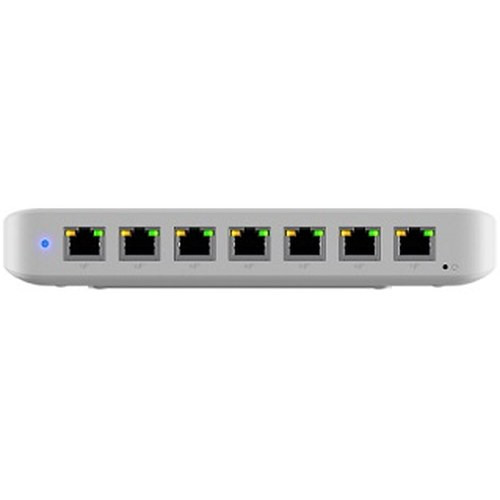
Both the USW-ULTRA and USW-ULTRA-210W are Ubiquiti 8-port Gigabit PoE++ compact switches sharing an identical physical chassis, switching fabric, and NDAA-compliant design. The comparison centers on a single but operationally significant difference: how each unit is powered and, as a direct consequence, how much PoE budget it can deliver to downstream devices. Buyers evaluating these two models are typically choosing between a power-source-agnostic edge device and a self-contained AC-powered unit capable of sustaining higher aggregate PoE output across all eight ports simultaneously.

In This Guide
- How much PoE power does each switch deliver, and what limits that budget?
- Do the two switches differ in switching performance, port count, or throughput?
- How do the physical form factor, mounting options, environmental ratings, and installation requirements compare?
- Which should you choose: the USW-ULTRA or the USW-ULTRA-210W?
- Side-by-Side Specs
- FAQ
How much PoE power does each switch deliver, and what limits that budget?
The USW-ULTRA derives its entire power supply from an upstream PoE++ (802.3bt, 50–57V DC) input, consuming 9W for its own operation. Under a PoE++ input, it delivers up to 42W per port; under a PoE+ input, that ceiling drops to 16W per port. No AC adapter is included or required, which means the total PoE output budget is constrained by what the upstream PD port can sustain—the spec lists 42W PoE++ or 16W PoE+ as the per-port ceiling, and a 210W AC figure appears in the power budget field, but the primary delivery mechanism is the PoE input chain.
The USW-ULTRA-210W ships with an included external AC/DC power supply rated at 210W, decoupling its PoE output budget entirely from any upstream PD port. Its specified total PoE output budget is 210W, available across all 8 ports simultaneously. Both units share the same 9W device-level power consumption (excluding PoE output) and the same 50–57V DC/PoE voltage range, but the -210W's AC adapter removes the upstream-port dependency, making the full 210W reliably available regardless of upstream infrastructure.
Do the two switches differ in switching performance, port count, or throughput?
On every data-plane metric, the two models are specification-identical. Both provide 8 × Gigabit Ethernet ports supporting 10M/100M/1G auto-negotiation. Both operate on a 16 Gbps switching capacity with 8 Gbps non-blocking throughput and a forwarding rate of 12 Mpps. VLAN support is 256 VLANs on each. The USW-ULTRA spec sheet notes RJ-45 connectivity; the USW-ULTRA-210W confirms the same.
Neither model offers SFP uplinks, 2.5G, or 10G ports per the provided specifications. Management on both is via Ethernet. There is no stated difference in MAC address table size, jumbo frame support, or QoS mechanisms in the provided specs for either model—buyers requiring those details should consult the respective datasheets before specifying.
How do the physical form factor, mounting options, environmental ratings, and installation requirements compare?
Both switches share a physically identical chassis: 203 × 76 × 33 mm, 320 g (11.3 oz), polycarbonate enclosure, and support for desktop, wall, and magnetic mounting. Operating temperature is rated at −30°C to 60°C (−22°F to 140°F) on both units. Both carry CE, FCC, IC, and Anatel (06367-24-08356) certifications and are NDAA compliant. Both carry a manufacturer warranty.
The installation footprint differs in one respect: the USW-ULTRA requires no AC outlet—it draws everything over the PoE cable from an upstream switch or injector, making it suitable for locations with no AC infrastructure. The USW-ULTRA-210W requires an AC outlet for its included external 210W AC/DC adapter. The -210W spec does not list a mount-material field (the USW-ULTRA spec lists polycarbonate for mount material); the -210W lists wall as its primary mount type versus desktop for the USW-ULTRA, though both specs reference desktop, wall, and magnetic mount options in their form factor descriptions.
Which should you choose: the USW-ULTRA or the USW-ULTRA-210W?
Our take: The USW-ULTRA is the stronger choice when the deployment site has no AC outlet and a capable upstream PoE++ port (802.3bt) is already present—its zero-AC-infrastructure requirement simplifies edge installs considerably. The USW-ULTRA-210W is the stronger choice when guaranteed aggregate PoE output matters: it delivers a fixed 210W total PoE budget from its included AC adapter versus the USW-ULTRA's budget, which is constrained by the upstream PD port's available power. On every other measurable dimension the two are identical—same 16 Gbps switching capacity, same 8 Gbps non-blocking throughput, same 12 Mpps forwarding rate, same 8-port 1G configuration, same 256-VLAN support, same 203 × 76 × 33 mm chassis at 320 g, and the same −30°C to 60°C operating range. Both are NDAA compliant. Platform fit is the deciding factor: infrastructure-constrained edge nodes favor the USW-ULTRA; sites needing reliable, AC-backed full-budget PoE favor the -210W.
Side-by-Side Comparison
Spec-for-spec, from manufacturer data.
| Specification | Ubiquiti USW-ULTRA | Ubiquiti USW-ULTRA-210W |
|---|---|---|
| SKU | USW-ULTRA | USW-ULTRA-210W |
| Port Count | 8 × Gigabit Ethernet | 8 × Gigabit Ethernet |
| Port Speed | 10M / 100M / 1G auto-negotiation | 1G |
| Switching Capacity | 16 Gbps | 16 Gbps |
| Non-Blocking Throughput | 8 Gbps | 8 Gbps |
| Forwarding Rate | 12 Mpps | 12 Mpps |
| VLAN Support | 256 VLANs | 256 VLANs |
| PoE Standard | PoE++ (802.3bt) | PoE++ (802.3bt) |
| Total PoE Output Budget | 42W per port (PoE++ input) / 16W per port (PoE+ input) | 210W total |
| Power Source | PoE++ input (50–57V DC) — AC adapter excluded | External AC/DC adapter 210W — included |
| Device Power Consumption | 9W (excluding PoE output) | 9W (excluding PoE output) |
| Dimensions | 203 × 76 × 33 mm | 203 × 76 × 33 mm |
| Weight | 320 g (11.3 oz) | 320 g (11.3 oz) |
| Enclosure | Polycarbonate | Polycarbonate |
| Operating Temperature | −30°C to 60°C (−22°F to 140°F) | −30°C to 60°C (−22°F to 140°F) |
| NDAA Compliant | Yes | Yes |
| Certifications | CE, FCC, IC, Anatel 06367-24-08356 | CE, FCC, IC, Anatel 06367-24-08356 |
| Mount Options | Desktop, wall, magnetic | Wall, desktop, magnetic |
| Warranty | Manufacturer Warranty | Manufacturer Warranty |
Frequently Asked Questions
Which should you choose: the USW-ULTRA or the USW-ULTRA-210W?
The USW-ULTRA is the stronger choice when the deployment site has no AC outlet and a capable upstream PoE++ port (802.3bt) is already present—its zero-AC-infrastructure requirement simplifies edge installs considerably. The USW-ULTRA-210W is the stronger choice when guaranteed aggregate PoE output matters: it delivers a fixed 210W total PoE budget from its included AC adapter versus the USW-ULTRA's budget, which is constrained by the upstream PD port's available power. On every other measurable dimension the two are identical—same 16 Gbps switching capacity, same 8 Gbps non-blocking throughput, same 12 Mpps forwarding rate, same 8-port 1G configuration, same 256-VLAN support, same 203 × 76 × 33 mm chassis at 320 g, and the same −30°C to 60°C operating range. Both are NDAA compliant. Platform fit is the deciding factor: infrastructure-constrained edge nodes favor the USW-ULTRA; sites needing reliable, AC-backed full-budget PoE favor the -210W.
Can I use the USW-ULTRA without any AC wiring at a remote camera location?
Yes. The USW-ULTRA is powered entirely by a 50–57V PoE++ (802.3bt) input from an upstream switch or injector, consuming 9W for its own operation. No AC outlet is required. The USW-ULTRA-210W, by contrast, requires an AC outlet for its included external 210W power supply.
Is the USW-ULTRA or USW-ULTRA-210W better for powering multiple high-wattage PoE cameras simultaneously?
The USW-ULTRA-210W is better suited for that scenario. Its included AC/DC adapter provides a fixed 210W total PoE output budget across all 8 ports, independent of any upstream port limitations. The USW-ULTRA's PoE output is bounded by its upstream PoE++ input—up to 42W per port under a PoE++ source—so aggregate output depends on what the upstream infrastructure can supply.
Do the two switches differ in switching speed, port count, or VLAN capacity?
No. Both models are specification-identical on all data-plane metrics: 8 × Gigabit Ethernet ports, 16 Gbps switching capacity, 8 Gbps non-blocking throughput, 12 Mpps forwarding rate, and 256 VLANs. The only specified difference between the two models is the power source and the resulting PoE output budget.
More Network Switch Comparisons
- Vivotek IHT-1271 vs TP-Link SG3210XHP-M2
- Vivotek IHT-1271 vs TP-Link S4500-8GP2F
- Vivotek IHT-1271 vs TP-Link SG1210P
- Vivotek IHT-1271 vs Allied Telesis AT-x530L-10GHXm-10
- Vivotek IHT-1271 vs Vivotek GEV-108A-130
- Vivotek IHT-1271 vs Vivotek IHT-1000
Network Switch Buying Guides
Get a Second Opinion on Your Camera Choice
Share your site layout, coverage goals, and budget. Our team will validate the camera selection, flag anything we would change, and recommend products that match the use case.