
Ubiquiti USW-PRO-MAX-48-POE vs Allied Telesis GS980M/52PS-10: Specification Comparison
Both the Ubiquiti USW-PRO-MAX-48-POE and the Allied Telesis AT-GS980M/52PS-10 are managed, 1U rack-mount PoE switches built around 48 RJ-45 copper ports — the core specification a surveillance or enterprise LAN buyer evaluates when powering IP cameras, access-control readers, or wireless APs from a single layer-2/3 device. The comparison below examines PoE power architecture and port speeds, switching performance and physical build, and management capability, drawing exclusively from published specifications for each model.

In This Guide
- Which switch delivers more usable PoE power, and at what port speeds?
- How do switching capacity, forwarding rate, and physical build compare?
- What management capabilities, VLAN support, certifications, and ecosystem integration does each switch offer?
- Which should you choose: the USW-PRO-MAX-48-POE or the GS980M/52PS-10?
- Side-by-Side Specs
- FAQ
Which switch delivers more usable PoE power, and at what port speeds?
The USW-PRO-MAX-48-POE specifies a 720W PoE budget across 48 ports with 802.3bt (PoE++) support, meaning individual ports can supply up to 90W where the endpoint supports it. Port speeds are heterogeneous: 48 × 1G RJ-45, 8 × 2.5G RJ-45, and 2 × 10G SFP+ uplinks, giving the switch a mixed-speed fabric suited to high-bandwidth endpoints such as multi-sensor cameras or Wi-Fi 6/6E APs. The internal power supply is rated 870W, with 100W reserved for switch operation, leaving 720W available for PoE loads.
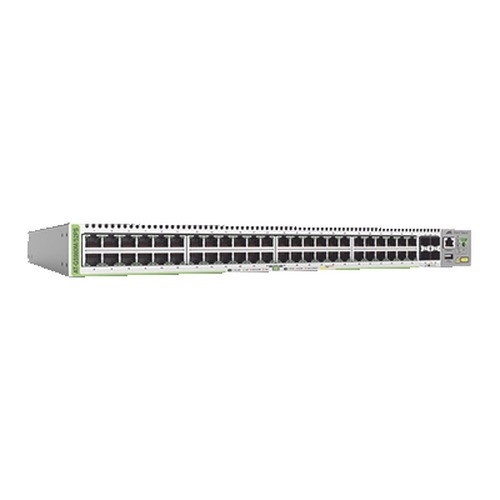
The AT-GS980M/52PS-10 specifies a 740W maximum PoE budget — 20W more than the Ubiquiti on paper — but all 48 copper ports are Gigabit-only (10/100/1000T), and the PoE standard is 802.3af/at (PoE+, maximum 30W per port), not 802.3bt. Allied Telesis also documents practical port-count ceilings: 48 ports simultaneously at 15W each, or 24 ports simultaneously at 30W each. Uplinks are 4 × SFP (100/1000X), capped at 1G. For installations where endpoints require only standard PoE+, the Allied Telesis budget is marginally larger; for endpoints requiring 802.3bt or faster uplinks, the Ubiquiti is the only option between the two.
How do switching capacity, forwarding rate, and physical build compare?
The USW-PRO-MAX-48-POE specifies a 224 Gbps switching capacity with 112 Gbps non-blocking throughput and a 167 Mpps forwarding rate. Its chassis is SGCC steel, measures 442.4 × 400 × 44 mm, and weighs 6.2 kg. Operating temperature is rated −5°C to 40°C. No acoustic noise figure is provided in the supplied specifications.
The AT-GS980M/52PS-10 specifies a 104 Gbps switching fabric and 77.4 Mpps forwarding rate — roughly 46% of the Ubiquiti's switching capacity and 54% of its forwarding rate. The chassis measures 441 × 359 × 44 mm (41 mm shallower, meaningful in shallow-depth enclosures) and weighs 5.8 kg. Maximum power consumption reaches 909W (vs. the Ubiquiti's 870W supply rating), with a maximum heat dissipation of 3,102 BTU/h and an acoustic noise figure of 42 dBA. Operating temperature for the Allied Telesis is not specified in the provided data. Housing color is White; the Ubiquiti finish is not specified.
What management capabilities, VLAN support, certifications, and ecosystem integration does each switch offer?
The USW-PRO-MAX-48-POE specifies support for up to 1,000 VLANs and Ethernet-based management. It carries NDAA compliance (Section 889 Part B), which is a procurement requirement for U.S. federal, state, and some municipal projects, as well as CE, FCC, IC, and Anatel certifications. It integrates with Ubiquiti's UniFi controller software ecosystem. Warranty terms are described as 'Manufacturer Warranty' without a stated duration in the provided specifications.
The AT-GS980M/52PS-10 specifications reference VLAN, QoS, and enterprise security management features, but no specific VLAN count limit is provided in the supplied data. Regulatory certifications and NDAA compliance status are not stated in the provided specifications. Allied Telesis positions this switch within its GS980M series, which supports the AlliedWare Plus NOS. Warranty terms are not specified in the provided data. Buyers requiring a specific VLAN scale figure, regulatory certification list, or NDAA confirmation for the Allied Telesis model should consult the manufacturer's full datasheet.
Which should you choose: the USW-PRO-MAX-48-POE or the GS980M/52PS-10?
Our take: The USW-PRO-MAX-48-POE is the stronger choice when endpoint bandwidth, 802.3bt power delivery, or NDAA compliance are requirements. Its switching capacity of 224 Gbps versus 104 Gbps on the AT-GS980M/52PS-10 is more than double, and its 167 Mpps forwarding rate exceeds the Allied Telesis's 77.4 Mpps by 116%. Port speeds of 2.5G and 10G SFP+ on the Ubiquiti have no equivalent on the Allied Telesis, which is bounded by 1G copper and 1G SFP uplinks. The Allied Telesis holds a narrow advantage in stated PoE budget (740W vs. 720W) and shallower chassis depth (359 mm vs. 400 mm), and it provides a documented acoustic noise rating (42 dBA) and heat dissipation figure (3,102 BTU/h) that the Ubiquiti specifications do not include. Deployments constrained by rack depth, requiring published thermal data for data-center planning, or running exclusively 802.3at endpoints should evaluate the Allied Telesis; government or federally-funded projects requiring NDAA compliance should specify the Ubiquiti.
Side-by-Side Comparison
Spec-for-spec, from manufacturer data.
| Specification | Ubiquiti USW-PRO-MAX-48-POE | Allied Telesis GS980M/52PS-10 |
|---|---|---|
| Form Factor | 1U Rack Mount | 1RU Rack-mount |
| RJ-45 Copper Ports | 48 × 1G + 8 × 2.5G | 48 × 10/100/1000T (Gigabit) |
| Uplink Ports | 2 × 10G SFP+ | 4 × SFP (100/1000X, max 1G) |
| Total Port Count (Switch) | 58 (48 + 8 + 2) | 52 (48 copper + 4 SFP) |
| PoE Standard | 802.3bt (PoE++) | 802.3af/at (PoE+) |
| Max PoE Budget | 720W | 740W |
| Switching Capacity | 224 Gbps | 104 Gbps |
| Non-Blocking Throughput | 112 Gbps | — |
| Forwarding Rate | 167 Mpps | 77.4 Mpps |
| VLAN Support | Up to 1,000 VLANs | Supported (count not specified) |
| Max Power Consumption | 870W (internal PSU) | 909W |
| Acoustic Noise | — | 42 dBA |
| Dimensions (W × D × H) | 442.4 × 400 × 44 mm | 441 × 359 × 44 mm |
| Weight | 6.2 kg (13.7 lb) | 5.8 kg (12.79 lb) |
| Operating Temperature | −5°C to 40°C | — |
| NDAA Compliant | Yes | — |
Frequently Asked Questions
Which should you choose: the USW-PRO-MAX-48-POE or the GS980M/52PS-10?
The USW-PRO-MAX-48-POE is the stronger choice when endpoint bandwidth, 802.3bt power delivery, or NDAA compliance are requirements. Its switching capacity of 224 Gbps versus 104 Gbps on the AT-GS980M/52PS-10 is more than double, and its 167 Mpps forwarding rate exceeds the Allied Telesis's 77.4 Mpps by 116%. Port speeds of 2.5G and 10G SFP+ on the Ubiquiti have no equivalent on the Allied Telesis, which is bounded by 1G copper and 1G SFP uplinks. The Allied Telesis holds a narrow advantage in stated PoE budget (740W vs. 720W) and shallower chassis depth (359 mm vs. 400 mm), and it provides a documented acoustic noise rating (42 dBA) and heat dissipation figure (3,102 BTU/h) that the Ubiquiti specifications do not include. Deployments constrained by rack depth, requiring published thermal data for data-center planning, or running exclusively 802.3at endpoints should evaluate the Allied Telesis; government or federally-funded projects requiring NDAA compliance should specify the Ubiquiti.
Is the USW-PRO-MAX-48-POE or the AT-GS980M/52PS-10 better for powering high-wattage devices like 802.3bt cameras or Wi-Fi 6 APs?
The USW-PRO-MAX-48-POE is the only option of the two that supports 802.3bt (PoE++), which allows individual ports to deliver up to 90W. The AT-GS980M/52PS-10 tops out at 802.3at (PoE+, 30W per port maximum). If your endpoints require more than 30W per device, the Allied Telesis cannot support them regardless of its 740W aggregate budget.
Which switch has a higher PoE power budget — the USW-PRO-MAX-48-POE or the AT-GS980M/52PS-10?
On paper, the AT-GS980M/52PS-10 specifies a higher maximum PoE budget: 740W versus 720W for the USW-PRO-MAX-48-POE. However, the Allied Telesis also documents practical simultaneous-load ceilings (48 ports at 15W, or 24 ports at 30W), so real-world available power depends on your device mix. The Ubiquiti's 802.3bt support means it can concentrate more watts on fewer high-draw ports that the Allied Telesis cannot power at all.
Does either switch meet NDAA Section 889 compliance requirements for government installations?
Yes — the USW-PRO-MAX-48-POE is specified as NDAA compliant. NDAA compliance status is not stated anywhere in the provided specifications for the AT-GS980M/52PS-10; buyers with federal or NDAA-governed procurement requirements should obtain written confirmation from Allied Telesis before specifying that model.
More Network Switch Comparisons
- NETGEAR GS748PP-100NAS vs Ubiquiti USW-48-POE
- NETGEAR GS748PP-100NAS vs Ubiquiti USW-PRO-MAX-48-POE
- NETGEAR GS748PP-100NAS vs Ubiquiti USW-ENTERPRISE-48-POE
- NETGEAR GS748PP-100NAS vs Ubiquiti ES-48-500W
- NETGEAR GS748PP-100NAS vs NETGEAR GS348PP-100NAS
- Ubiquiti USW-48-POE vs NETGEAR GS348PP-100NAS
Network Switch Buying Guides
Get a Second Opinion on Your Camera Choice
Share your site layout, coverage goals, and budget. Our team will validate the camera selection, flag anything we would change, and recommend products that match the use case.