
Ubiquiti USW-PRO-48-POE vs Ubiquiti USW-PRO-MAX-48-POE: Specification Comparison
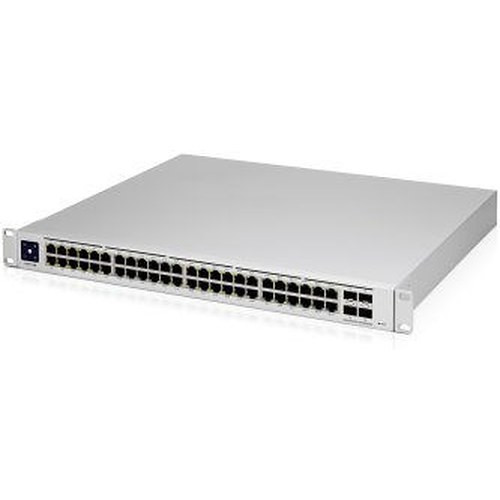
The Ubiquiti USW-PRO-48-POE and USW-PRO-MAX-48-POE are both 48-port managed PoE rack-mount switches from the UniFi Switching family, positioned for enterprise LAN deployments. Both deliver PoE++ (802.3bt) power across 48 data ports, 1,000-VLAN segmentation, and 10G SFP+ uplinks in a 1U chassis. The comparison centers on PoE power budget and port-speed mix, switching capacity and forwarding performance, and management capabilities and compliance credentials — the three axes that most directly drive purchasing decisions for converged camera, AP, and VoIP infrastructure.

In This Guide
- Which switch delivers more PoE power and higher per-port speeds?
- How do switching capacity and forwarding throughput compare between the two models?
- Which model offers stronger management options, compliance credentials, and environmental ratings?
- Which should you choose: the USW-PRO-48-POE or the USW-PRO-MAX-48-POE?
- Side-by-Side Specs
- FAQ
Which switch delivers more PoE power and higher per-port speeds?
The USW-PRO-48-POE provides a 660W total PoE budget (600W PoE output plus 60W independent), distributed across 40 ports rated at 32W (PoE+) and 8 ports rated at 64W (PoE++). All 48 data ports run at Gigabit (1G/100M/10M) speeds. Four 10G SFP+ uplink ports serve as backhaul.
The USW-PRO-MAX-48-POE raises the PoE budget to 720W simultaneous across all ports, backed by an internal 870W AC power supply. Its port-speed mix is differentiated: 48 × 1G RJ-45 ports plus 8 × 2.5G ports, with 2 × 10G SFP+ uplinks. The MAX variant therefore offers both more aggregate PoE headroom (+60W) and multi-speed (1G/2.5G) access-layer capability, though it provides fewer 10G SFP+ uplinks (2 vs. 4).
For deployments where endpoint count and simultaneous full-power draw are the binding constraints — dense camera arrays or high-density Wi-Fi 6E APs drawing near their maximums — the MAX's 720W budget and 870W power supply offer more margin. Installers needing higher-bandwidth uplinks for aggregation duties will note the PRO-48-POE's four 10G SFP+ ports versus the MAX's two.
How do switching capacity and forwarding throughput compare between the two models?
The USW-PRO-48-POE is specified at 176 Gbps aggregate switching capacity and 88 Gbps non-blocking throughput, with a forwarding rate of 131 Mpps. These figures reflect a Gigabit access layer with 10G uplinks.
The USW-PRO-MAX-48-POE is specified at 224 Gbps switching capacity and 112 Gbps non-blocking throughput, with a forwarding rate of 167 Mpps. The higher figures are consistent with its multi-speed (1G/2.5G) access ports, which increase aggregate bandwidth potential per port beyond 1G.
The MAX outperforms the PRO-48-POE on every switching metric: +27% switching capacity (224 vs. 176 Gbps), +27% non-blocking throughput (112 vs. 88 Gbps), and +27% forwarding rate (167 vs. 131 Mpps). For deployments where access-layer endpoints are migrating to 2.5G (e.g., Wi-Fi 7 APs or NVRs with multi-gig NICs), the MAX's headroom is directly relevant. Pure 1G camera or VoIP deployments will rarely saturate either switch.
Which model offers stronger management options, compliance credentials, and environmental ratings?
The USW-PRO-48-POE specifies management via Web UI, SSH, UniFi Controller, SNMP, and REST API, with Layer 2/3 capabilities including static routes and DHCP. NDAA compliance status is not stated in the provided specifications for this model.
The USW-PRO-MAX-48-POE lists management as 'Ethernet' in its top-level spec — the datasheet-sourced fields confirm UniFi ecosystem integration but do not enumerate SSH, SNMP, or REST API explicitly in the provided data. Critically, it is confirmed NDAA-compliant and carries CE, FCC, IC, and Anatel certifications. Operating temperature is specified at -5°C to 40°C (23°F to 104°F); enclosure is SGCC steel. These fields are absent from the PRO-48-POE spec set provided.
For government, federal, or regulated-sector buyers where NDAA Section 889 compliance is a procurement requirement, the MAX is the only model in this comparison with a confirmed NDAA-compliant designation. The PRO-48-POE's more explicit management protocol list (SNMP, REST API, SSH) may be relevant to IT teams with existing NMS or automation tooling, though the absence of those fields in the MAX's spec sheet does not confirm their absence from the product.
Which should you choose: the USW-PRO-48-POE or the USW-PRO-MAX-48-POE?
Our take: The USW-PRO-MAX-48-POE is the stronger choice when PoE power headroom, multi-gig port speeds, switching throughput, and NDAA compliance are the deciding criteria. On power, it provides 720W simultaneous PoE versus 660W on the PRO-48-POE — a 60W advantage that matters when endpoints approach their rated draw simultaneously. On throughput, the MAX delivers 224 Gbps switching capacity and 167 Mpps forwarding against the PRO-48-POE's 176 Gbps and 131 Mpps — a 27% margin enabled by its 2.5G access ports. The MAX also carries a confirmed NDAA-compliant designation; that status is not stated for the PRO-48-POE in the provided specifications. The PRO-48-POE counters with four 10G SFP+ uplinks versus the MAX's two, making it preferable in aggregation-layer roles where uplink count matters more than per-port access speed. Choose the PRO-48-POE for pure-Gigabit deployments needing denser 10G uplinks; choose the MAX for power-heavy, multi-gig, or compliance-sensitive installations.
Side-by-Side Comparison
Spec-for-spec, from manufacturer data.
| Specification | Ubiquiti USW-PRO-48-POE | Ubiquiti USW-PRO-MAX-48-POE |
|---|---|---|
| SKU | USW-PRO-48-POE | USW-PRO-MAX-48-POE |
| Total PoE Power Budget | 660W (600W PoE + 60W independent) | 720W simultaneous |
| Internal Power Supply | — | 870W AC |
| Base Power Consumption (excl. PoE) | — | 100W |
| PoE Standard | PoE++ (802.3bt) | PoE++ (802.3bt) |
| PoE+ Ports (32W) | 40 ports | — |
| PoE++ Ports (64W) | 8 ports | — |
| Data Port Speed | 48 × 1G (1G/100M/10M) | 48 × 1G RJ-45 + 8 × 2.5G |
| 10G SFP+ Uplinks | 4 × 10G SFP+ | 2 × 10G SFP+ |
| Switching Capacity | 176 Gbps | 224 Gbps |
| Non-Blocking Throughput | 88 Gbps | 112 Gbps |
| Forwarding Rate | 131 Mpps | 167 Mpps |
| VLAN Support | 1,000 VLANs | 1,000 VLANs |
| Layer | L2/L3 (static routes, DHCP) | — |
| NDAA Compliant | — | Yes |
| Certifications | — | CE, FCC, IC, Anatel (06373-24-08356) |
| Operating Temperature | — | -5°C to 40°C (23°F to 104°F) |
| Weight | 16.3 lb (7.4 kg) | 13.7 lb (6.2 kg) |
| Enclosure | — | SGCC steel |
| Input Voltage | — | 100–240V AC |
| Form Factor | 1U Rack Mount | 1U Rack Mount |
Frequently Asked Questions
Which should you choose: the USW-PRO-48-POE or the USW-PRO-MAX-48-POE?
The USW-PRO-MAX-48-POE is the stronger choice when PoE power headroom, multi-gig port speeds, switching throughput, and NDAA compliance are the deciding criteria. On power, it provides 720W simultaneous PoE versus 660W on the PRO-48-POE — a 60W advantage that matters when endpoints approach their rated draw simultaneously. On throughput, the MAX delivers 224 Gbps switching capacity and 167 Mpps forwarding against the PRO-48-POE's 176 Gbps and 131 Mpps — a 27% margin enabled by its 2.5G access ports. The MAX also carries a confirmed NDAA-compliant designation; that status is not stated for the PRO-48-POE in the provided specifications. The PRO-48-POE counters with four 10G SFP+ uplinks versus the MAX's two, making it preferable in aggregation-layer roles where uplink count matters more than per-port access speed. Choose the PRO-48-POE for pure-Gigabit deployments needing denser 10G uplinks; choose the MAX for power-heavy, multi-gig, or compliance-sensitive installations.
Is the USW-PRO-MAX-48-POE better than the USW-PRO-48-POE for powering a large camera system?
Based on the provided specifications, yes — the USW-PRO-MAX-48-POE offers 720W of simultaneous PoE power backed by an 870W internal supply, versus 660W total (600W PoE + 60W independent) on the USW-PRO-48-POE. If your camera count approaches the 48-port maximum and devices draw near their rated power, the MAX's additional 60W of headroom and higher-capacity power supply reduce the risk of load-shedding. Both models support PoE++ (802.3bt) for high-draw endpoints.
Does either switch support multi-gigabit speeds for Wi-Fi 6E or Wi-Fi 7 access points?
Only the USW-PRO-MAX-48-POE provides multi-gigabit access ports: its spec sheet lists 8 × 2.5G ports in addition to 48 × 1G RJ-45 ports. The USW-PRO-48-POE is specified at 1G/100M/10M on all 48 data ports with no 2.5G capability listed. If backhaul to Wi-Fi 6E or 7 APs capable of exceeding 1G per radio is a requirement, the MAX is the only option between these two models.
Which switch should I specify for a government or federal project requiring NDAA compliance?
The USW-PRO-MAX-48-POE is confirmed NDAA-compliant per the provided specifications. The USW-PRO-48-POE's provided specifications do not include an NDAA compliance statement. For any procurement governed by NDAA Section 889 restrictions, the MAX is the documented choice between these two models; the PRO-48-POE cannot be confirmed compliant from the data provided.
More Network Switch Comparisons
- NETGEAR GS748PP-100NAS vs Ubiquiti USW-48-POE
- NETGEAR GS748PP-100NAS vs Ubiquiti USW-PRO-MAX-48-POE
- NETGEAR GS748PP-100NAS vs Ubiquiti USW-ENTERPRISE-48-POE
- NETGEAR GS748PP-100NAS vs Ubiquiti ES-48-500W
- NETGEAR GS748PP-100NAS vs NETGEAR GS348PP-100NAS
- Ubiquiti USW-48-POE vs NETGEAR GS348PP-100NAS
Network Switch Buying Guides
Get a Second Opinion on Your Camera Choice
Share your site layout, coverage goals, and budget. Our team will validate the camera selection, flag anything we would change, and recommend products that match the use case.