
Ubiquiti USW-PRO-48-POE vs Ubiquiti USW-48-POE: Specification Comparison
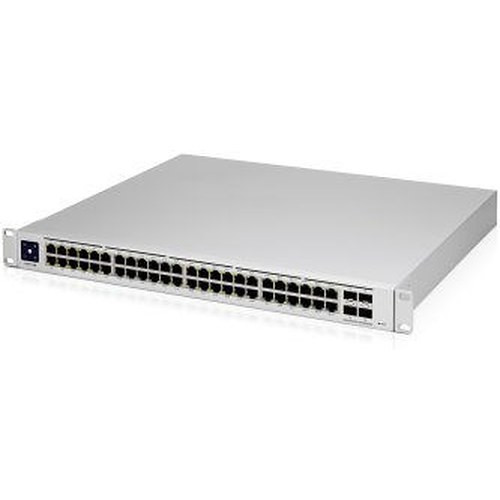
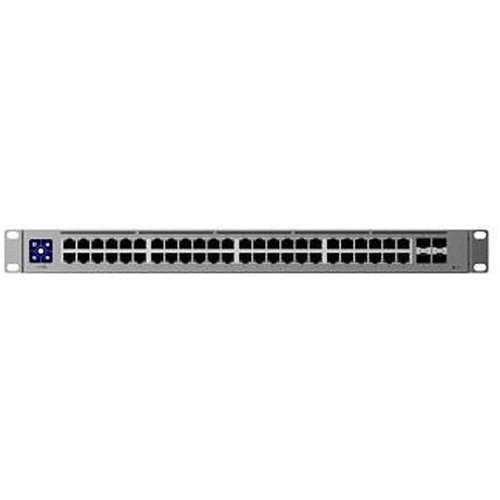
Both the Ubiquiti USW-PRO-48-POE and USW-48-POE are 1U rackmount, UniFi-managed 48-port Gigabit PoE switches aimed at access-layer deployments where IP cameras, wireless access points, and VoIP endpoints need inline power. They share 48 copper Gigabit ports, 1,000-VLAN support, and UniFi controller integration, making them direct cross-shop candidates for installers sizing an access switch. Key differentiators are PoE budget, uplink speed, Layer 3 routing capability, and total port power class — all of which affect which installations each switch can realistically serve.
In This Guide
- How do PoE budget and per-port power class differ between the two switches?
- Which switch offers greater switching capacity, uplink speed, and routing capability?
- How do the two switches compare on physical build, environmental ratings, and management interfaces?
- Which should you choose: the USW-PRO-48-POE or the USW-48-POE?
- Side-by-Side Specs
- FAQ
How do PoE budget and per-port power class differ between the two switches?
The USW-PRO-48-POE delivers a 660W total PoE budget (600W shared PoE pool plus 60W independent), with 40 ports rated at PoE+ (802.3at, 32W each) and 8 ports rated at PoE++ (802.3bt, 64W each). This makes it capable of powering high-draw devices such as PTZ cameras, 802.11ax tri-band APs, and IP intercoms that require more than 30W without external injectors.
The USW-48-POE provides a 195W maximum PoE output budget across 32 PoE+ (802.3at, up to 30W each) ports; the remaining 16 copper ports carry no PoE. With a 240W internal power supply and 45W baseline consumption, the headroom for PoE is substantially lower. The 195W budget supports mixed low-to-mid-draw deployments but constrains simultaneous full-load scenarios — for example, 32 devices drawing 30W each would require 960W, far exceeding the rated budget.
In practical terms, the PRO model's 3.4× larger PoE budget (660W vs 195W) and PoE++ capability make it the appropriate choice wherever high-density or high-wattage endpoints are present. The standard USW-48-POE is suitable for lighter access layers where most devices draw well under 10W and total simultaneous draw stays within 195W.
Which switch offers greater switching capacity, uplink speed, and routing capability?
The USW-PRO-48-POE is specified at 176 Gbps aggregate switching capacity (88 Gbps non-blocking) with a 131 Mpps forwarding rate. Its uplink tier comprises four 10G SFP+ ports, providing up to 40 Gbps of backhaul bandwidth. It also supports Layer 2/3 management including static routing and DHCP, enabling inter-VLAN routing without an external router for basic segmentation scenarios.
The USW-48-POE is specified at 104 Gbps switching capacity with 52 Gbps non-blocking throughput and a 77 Mpps forwarding rate. Its uplink tier is four 1G SFP ports, capping backhaul at 4 Gbps. Management is listed as Layer 2 via UniFi controller with 1,000 VLAN support; Layer 3 routing capability is not stated in the provided specifications.
For high-density environments where all 48 access ports are simultaneously loaded or where uplink aggregation to a core switch is required, the PRO's 10G SFP+ uplinks and higher forwarding rate represent a meaningful architectural advantage. The standard model's 1G SFP uplinks become a bottleneck if aggregate downstream traffic approaches or exceeds 1 Gbps.
How do the two switches compare on physical build, environmental ratings, and management interfaces?
The USW-PRO-48-POE weighs 16.3 lb (approximately 7.4 kg) and measures 442.4 × 399.6 × 43.7 inches as listed — note the dimension unit appears to be a data entry error (likely mm, consistent with standard 1U rackmount form factor); installers should verify against the datasheet at /content/product-datasheets/USW-PRO-48-POE.pdf. Operating temperature range and enclosure material are not stated in the provided specifications. Management interfaces include Web UI, SSH, UniFi Controller, SNMP, and REST API.
The USW-48-POE weighs 4.5 kg (10 lb) without mounting brackets, is constructed from SGCC steel, and carries an operating temperature rating of –5°C to +40°C (23°F to 104°F). It includes a 1.3-inch LCM color touchscreen for local status monitoring. Certifications include CE, FCC, IC, and Anatel (00593-21-08356). It is listed as NDAA compliant. Management is via UniFi controller integration with 1,000 VLAN support.
The USW-48-POE has a notable advantage in documented compliance and environmental data: NDAA compliance, an explicit operating temperature range, and regulatory certifications are all confirmed in the provided specs. None of these are confirmed in the provided specs for the USW-PRO-48-POE. For federal or government-adjacent deployments where NDAA compliance is a procurement requirement, the USW-48-POE is the only model with that status confirmed here. The PRO model's richer management interface set (SNMP, REST API, SSH explicitly listed) is an advantage for enterprise IT environments requiring programmatic management.
Which should you choose: the USW-PRO-48-POE or the USW-48-POE?
Our take: The USW-PRO-48-POE is the stronger choice when high PoE density, high-wattage endpoints, or 10G uplinks are required — its 660W PoE budget is 3.4× that of the USW-48-POE (195W), its eight PoE++ ports supply up to 64W each versus a maximum of 30W per port on the standard model, and its four 10G SFP+ uplinks provide up to 10× the backhaul bandwidth of the USW-48-POE's four 1G SFP ports. The USW-48-POE is appropriate for lighter access-layer deployments where total simultaneous PoE draw stays within 195W, weight and cost are considerations, and where NDAA compliance or a confirmed operating temperature range (–5°C to +40°C) are explicit procurement requirements — neither of those attributes is confirmed in the provided specifications for the PRO model. Both switches share UniFi controller integration and 1,000-VLAN support.
Side-by-Side Comparison
Spec-for-spec, from manufacturer data.
| Specification | Ubiquiti USW-PRO-48-POE | Ubiquiti USW-48-POE |
|---|---|---|
| Total Ports (Copper) | 48 × 1GbE | 48 × 1GbE |
| PoE-Capable Copper Ports | 48 (40 PoE+, 8 PoE++) | 32 PoE+ |
| Max PoE Standard | PoE++ (802.3bt) | PoE+ (802.3at) |
| Max Per-Port PoE Power | 64W (PoE++ ports) | 30W |
| Total PoE Power Budget | 660W (600W + 60W independent) | 195W |
| Uplink Ports | 4 × 10G SFP+ | 4 × 1G SFP |
| Switching Capacity | 176 Gbps aggregate | 104 Gbps |
| Non-Blocking Throughput | 88 Gbps | 52 Gbps |
| Forwarding Rate | 131 Mpps | 77 Mpps |
| VLAN Support | 1,000 | 1,000 |
| Layer 3 Routing | Yes (static routes, DHCP) | Not stated in provided specs |
| Management Interfaces | Web UI, SSH, UniFi, SNMP, REST API | UniFi controller |
| Local Display | Not stated in provided specs | 1.3" LCM color touchscreen |
| Operating Temperature | Not stated in provided specs | –5°C to +40°C (23°F to 104°F) |
| NDAA Compliant | Not stated in provided specs | Yes |
| Weight | 16.3 lb (7.4 kg approx.) | 4.5 kg (10 lb) without brackets |
Frequently Asked Questions
Which should you choose: the USW-PRO-48-POE or the USW-48-POE?
The USW-PRO-48-POE is the stronger choice when high PoE density, high-wattage endpoints, or 10G uplinks are required — its 660W PoE budget is 3.4× that of the USW-48-POE (195W), its eight PoE++ ports supply up to 64W each versus a maximum of 30W per port on the standard model, and its four 10G SFP+ uplinks provide up to 10× the backhaul bandwidth of the USW-48-POE's four 1G SFP ports. The USW-48-POE is appropriate for lighter access-layer deployments where total simultaneous PoE draw stays within 195W, weight and cost are considerations, and where NDAA compliance or a confirmed operating temperature range (–5°C to +40°C) are explicit procurement requirements — neither of those attributes is confirmed in the provided specifications for the PRO model. Both switches share UniFi controller integration and 1,000-VLAN support.
Is the USW-PRO-48-POE or USW-48-POE better for powering PTZ cameras and high-wattage APs?
The USW-PRO-48-POE is the appropriate choice for high-wattage endpoints. It provides eight PoE++ ports rated at 64W each (802.3bt) and a 660W total PoE budget. The USW-48-POE's PoE+ ports are capped at 30W each with a 195W total budget, which is insufficient for devices requiring more than 30W or for dense deployments with many simultaneous high-draw devices.
Does either switch support Layer 3 routing for inter-VLAN traffic without an external router?
Based on the provided specifications, Layer 2/3 management with static routing and DHCP is explicitly stated for the USW-PRO-48-POE. Layer 3 routing capability is not stated in the provided specifications for the USW-48-POE — buyers requiring inter-VLAN routing on the standard model should verify directly with Ubiquiti's documentation before specifying.
Which switch is confirmed NDAA compliant for government or federal deployments?
The USW-48-POE is listed as NDAA compliant in the provided specifications. NDAA compliance is not stated in the provided specifications for the USW-PRO-48-POE. For any deployment where NDAA compliance is a procurement requirement, the USW-48-POE is the only model with that status confirmed in the data provided here.
More Network Switch Comparisons
- NETGEAR GS748PP-100NAS vs Ubiquiti USW-48-POE
- NETGEAR GS748PP-100NAS vs Ubiquiti USW-PRO-MAX-48-POE
- NETGEAR GS748PP-100NAS vs Ubiquiti USW-ENTERPRISE-48-POE
- NETGEAR GS748PP-100NAS vs Ubiquiti ES-48-500W
- NETGEAR GS748PP-100NAS vs NETGEAR GS348PP-100NAS
- Ubiquiti USW-48-POE vs NETGEAR GS348PP-100NAS
Network Switch Buying Guides
Get a Second Opinion on Your Camera Choice
Share your site layout, coverage goals, and budget. Our team will validate the camera selection, flag anything we would change, and recommend products that match the use case.