
Ubiquiti USW-PRO-48-POE vs Allied Telesis GS980M/52PS-10: Specification Comparison
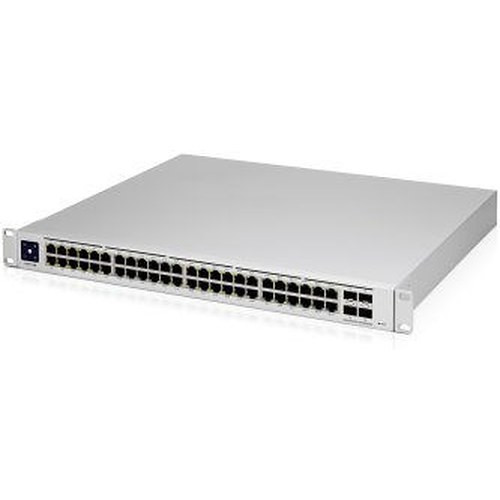
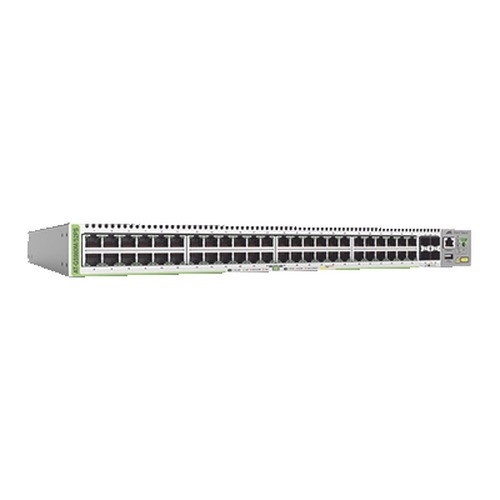
Both the Ubiquiti USW-PRO-48-POE and the Allied Telesis AT-GS980M/52PS-10 are 1U rack-mount managed Gigabit switches offering 48 PoE-capable copper ports and SFP uplinks, positioned for enterprise LAN infrastructure, IP surveillance, and converged access deployments. This comparison evaluates their PoE power delivery and port flexibility, switching performance and uplink capacity, and management depth and platform ecosystem—the three axes most relevant to installers and IT buyers selecting a 48-port PoE access switch.
In This Guide
- Which switch delivers more usable PoE power, and how flexible is the per-port power allocation?
- How do the two switches compare on switching capacity, forwarding rate, and uplink speed?
- What management capabilities and platform ecosystems does each switch offer?
- Which should you choose: the USW-PRO-48-POE or the GS980M/52PS-10?
- Side-by-Side Specs
- FAQ
Which switch delivers more usable PoE power, and how flexible is the per-port power allocation?
The AT-GS980M/52PS-10 posts the higher maximum PoE budget at 740W, versus 600W dedicated PoE output (660W total including 60W independent) on the USW-PRO-48-POE. In a worst-case 48-camera scenario where every port draws 15W, the Allied Telesis covers all 48 ports; the Ubiquiti's 600W PoE pool also covers 40 ports at 15W but its architecture explicitly splits into 40 PoE+ ports at up to 32W each and 8 PoE++ ports at up to 64W each.
The Ubiquiti's PoE++ (802.3bt) support on 8 ports is a meaningful differentiator: devices such as Wi-Fi 6E APs, PTZ cameras, or multi-sensor units that draw 45–90W can be powered natively without external injectors. The Allied Telesis spec lists a maximum of 30W per port (PoE+, 802.3at implied), with no PoE++ capability stated in the provided specifications. Installers mixing high-wattage endpoints alongside standard cameras will find the USW-PRO-48-POE's tiered PoE architecture more accommodating for those eight demanding slots.
Maximum power consumption is 909W for the Allied Telesis versus a combined 660W maximum for the Ubiquiti, reflecting the larger PoE reservoir on the AT model. Heat dissipation for the Allied Telesis is specified at 3,102 BTU/h; no equivalent figure is provided in the Ubiquiti specifications supplied.
How do the two switches compare on switching capacity, forwarding rate, and uplink speed?
The USW-PRO-48-POE leads on switching capacity with 176 Gbps aggregate (88 Gbps non-blocking) and a forwarding rate of 131 Mpps. The AT-GS980M/52PS-10 specifies a 104 Gbps switching fabric and 77.4 Mpps forwarding rate. Both figures favor the Ubiquiti by approximately 70% on fabric and 69% on forwarding throughput.
Uplink technology is a decisive gap: the USW-PRO-48-POE provides four 10G SFP+ ports, enabling 40 Gbps of aggregate uplink capacity to a core switch or router. The AT-GS980M/52PS-10 provides four SFP ports rated at 100/1000X—meaning uplinks top out at 4 Gbps aggregate (1G each). In high-density surveillance or unified-communications deployments where all 48 access ports are simultaneously active, the Ubiquiti's 10G uplinks provide substantially more headroom before the uplink becomes the bottleneck.
The Allied Telesis specification notes a noise level of 42 dBA; no acoustic specification is provided for the USW-PRO-48-POE. The Ubiquiti weighs 16.3 lbs (7.4 kg) versus 12.79 lbs (5.8 kg) for the Allied Telesis, with similar 1U depth profiles (399.6 mm vs. 359 mm).
What management capabilities and platform ecosystems does each switch offer?
The USW-PRO-48-POE operates within the UniFi ecosystem and is managed via Web UI, SSH, the UniFi Controller (on-premises or cloud-hosted), SNMP, and a REST API. It supports Layer 2/3 operation with static routing, DHCP, and up to 1,000 VLANs. This tight integration with UniFi's single-pane-of-glass controller—which also manages UniFi APs, cameras (UniFi Protect), and gateways—is a significant operational advantage for sites already invested in or planning a UniFi infrastructure.
The AT-GS980M/52PS-10 specifications list VLAN, QoS, and enterprise security as management features, consistent with a managed L2 switch. However, the provided specifications do not enumerate the specific management protocols (SNMP version, CLI access method, web UI details), maximum VLAN count, or routing capabilities beyond these generic labels. Buyers evaluating multi-vendor NMS integration or scripted automation should request the Allied Telesis full feature matrix before committing.
The Allied Telesis switch carries a white housing color per spec, which may matter for deployments in non-standard rack environments. Country of origin is specified as China for the Ubiquiti; no country-of-origin data is provided in the Allied Telesis specifications supplied. Warranty terms are listed as 'Manufacturer Warranty' for the Ubiquiti; no equivalent warranty language is present in the Allied Telesis specifications provided.
Which should you choose: the USW-PRO-48-POE or the GS980M/52PS-10?
Our take: The USW-PRO-48-POE is the stronger choice when switching performance, uplink capacity, and PoE++ device support are the primary decision criteria. Its 176 Gbps switching fabric outpaces the AT-GS980M/52PS-10's 104 Gbps by approximately 70%, its four 10G SFP+ uplinks deliver 10× the uplink bandwidth of the Allied Telesis's four 1G SFP ports, and its eight PoE++ ports (64W each) support high-draw endpoints that the Allied Telesis's 30W-per-port ceiling cannot serve. The AT-GS980M/52PS-10 holds an edge in raw PoE pool size (740W versus 600W PoE output) and is lighter. However, the Allied Telesis management specification is underspecified in the data provided, making side-by-side NMS or VLAN-depth comparison incomplete. The USW-PRO-48-POE is best suited to UniFi-ecosystem deployments with mixed high-wattage devices; the AT-GS980M/52PS-10 warrants a full Allied Telesis datasheet review before selection.
Side-by-Side Comparison
Spec-for-spec, from manufacturer data.
| Specification | Ubiquiti USW-PRO-48-POE | Allied Telesis GS980M/52PS-10 |
|---|---|---|
| PoE Copper Ports | 48 (40× PoE+, 8× PoE++) | 48 (all PoE+) |
| Uplink Ports | 4× 10G SFP+ | 4× SFP 100/1000X |
| Total Port Count (inc. uplinks) | 52 | 48 (spec lists 48 total) |
| Max PoE Power Budget | 600W PoE output (660W total) | 740W |
| Max Per-Port PoE Power | 32W (PoE+) / 64W (PoE++) | 30W (PoE+) |
| PoE Standard | 802.3at (PoE+) / 802.3bt (PoE++) | PoE+ (802.3at implied; PoE++ not stated) |
| Switching Fabric | 176 Gbps | 104 Gbps |
| Forwarding Rate | 131 Mpps | 77.4 Mpps |
| Layer | L2/L3 (static routing, DHCP) | L2 managed (routing not stated) |
| VLAN Support | Up to 1,000 VLANs | VLAN supported (max count not stated) |
| Management Interfaces | Web UI, SSH, UniFi Controller, SNMP, REST API | VLAN, QoS, enterprise security (protocol detail not stated) |
| Form Factor | 1U rack-mount | 1RU rack-mount |
| Dimensions (W×D×H) | 442.4 × 399.6 × 43.7 mm* | 441 × 359 × 44 mm |
| Weight | 16.3 lbs (7.4 kg) | 12.79 lbs (5.8 kg) |
| Max Power Consumption | 660W | 909W |
| Acoustic Noise | — | 42 dBA |
Frequently Asked Questions
Which should you choose: the USW-PRO-48-POE or the GS980M/52PS-10?
The USW-PRO-48-POE is the stronger choice when switching performance, uplink capacity, and PoE++ device support are the primary decision criteria. Its 176 Gbps switching fabric outpaces the AT-GS980M/52PS-10's 104 Gbps by approximately 70%, its four 10G SFP+ uplinks deliver 10× the uplink bandwidth of the Allied Telesis's four 1G SFP ports, and its eight PoE++ ports (64W each) support high-draw endpoints that the Allied Telesis's 30W-per-port ceiling cannot serve. The AT-GS980M/52PS-10 holds an edge in raw PoE pool size (740W versus 600W PoE output) and is lighter. However, the Allied Telesis management specification is underspecified in the data provided, making side-by-side NMS or VLAN-depth comparison incomplete. The USW-PRO-48-POE is best suited to UniFi-ecosystem deployments with mixed high-wattage devices; the AT-GS980M/52PS-10 warrants a full Allied Telesis datasheet review before selection.
Is the USW-PRO-48-POE or the AT-GS980M/52PS-10 better for powering a dense IP camera deployment where most cameras draw 15–25W?
Both switches can power 48 cameras in that range. The AT-GS980M/52PS-10 provides a 740W PoE pool versus the USW-PRO-48-POE's 600W PoE output, giving slightly more headroom at full 48-port load. However, if any cameras or APs require more than 30W per port, only the USW-PRO-48-POE supports PoE++ (up to 64W) on eight of its ports, as no PoE++ capability is stated in the Allied Telesis specifications provided.
Which switch is better for a site that already uses UniFi APs and a UniFi gateway?
The USW-PRO-48-POE is the clear fit. It is part of the UniFi Switching family and is managed natively within the UniFi Controller alongside UniFi APs, gateways, and cameras. This means a single management interface, automatic port profiling, and integrated traffic analytics. The AT-GS980M/52PS-10 is a standalone managed switch from Allied Telesis and does not integrate into the UniFi ecosystem.
Which switch handles high-bandwidth uplinks better when all 48 access ports are active simultaneously?
The USW-PRO-48-POE has a substantial advantage here: its four 10G SFP+ uplinks provide up to 40 Gbps of aggregate uplink capacity. The AT-GS980M/52PS-10 provides four 100/1000X SFP uplinks for a maximum of 4 Gbps aggregate. In full-load scenarios—such as a surveillance deployment with 48 cameras streaming 4K—the Ubiquiti's 10G uplinks are far less likely to become the bottleneck.
More Network Switch Comparisons
- NETGEAR GS748PP-100NAS vs Ubiquiti USW-48-POE
- NETGEAR GS748PP-100NAS vs Ubiquiti USW-PRO-MAX-48-POE
- NETGEAR GS748PP-100NAS vs Ubiquiti USW-ENTERPRISE-48-POE
- NETGEAR GS748PP-100NAS vs Ubiquiti ES-48-500W
- NETGEAR GS748PP-100NAS vs NETGEAR GS348PP-100NAS
- Ubiquiti USW-48-POE vs NETGEAR GS348PP-100NAS
Network Switch Buying Guides
Get a Second Opinion on Your Camera Choice
Share your site layout, coverage goals, and budget. Our team will validate the camera selection, flag anything we would change, and recommend products that match the use case.