
Ubiquiti USW-LITE-8-POE vs Vivotek IHT-1271: Specification Comparison
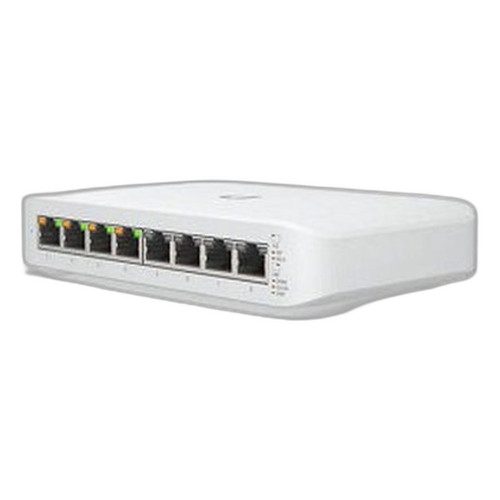
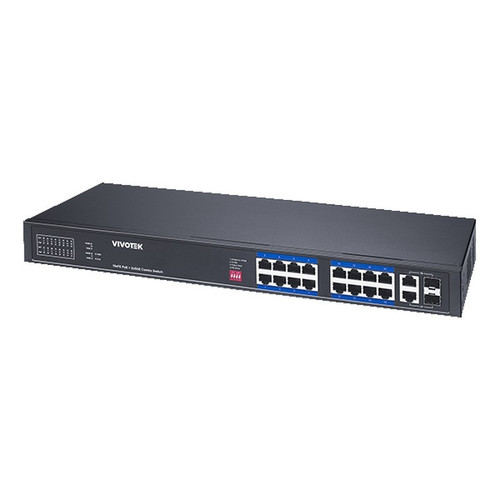
Both the Ubiquiti USW-LITE-8-POE and the Vivotek AW-IHT-1271 are 8-port Gigabit managed PoE switches—a buyer sizing a small surveillance or access-control LAN will encounter both. The Ubiquiti is a compact, consumer-adjacent desktop/wall-mount unit aimed at distributed indoor deployments. The Vivotek is a ruggedized industrial switch with fiber uplinks and dual redundant power, targeting harsh or mission-critical environments. The comparison is valid: same port count, same base technology class, overlapping but distinct market positions.
In This Guide
- Which switch delivers more PoE power and switching headroom across its ports?
- How do the two switches compare for physical durability, power resilience, and operating environment?
- Which switch offers deeper management, VLAN flexibility, and surveillance-platform integration?
- Which should you choose: the USW-LITE-8-POE or the IHT-1271?
- Side-by-Side Specs
- FAQ
Which switch delivers more PoE power and switching headroom across its ports?
The AW-IHT-1271 holds a decisive advantage in raw PoE capacity. Its 240 W total PoE budget delivers up to 30 W per port (802.3at), meaning all 8 ports can simultaneously power high-draw devices—PTZ cameras, multi-radio APs, or access-control panels—without throttling. The USW-LITE-8-POE provides 52 W total across its 8 ports, also rated 802.3at per port, but that aggregate budget averages just 6.5 W per port under full load, which may force per-port rationing in dense camera deployments.
On switching capacity, the AW-IHT-1271 again leads: 24 Gbps switching capacity and 17.856 Mpps forwarding rate versus the USW-LITE-8-POE's 16 Gbps switching capacity (8 Gbps non-blocking) and 12 Mpps forwarding rate. The Vivotek also adds 4 × 100M/1G SFP fiber uplink ports, enabling fiber backbone connections that the Ubiquiti does not offer. The Ubiquiti's port complement is 8 × 1 Gbps RJ45 only, with no fiber option specified.
How do the two switches compare for physical durability, power resilience, and operating environment?
The AW-IHT-1271 is purpose-built for industrial conditions. Its operating temperature range is -40 °C to 75 °C (-40 °F to 167 °F), and it is tested to IEC 60068-2-6 (vibration), IEC 60068-2-27 (shock), and IEC 60068-2-32 (freefall). Each PoE port carries 6 KV surge protection, and the unit is EMS-compliant (ESD, RS, EFT, Surge, CS, PFMF). Dual 48–57 VDC power inputs provide redundant power backup—if one supply fails, the second sustains operation.
The USW-LITE-8-POE is a polycarbonate-enclosure desktop/wall-mount unit rated -15 °C to 40 °C (5 °F to 104 °F). It draws power from a single 60 W external AC/DC adapter at 50–57 V DC. No per-port surge rating, no vibration or shock test certification, and no redundant power input are specified. For indoor, climate-controlled, low-vibration environments this is adequate; for outdoor enclosures, industrial floors, or transportation applications it is not specified to meet those conditions. The Ubiquiti weighs 295 g; the Vivotek 680 g, reflecting the heavier industrial chassis.
Which switch offers deeper management, VLAN flexibility, and surveillance-platform integration?
The AW-IHT-1271 provides L2+ managed features: 4,096 VLAN IDs (802.1Q tag-based, port-based, MAC-based, management VLAN, Q-in-Q, Private VLAN Edge, Voice VLAN, GVRP), IEEE 802.1D/w/s spanning tree, LACP (up to 4-port groups, 6 groups), IGMP snooping v1/v2/v3, IPv4/v6 static routing, DHCP server, RADIUS authentication, 802.1x port security, DDoS prevention, IP Source Guard, storm control, SSH v1.5/v2.0, HTTPS/SSL, SNMP v1/v2c/v3, RMON, IEEE 1588v2 PTP, and G.8031/G.8032 ring protection with sub-20 ms convergence. The Vivotek VAST-compatible management software adds auto-discovery of up to 256 Vivotek devices, topology/floor/Google Map views, PoE scheduling (7/24 on/off), and alive-checking for powered devices.
The USW-LITE-8-POE supports 1,000 VLANs and is managed via Ethernet (UniFi controller ecosystem implied by the platform, though the spec lists only 'Ethernet' as the management type). Specific L3, spanning-tree protocol variants, LACP group counts, ACL depth, or PTP support are not enumerated in the provided specifications. The Ubiquiti's strength is NDAA Section 889 compliance (explicitly certified), CE, FCC, IC, and Anatel certifications—relevant for US federal and regulated deployments. The Vivotek lists FCC Part 15 Class A, CE, LVD, and VCCI but does not specify NDAA compliance in the provided specs. The AW-IHT-1271 also carries a 60-month (5-year) warranty; the USW-LITE-8-POE warranty duration is not specified beyond 'Manufacturer Warranty.'
Which should you choose: the USW-LITE-8-POE or the IHT-1271?
Our take: The AW-IHT-1271 is the stronger choice when the deployment demands high sustained PoE loads, industrial environmental ratings, or network resilience features. Its 240 W PoE budget is 4.6× the USW-LITE-8-POE's 52 W, making it capable of powering all 8 ports at full 30 W simultaneously without rationing. Its -40 °C to 75 °C operating range versus the Ubiquiti's -15 °C to 40 °C, combined with 6 KV per-port surge protection, dual redundant DC power inputs, and IEC shock/vibration certification, makes it the only specified option for outdoor enclosures or industrial sites. Its 4 × SFP fiber ports also enable backbone uplinks absent from the Ubiquiti. The USW-LITE-8-POE is the appropriate choice for indoor, office-grade, or SMB environments where NDAA Section 889 federal compliance is required—a certification not specified for the Vivotek—and where a lighter, lower-cost 52 W PoE switch integrated into a UniFi ecosystem is sufficient.
Side-by-Side Comparison
Spec-for-spec, from manufacturer data.
| Specification | Ubiquiti USW-LITE-8-POE | Vivotek IHT-1271 |
|---|---|---|
| PoE Ports | 8 × 1 Gbps RJ45 (all PoE+) | 8 × 10/100/1000 RJ45 (all PoE+) |
| Fiber / Uplink Ports | — | 4 × 100M/1G SFP |
| Total PoE Power Budget | 52 W | 240 W |
| Max PoE per Port | 30 W (802.3at) | 30 W (802.3at) |
| PoE Standard | 802.3at (PoE+) | 802.3at / 802.3af |
| Switching Capacity | 16 Gbps | 24 Gbps |
| Forwarding Rate | 12 Mpps | 17.856 Mpps |
| VLAN Support | 1,000 VLANs | 4,096 VLAN IDs (802.1Q, port, MAC, Q-in-Q, PVE, Voice) |
| Spanning Tree | — | STP (802.1D), RSTP (802.1w), MSTP (802.1s) |
| Operating Temperature | -15 °C to 40 °C | -40 °C to 75 °C |
| Power Input / Redundancy | Single 60 W AC/DC adapter (50–57 V DC) | Dual 48–57 VDC inputs, redundant |
| Per-Port Surge Protection | — | 6 KV |
| Enclosure / Form Factor | Polycarbonate, compact desktop/wall-mount | Industrial chassis, wall-mount |
| NDAA Section 889 Compliance | Yes (specified) | Not specified in provided specs |
| Warranty | Manufacturer Warranty (duration not specified) | 60 months (5 years) |
| Weight | 295 g (10.4 oz) | 680 g (0.68 kg) |
Frequently Asked Questions
Which should you choose: the USW-LITE-8-POE or the IHT-1271?
The AW-IHT-1271 is the stronger choice when the deployment demands high sustained PoE loads, industrial environmental ratings, or network resilience features. Its 240 W PoE budget is 4.6× the USW-LITE-8-POE's 52 W, making it capable of powering all 8 ports at full 30 W simultaneously without rationing. Its -40 °C to 75 °C operating range versus the Ubiquiti's -15 °C to 40 °C, combined with 6 KV per-port surge protection, dual redundant DC power inputs, and IEC shock/vibration certification, makes it the only specified option for outdoor enclosures or industrial sites. Its 4 × SFP fiber ports also enable backbone uplinks absent from the Ubiquiti. The USW-LITE-8-POE is the appropriate choice for indoor, office-grade, or SMB environments where NDAA Section 889 federal compliance is required—a certification not specified for the Vivotek—and where a lighter, lower-cost 52 W PoE switch integrated into a UniFi ecosystem is sufficient.
Is the USW-LITE-8-POE or AW-IHT-1271 better for powering multiple PTZ cameras at full wattage?
The AW-IHT-1271 is better suited. It provides 240 W total PoE budget at up to 30 W per port, allowing all 8 ports to run simultaneously at full 802.3at load. The USW-LITE-8-POE has a 52 W total budget shared across 8 ports, averaging approximately 6.5 W per port at full load—which will require careful per-port power management if high-draw PTZ cameras are connected to multiple ports at once.
Can either switch be installed in an outdoor cabinet or an unheated industrial space?
Only the AW-IHT-1271 is specified for those conditions. It is rated for -40 °C to 75 °C operation, tested to IEC vibration and shock standards, and includes 6 KV surge protection per PoE port with dual redundant 48–57 VDC power inputs. The USW-LITE-8-POE is rated -15 °C to 40 °C in a polycarbonate enclosure with a single external AC/DC adapter; no surge, shock, or vibration ratings are specified for it.
Which switch is required for a US federal or NDAA-compliant installation?
The USW-LITE-8-POE explicitly lists NDAA Section 889 compliance among its certifications. NDAA compliance is not specified in the provided specifications for the AW-IHT-1271. Buyers subject to NDAA Section 889 procurement requirements should verify compliance documentation directly with Vivotek before specifying the AW-IHT-1271 on federal projects.
More Network Switch Comparisons
- Vivotek IHT-1271 vs TP-Link SG3210XHP-M2
- Vivotek IHT-1271 vs TP-Link S4500-8GP2F
- Vivotek IHT-1271 vs TP-Link SG1210P
- Vivotek IHT-1271 vs Allied Telesis AT-x530L-10GHXm-10
- Vivotek IHT-1271 vs Vivotek GEV-108A-130
- Vivotek IHT-1271 vs Vivotek IHT-1000
Network Switch Buying Guides
Get a Second Opinion on Your Camera Choice
Share your site layout, coverage goals, and budget. Our team will validate the camera selection, flag anything we would change, and recommend products that match the use case.