
Ubiquiti USW-LITE-16-POE vs Ubiquiti USW-16-POE: Specification Comparison
The USW-LITE-16-POE and USW-16-POE are both Ubiquiti 16-port Gigabit PoE+ managed switches targeting small-to-medium deployments of access points, IP cameras, and VoIP endpoints. Both share the same port count, PoE standard (802.3at), VLAN depth, and power-supply rating, making them direct cross-shop candidates. The key differentiators are form factor, uplink options, PoE budget, switching capacity, and enclosure material—each of which points to a distinct deployment context.

In This Guide
Which switch delivers more ports, uplinks, and switching headroom?
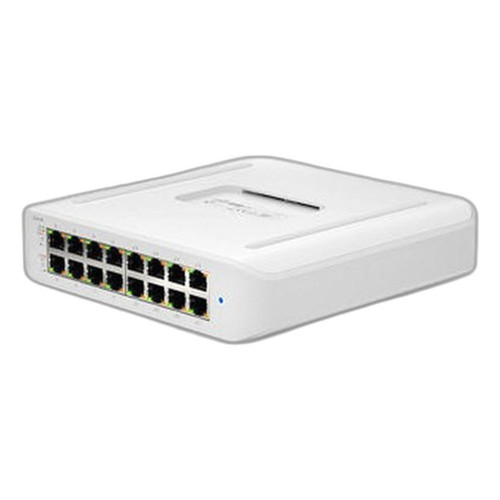
The USW-LITE-16-POE provides 16 × 1 Gbps PoE+ RJ45 ports and no dedicated uplink ports. Its switching capacity is 32 Gbps with a forwarding rate of 24 Mpps across a 16 Gbps non-blocking throughput fabric. Every port is PoE+, so the full port count is available for powered devices without reserving any for uplinks.
The USW-16-POE provides 16 × 1 Gbps PoE+ RJ45 ports plus 2 × SFP uplink ports, totaling 18 logical ports. Its switching capacity is 36 Gbps with a forwarding rate of 27 Mpps and 18 Gbps non-blocking throughput. The two SFP ports support fiber or SFP-copper uplinks, enabling backbone aggregation to a core switch or across buildings without consuming a PoE port.
For deployments requiring fiber uplinks or multi-switch stacking, the USW-16-POE's SFP slots are a meaningful structural advantage. For flat, single-switch topologies where all 16 ports serve endpoints, the USW-LITE-16-POE's architecture is sufficient, and its slightly lower forwarding and capacity figures (24 Mpps / 32 Gbps vs. 27 Mpps / 36 Gbps) are unlikely to be limiting at 1 Gbps line rates.
Which switch powers more or heavier PoE devices?
The USW-LITE-16-POE carries a 45W total PoE+ budget across all 16 ports, sourced from a 60W internal AC/DC supply. The per-port maximum follows the 802.3at standard (up to 30W per port), subject to the 45W aggregate ceiling. Non-PoE idle draw is 15W, leaving 45W for powered devices from the 60W supply.
The USW-16-POE carries a 42W total PoE+ budget across its 16 PoE+ ports, also from a 60W internal supply. Non-PoE idle draw is 18W. Note: the spec field '_Poe Budget: 32W 32W 32W' and '_Power Watts: 180W' appear internally inconsistent with the primary spec of 42W total and 60W supply; the 42W figure from the primary spec and datasheet reference is used here as the authoritative value. Buyers should verify with Ubiquiti documentation before sizing deployments.
Despite sharing identical 60W internal supplies, the USW-LITE-16-POE specifies a higher aggregate PoE budget (45W vs. 42W) while drawing less idle power (15W vs. 18W). In practice, neither budget supports simultaneous full 802.3at (30W) loads across more than one or two ports at a time; both switches are sized for lightweight mixed loads (access points, IP cameras, VoIP phones) rather than high-wattage PTZ cameras or 802.3bt devices.
Which switch fits the installation environment—rack room, wiring closet, or open wall?
The USW-LITE-16-POE is a compact desktop/wall-mountable unit measuring 192 × 185 × 44 mm and weighing 1.2 kg. Its enclosure is polycarbonate. It operates from −15°C to +40°C, giving it a lower cold-side tolerance suited for unheated spaces such as exterior closets or garages. It does not occupy rack space and requires no mounting brackets.
The USW-16-POE is a 1U rack-mount unit measuring 442 × 200 × 44 mm and weighing 2.8 kg (without mounting brackets). Its enclosure is SGCC steel, which is more robust against physical impact and EMI. Its operating range is −5°C to +40°C. It is designed for standard 19-inch rack installation in an IDF or MDF.
The choice between the two is largely dictated by installation context. Wall-mount or surface-mount deployments in confined spaces favor the USW-LITE-16-POE's smaller footprint and polycarbonate build. Rack-based IDF/MDF closets favor the USW-16-POE's steel 1U form factor, which integrates cleanly with patch panels and other rack equipment. The USW-LITE-16-POE's wider cold-temperature tolerance (down to −15°C vs. −5°C) is a concrete advantage in unheated or outdoor-adjacent enclosures.
Which should you choose: the USW-LITE-16-POE or the USW-16-POE?
Our take: The USW-LITE-16-POE is the stronger choice when the deployment is wall-mount or surface-mount, operates in colder ambient conditions, and does not require fiber uplinks. It delivers a higher PoE budget (45W vs. 42W), lower idle draw (15W vs. 18W), and a wider operating temperature floor (−15°C vs. −5°C)—meaningful advantages in compact, unheated, or budget-constrained installs. The USW-16-POE is the stronger choice for rack-based infrastructure rooms: its SGCC steel 1U enclosure, two SFP uplink ports, higher switching capacity (36 Gbps vs. 32 Gbps), and higher forwarding rate (27 Mpps vs. 24 Mpps) align with structured cabling environments where fiber backbone aggregation or future multi-switch expansion is planned. Both models share the same PoE+ standard, VLAN depth (1,000), port count, and power-supply rating. Platform note: both are NDAA-compliant Ubiquiti UniFi switches and require UniFi Network for managed operation.
Side-by-Side Comparison
Spec-for-spec, from manufacturer data.
| Specification | Ubiquiti USW-LITE-16-POE | Ubiquiti USW-16-POE |
|---|---|---|
| PoE RJ45 Ports | 16 × 1 Gbps PoE+ | 16 × 1 Gbps PoE+ |
| SFP Uplink Ports | — | 2 × SFP |
| Total Port Count | 16 | 18 (16 RJ45 + 2 SFP) |
| PoE Standard | 802.3at (PoE+) | 802.3at (PoE+) |
| Total PoE Budget | 45W | 42W |
| Switching Capacity | 32 Gbps | 36 Gbps |
| Non-Blocking Throughput | 16 Gbps | 18 Gbps |
| Forwarding Rate | 24 Mpps | 27 Mpps |
| Idle Power Draw (excl. PoE) | 15W | 18W |
| Internal Power Supply | 60W AC/DC | 60W AC/DC |
| Form Factor | Compact desktop / wall-mount | 1U rack-mount |
| Dimensions | 192 × 185 × 44 mm | 442 × 200 × 44 mm |
| Weight | 1.2 kg (2.6 lb) | 2.8 kg (6.2 lb) excl. brackets |
| Enclosure Material | Polycarbonate | SGCC steel |
| Operating Temperature | −15°C to +40°C | −5°C to +40°C |
| VLAN Support | 1,000 | 1,000 |
| NDAA Compliant | Yes | Yes |
| Certifications | CE, FCC, IC, Anatel | CE, FCC, IC, Anatel |
Frequently Asked Questions
Which should you choose: the USW-LITE-16-POE or the USW-16-POE?
The USW-LITE-16-POE is the stronger choice when the deployment is wall-mount or surface-mount, operates in colder ambient conditions, and does not require fiber uplinks. It delivers a higher PoE budget (45W vs. 42W), lower idle draw (15W vs. 18W), and a wider operating temperature floor (−15°C vs. −5°C)—meaningful advantages in compact, unheated, or budget-constrained installs. The USW-16-POE is the stronger choice for rack-based infrastructure rooms: its SGCC steel 1U enclosure, two SFP uplink ports, higher switching capacity (36 Gbps vs. 32 Gbps), and higher forwarding rate (27 Mpps vs. 24 Mpps) align with structured cabling environments where fiber backbone aggregation or future multi-switch expansion is planned. Both models share the same PoE+ standard, VLAN depth (1,000), port count, and power-supply rating. Platform note: both are NDAA-compliant Ubiquiti UniFi switches and require UniFi Network for managed operation.
Is the USW-LITE-16-POE or USW-16-POE better for powering multiple access points or IP cameras?
The USW-LITE-16-POE specifies a slightly higher aggregate PoE budget (45W vs. 42W) from the same 60W internal supply, so it can marginally sustain more simultaneous PoE load. However, neither switch supports more than one or two simultaneous full 802.3at (30W) ports before hitting the budget ceiling. For deployments with more than a handful of powered devices drawing over 10W each, a higher-budget PoE switch outside this comparison should be evaluated.
Can the USW-16-POE connect to a fiber uplink or core switch, and can the USW-LITE-16-POE do the same?
Yes—the USW-16-POE includes two SFP ports that accept fiber or copper SFP modules, enabling direct fiber backbone connections to a core switch or cross-building links. The USW-LITE-16-POE has no SFP ports; all 16 ports are copper RJ45. If a fiber uplink or dedicated backbone port is required, the USW-16-POE is the only option between these two models.
Which switch is better suited for installation in an unheated or outdoor-adjacent enclosure?
The USW-LITE-16-POE is rated for operation down to −15°C, compared to −5°C for the USW-16-POE. In unheated wiring closets, garages, or exterior NEMA enclosures where winter temperatures may drop below freezing, the USW-LITE-16-POE's wider cold-side tolerance is a direct spec advantage. Neither switch carries an IP or NEMA ingress-protection rating in the provided specs, so both require a dry, sheltered mounting location.
More Network Switch Comparisons
- Vivotek GEL-205A-260 vs TP-Link SL1218MP
- Vivotek GEL-205A-260 vs Allied Telesis AT-x530L-18GHXm-10
- Vivotek GEL-205A-260 vs Ubiquiti USW-LITE-16-POE
- Vivotek GEL-205A-260 vs Ubiquiti USW-16-POE
- TP-Link SL1218MP vs Allied Telesis AT-x530L-18GHXm-10
- TP-Link SL1218MP vs Ubiquiti USW-LITE-16-POE
Network Switch Buying Guides
Get a Second Opinion on Your Camera Choice
Share your site layout, coverage goals, and budget. Our team will validate the camera selection, flag anything we would change, and recommend products that match the use case.