
Vivotek GEL-205A-260 vs TP-Link SL1218MP: Specification Comparison
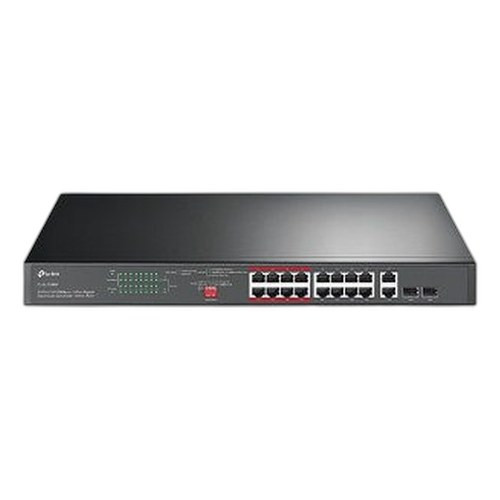
Both the Vivotek AW-GEL-205A-260 and the TP-Link TL-SL1218MP are 16-port rack-mount PoE switches intended for IP camera and access-control deployments. The Vivotek is a managed Gigabit switch with a tiered 260 W PoE budget, while the TP-Link is an unmanaged Fast Ethernet switch with a 192 W budget and Gigabit uplinks only. A buyer evaluating either unit is choosing a 16-port PoE switch for a mid-scale physical-security edge installation, making direct comparison appropriate.

In This Guide
- How do port speed, uplink capacity, and switching throughput compare?
- Which switch delivers more PoE power, and how is that power distributed?
- How do management capabilities and environmental ratings differ between the two switches?
- Which should you choose: the GEL-205A-260 or the SL1218MP?
- Side-by-Side Specs
- FAQ
How do port speed, uplink capacity, and switching throughput compare?
The AW-GEL-205A-260 provides 16 Gigabit PoE ports (1000 Mbps), 2 additional Gigabit RJ45 uplinks, and 2 Gigabit SFP ports, yielding 20 total ports and a switching bandwidth of 40 Gbps. The TL-SL1218MP provides 16 ports at 10/100 Mbps (Fast Ethernet, not Gigabit) and 2 Gigabit RJ45 combo uplinks for 18 total ports, with a switching capacity of 7.2 Gbps.
The throughput gap is substantial: 40 Gbps versus 7.2 Gbps. For camera networks, this matters when multiple high-bitrate streams converge on the same switch fabric. The Vivotek also adds 2 SFP fiber slots, enabling fiber uplinks to an aggregation switch or NVR; the TP-Link spec lists '2× Gigabit combo' SFP slots but does not explicitly confirm dedicated SFP-only ports separate from the RJ45 uplinks — buyers should verify the physical port count with the TP-Link datasheet. The TP-Link's 16 access ports max out at 100 Mbps per port, which caps each camera to that throughput ceiling regardless of camera capability.
Which switch delivers more PoE power, and how is that power distributed?
The AW-GEL-205A-260 carries a 260 W total PoE budget. Ports 1–4 are rated at 90 W each (IEEE 802.3bt), supporting PTZ cameras, multi-sensor units, or powered access-control panels. Ports 5–16 deliver up to 30 W each (IEEE 802.3at). PoE pin assignment is 4-pair on ports 1–4 and 2-pair on ports 5–16. The maximum AC draw is stated as 280 W.
The TL-SL1218MP carries a 192 W total PoE budget with up to 30 W per port across all 16 PoE ports (IEEE 802.3af/at). It offers no 802.3bt (90 W) ports. The 68 W budget difference (260 W vs. 192 W) is meaningful in dense deployments where several high-wattage devices — PTZ cameras, intercoms, or door controllers with electric locking — share the switch.
The Vivotek also specifies 4 kV surge protection per PoE port, Non-Stop PoE (power maintained during management reboots), PoE auto-checking, and PoE On/Off scheduling. None of these features are listed in the TP-Link specification.
How do management capabilities and environmental ratings differ between the two switches?
The AW-GEL-205A-260 is a fully managed switch. Documented management features include: 802.1Q tag-based VLAN (4096 VLAN IDs), port-based VLAN, STP (802.1d), RSTP (802.1w), Link Aggregation Control Protocol (LACP), CoS port-based / 802.1p / DSCP, storm control, loop protection, flow control, port mirroring, port isolation, bandwidth control, and static MAC. These capabilities allow VLAN segmentation of camera traffic, prioritization of video streams over control traffic, and redundant uplink configurations.
The TL-SL1218MP is explicitly unmanaged ('Managed: No'). It provides plug-and-play operation with a Priority Mode (ports 1–8 prioritized) and Extend Mode (250 m reach at reduced speed). No VLAN, QoS configuration, STP, or mirroring features are listed. For installations requiring network segmentation or integration with a managed infrastructure, this is a significant constraint.
On operating environment: the Vivotek is rated 0 °C to 50 °C operating; the TP-Link is rated 0 °C to 40 °C — a 10 °C narrower upper limit that may matter in warm equipment closets or outdoor enclosures. Storage temperature ranges are equivalent at –20/–40 °C lower and 70 °C upper (Vivotek –20 °C; TP-Link –40 °C lower bound). The Vivotek lists CE, FCC, LVD, and VCCI certifications; TP-Link certifications are not stated in the provided spec.
Which should you choose: the GEL-205A-260 or the SL1218MP?
Our take: The AW-GEL-205A-260 is the stronger choice when the installation requires managed network control, high-wattage PoE devices, or Gigabit access-layer throughput. Concretely: its switching bandwidth is 40 Gbps versus the TL-SL1218MP's 7.2 Gbps; its PoE budget is 260 W versus 192 W, and it includes four 802.3bt 90 W ports the TP-Link entirely lacks; and it operates to 50 °C versus the TP-Link's 40 °C ceiling. The TL-SL1218MP is an unmanaged Fast Ethernet switch — appropriate only where camera bitrates fit within 100 Mbps per port, no VLAN segmentation is required, and the total PoE load stays within 192 W. For any security deployment running modern Gigabit IP cameras, PTZ units, or access-control hardware requiring VLAN isolation and QoS, the AW-GEL-205A-260 is the technically suitable option. The TP-Link suits only the smallest, lowest-budget installations with no managed-network requirement.
Side-by-Side Comparison
Spec-for-spec, from manufacturer data.
| Specification | Vivotek GEL-205A-260 | TP-Link SL1218MP |
|---|---|---|
| Product Type | Managed Gigabit PoE Switch | Unmanaged Fast Ethernet PoE Switch |
| Total Ports | 20 (16 PoE + 2 RJ45 + 2 SFP) | 18 (16 PoE + 2 Gigabit combo) |
| PoE Access Port Speed | 10/100/1000 Mbps (Gigabit) | 10/100 Mbps (Fast Ethernet) |
| Uplink Port Speed | 2× Gigabit RJ45 + 2× Gigabit SFP | 2× Gigabit RJ45 combo |
| Switching Bandwidth | 40 Gbps | 7.2 Gbps |
| PoE Standard | 802.3af / at / bt | 802.3af / at |
| Total PoE Budget | 260 W | 192 W |
| Max PoE Per Port (High) | 90 W (ports 1–4, 802.3bt) | 30 W (all ports, 802.3at) |
| Max PoE Per Port (Standard) | 30 W (ports 5–16, 802.3at) | 30 W (all ports) |
| PoE Surge Protection | 4 kV per PoE port | — |
| Extend Mode (250 m PoE) | Yes | Yes |
| VLAN Support | 802.1Q (4096 IDs) + port-based | None (unmanaged) |
| QoS | CoS port / 802.1p / DSCP | Priority Mode (ports 1–8 only) |
| STP / RSTP | 802.1d / 802.1w | — |
| Operating Temperature | 0 °C to 50 °C | 0 °C to 40 °C |
| Warranty | 24 months | — |
Frequently Asked Questions
Which should you choose: the GEL-205A-260 or the SL1218MP?
The AW-GEL-205A-260 is the stronger choice when the installation requires managed network control, high-wattage PoE devices, or Gigabit access-layer throughput. Concretely: its switching bandwidth is 40 Gbps versus the TL-SL1218MP's 7.2 Gbps; its PoE budget is 260 W versus 192 W, and it includes four 802.3bt 90 W ports the TP-Link entirely lacks; and it operates to 50 °C versus the TP-Link's 40 °C ceiling. The TL-SL1218MP is an unmanaged Fast Ethernet switch — appropriate only where camera bitrates fit within 100 Mbps per port, no VLAN segmentation is required, and the total PoE load stays within 192 W. For any security deployment running modern Gigabit IP cameras, PTZ units, or access-control hardware requiring VLAN isolation and QoS, the AW-GEL-205A-260 is the technically suitable option. The TP-Link suits only the smallest, lowest-budget installations with no managed-network requirement.
Can I power PTZ cameras or multi-sensor cameras that draw more than 30 W on either of these switches?
Yes on the AW-GEL-205A-260: ports 1–4 are 802.3bt rated at 90 W each, supporting high-wattage PTZ and multi-sensor cameras. Ports 5–16 supply up to 30 W (802.3at). The TL-SL1218MP caps all 16 PoE ports at 30 W (802.3at); 802.3bt is not supported, so devices requiring more than 30 W cannot be powered by the TP-Link.
Does either switch support VLANs for separating camera traffic from the corporate network?
Only the AW-GEL-205A-260 supports VLANs. It provides 802.1Q tag-based VLANs with up to 4096 VLAN IDs and port-based VLAN assignment. The TL-SL1218MP is an unmanaged switch and provides no VLAN capability. If network segmentation is a security or compliance requirement, the TP-Link does not meet it.
Which switch is better suited for installations in warmer equipment rooms or enclosures?
The AW-GEL-205A-260 is rated for operation up to 50 °C; the TL-SL1218MP is rated up to 40 °C. In equipment closets or enclosures where ambient temperatures can exceed 40 °C — particularly in summer or in non-air-conditioned spaces — the Vivotek's wider thermal tolerance provides a 10 °C additional margin. Neither switch is rated for outdoor direct-exposure installation based on the provided specifications.
More Network Switch Comparisons
- Vivotek GEL-205A-260 vs Allied Telesis AT-x530L-18GHXm-10
- Vivotek GEL-205A-260 vs Ubiquiti USW-LITE-16-POE
- Vivotek GEL-205A-260 vs Ubiquiti USW-16-POE
- TP-Link SL1218MP vs Allied Telesis AT-x530L-18GHXm-10
- TP-Link SL1218MP vs Ubiquiti USW-LITE-16-POE
- TP-Link SL1218MP vs Ubiquiti USW-16-POE
Network Switch Buying Guides
Get a Second Opinion on Your Camera Choice
Share your site layout, coverage goals, and budget. Our team will validate the camera selection, flag anything we would change, and recommend products that match the use case.