
TP-Link SL1218MP vs Ubiquiti USW-16-POE: Specification Comparison
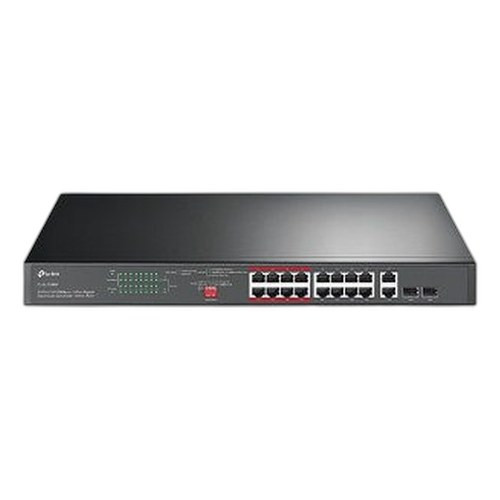
This comparison examines two 16-port PoE+ switches in a 1U rack form factor aimed at IP surveillance, VoIP, and access-control deployments. The TP-Link TL-SL1218MP is an unmanaged unit with a 192W PoE budget and Fast Ethernet access ports, while the Ubiquiti USW-16-POE is a UniFi-managed Gigabit switch with a 42W PoE budget and full VLAN support. Buyers cross-shopping these models are typically weighing raw PoE power delivery against network intelligence and port-speed headroom.

In This Guide
- How do port speed, switching capacity, and PoE budget compare?
- What management capabilities, VLAN support, and operating modes does each switch offer?
- How do build quality, power efficiency, certifications, and environmental specs compare?
- Which should you choose: the SL1218MP or the USW-16-POE?
- Side-by-Side Specs
- FAQ
How do port speed, switching capacity, and PoE budget compare?
The TL-SL1218MP provides 16 access ports at 10/100 Mbps plus two Gigabit combo SFP uplinks, yielding a switching capacity of 7.2 Gbps. Its forwarding rate is not specified. Its defining advantage is a 192W total PoE budget with up to 30W per port, supporting PoE+ devices across all 16 ports simultaneously at moderate draw. An Extend Mode on ports 1–8 stretches PoE reach to 250 meters at reduced speed, relevant for long cable runs in large facilities.
The USW-16-POE delivers all 16 access ports at full Gigabit (1000 Mbps), plus two SFP uplinks, with a switching capacity of 36 Gbps, non-blocking throughput of 18 Gbps, and a forwarding rate of 27 Mpps. However, its total PoE budget is 42W shared across all 16 ports, constrained by its 60W internal power supply. Maximum per-port PoE allocation is not individually specified, but the 42W aggregate severely limits simultaneous high-draw device counts. Buyers powering multiple PTZ cameras or PoE access-control panels at 15–25W each will exhaust this budget with only two or three active devices.
What management capabilities, VLAN support, and operating modes does each switch offer?
The TL-SL1218MP is fully unmanaged. There is no web interface, CLI, SNMP, or remote monitoring capability. Its only configurable behaviors are hardware-selected: Priority Mode prioritizes ports 1–8 for PoE delivery, and Extend Mode on ports 1–8 enables 250-meter PoE reach at reduced bandwidth. VLAN support is not specified. This simplicity means zero configuration overhead and no learning curve, but also no traffic segmentation, no QoS tuning, and no visibility into port utilization or fault conditions.
The USW-16-POE is fully managed via the UniFi Network controller (cloud or self-hosted). It supports up to 1,000 VLANs, QoS policies, link aggregation, port isolation, traffic statistics, and firmware management from a unified dashboard. For multi-site deployments already running UniFi infrastructure, this switch integrates natively with UniFi access points, cameras, and security gateways, enabling consistent policy enforcement across the network. The management overhead is real but the operational visibility gain is substantial for IT-conscious buyers.
How do build quality, power efficiency, certifications, and environmental specs compare?
The TL-SL1218MP ships in an unspecified enclosure material; its weight and idle power consumption (separate from PoE budget) are not listed in the provided specifications. It uses two fans for active cooling. Its operating temperature range is 0°C to 40°C (32°F to 104°F), and storage temperature spans −40°C to 70°C. NDAA compliance status, certifications, and warranty duration are all not specified in the provided data.
The USW-16-POE uses an SGCC steel enclosure and weighs 2.8 kg (6.2 lb) without mounting brackets. Its idle power consumption (excluding PoE load) is 18W from a 60W internal power supply. Fan configuration is not specified in the provided data. Its operating temperature range is −5°C to 40°C (23°F to 104°F), extending 5 degrees below the TP-Link's floor, a minor but real edge in cold environments. It carries CE, FCC, IC, and Anatel certifications, is confirmed NDAA compliant, and includes a manufacturer warranty of unspecified duration. The TL-SL1218MP's certifications, NDAA status, and warranty are all absent from the provided specifications.
Which should you choose: the SL1218MP or the USW-16-POE?
Our take: The TL-SL1218MP is the stronger choice when PoE power budget is the primary constraint — its 192W total (30W per port) versus the USW-16-POE's 42W total means it can simultaneously power four to six times as many high-draw PoE+ devices. Conversely, the USW-16-POE is the correct choice when network intelligence and port speed matter: its 36 Gbps switching capacity dwarfs the TL-SL1218MP's 7.2 Gbps, all 16 access ports run at Gigabit versus 100 Mbps, and it supports 1,000 VLANs with full UniFi controller management versus zero management capability. NDAA compliance is confirmed only on the USW-16-POE, which is a hard requirement for U.S. federal and many state/local government projects. Choose the TL-SL1218MP for dense analog-to-IP camera migrations or large fixed-camera deployments where raw wattage outweighs management. Choose the USW-16-POE for UniFi-ecosystem sites, NDAA-governed projects, or any deployment where traffic segmentation and Gigabit access ports are non-negotiable.
Side-by-Side Comparison
Spec-for-spec, from manufacturer data.
| Specification | TP-Link SL1218MP | Ubiquiti USW-16-POE |
|---|---|---|
| Management | Unmanaged | Managed (UniFi controller) |
| Access Port Speed | 16× 10/100 Mbps | 16× 1000 Mbps (Gigabit) |
| Uplink Ports | 2× Gigabit combo SFP | 2× SFP |
| PoE Standard | 802.3af/at (PoE+) | 802.3at (PoE+) |
| PoE Budget (Total) | 192W | 42W |
| Max PoE per Port | 30W | — |
| Switching Capacity | 7.2 Gbps | 36 Gbps |
| Non-blocking Throughput | — | 18 Gbps |
| Forwarding Rate | — | 27 Mpps |
| VLAN Support | — | 1,000 VLANs |
| Operating Modes / Features | Priority Mode; Extend Mode (250m, ports 1–8) | VLAN, QoS, port isolation, link aggregation, UniFi dashboard |
| Power Supply Input | 100–240V AC, 50/60Hz | 100–240V AC, 50/60Hz; 60W internal PSU |
| Idle Power Consumption | — | 18W (excl. PoE) |
| Operating Temperature | 0°C to 40°C | −5°C to 40°C |
| Enclosure Material | — | SGCC steel |
| NDAA Compliant | — | Yes |
Frequently Asked Questions
Which should you choose: the SL1218MP or the USW-16-POE?
The TL-SL1218MP is the stronger choice when PoE power budget is the primary constraint — its 192W total (30W per port) versus the USW-16-POE's 42W total means it can simultaneously power four to six times as many high-draw PoE+ devices. Conversely, the USW-16-POE is the correct choice when network intelligence and port speed matter: its 36 Gbps switching capacity dwarfs the TL-SL1218MP's 7.2 Gbps, all 16 access ports run at Gigabit versus 100 Mbps, and it supports 1,000 VLANs with full UniFi controller management versus zero management capability. NDAA compliance is confirmed only on the USW-16-POE, which is a hard requirement for U.S. federal and many state/local government projects. Choose the TL-SL1218MP for dense analog-to-IP camera migrations or large fixed-camera deployments where raw wattage outweighs management. Choose the USW-16-POE for UniFi-ecosystem sites, NDAA-governed projects, or any deployment where traffic segmentation and Gigabit access ports are non-negotiable.
Can the USW-16-POE power 16 PoE+ cameras simultaneously?
Unlikely in practice. The USW-16-POE has a 42W total PoE budget shared across all 16 ports. A typical PoE+ IP camera draws 10–15W; four cameras at 12W each would consume the full budget. For deployments requiring simultaneous power to many cameras, the TL-SL1218MP's 192W budget (up to 30W per port) is far more suitable.
Does the TL-SL1218MP support VLAN segmentation?
VLAN support is not specified for the TL-SL1218MP in the provided specifications. As an unmanaged switch, it offers no software-configurable features; the only operational modes are hardware-selected Priority Mode and Extend Mode on ports 1–8. If VLAN segmentation is required — for example, isolating camera traffic from corporate LAN — the USW-16-POE with its 1,000-VLAN support is the appropriate choice.
Which switch is required for NDAA-compliant projects?
NDAA compliance is confirmed for the USW-16-POE. The TL-SL1218MP's NDAA compliance status is not specified in the provided data. U.S. federal, state, or local government projects with NDAA Section 889 requirements should verify compliance status directly with the manufacturer before deploying the TL-SL1218MP; if confirmation cannot be obtained, the USW-16-POE is the lower-risk selection.
More Network Switch Comparisons
- Vivotek GEL-205A-260 vs TP-Link SL1218MP
- Vivotek GEL-205A-260 vs Allied Telesis AT-x530L-18GHXm-10
- Vivotek GEL-205A-260 vs Ubiquiti USW-LITE-16-POE
- Vivotek GEL-205A-260 vs Ubiquiti USW-16-POE
- TP-Link SL1218MP vs Allied Telesis AT-x530L-18GHXm-10
- TP-Link SL1218MP vs Ubiquiti USW-LITE-16-POE
Network Switch Buying Guides
Get a Second Opinion on Your Camera Choice
Share your site layout, coverage goals, and budget. Our team will validate the camera selection, flag anything we would change, and recommend products that match the use case.