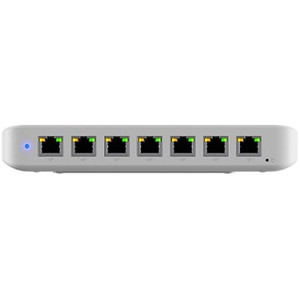
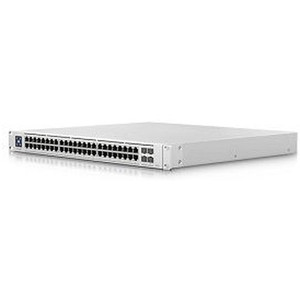
Ubiquiti USW-16-POE 16-Port Gigabit PoE+ Switch
The Ubiquiti USW-16-POE is a compact 1U rack-mount switch designed for small-to-mid-scale deployments requiring distributed Power over Ethernet (PoE) delivery across access points, IP cameras, and wireless clients. With 16 Gigabit RJ45 ports plus 2 SFP uplinks, the USW-16-POE combines wired access density with sufficient backhaul capacity for multi-floor offices, remote sites, and campus edge installations. The 36 Gbps switching fabric delivers 18 Gbps non-blocking throughput—meaning all ports can transmit simultaneously at full Gigabit speed without performance degradation—critical when multiple PoE devices operate concurrently. A 42W PoE power budget supports 8–10 standard access points or a mixed load of cameras and wireless endpoints, eliminating the need for external injectors on smaller networks.
Key Features
- 16 Gigabit PoE+ Ports: Each port delivers up to 30W via 802.3at PoE+, enabling power-hungry devices like multi-sensor cameras and enterprise access points without dedicated power supplies. Reduces cable runs and wall outlet clutter on distributed deployments.
- 2 SFP Uplinks: Connect fiber backbone switches or copper modules for long-distance aggregation. Fiber uplinks span hundreds of meters without signal loss—essential for multi-building campuses or warehouse floor consolidation where copper runs become impractical.
- 18 Gbps Non-Blocking Throughput: Guarantees that forwarding performance doesn't degrade when all 16 ports are active. This matters on camera networks where simultaneous streams from multiple HD or 4K devices demand consistent latency—no queuing or buffer stalls.
- 1,000 VLAN Support: Segment guest traffic, security cameras, and operational networks without external routing appliances. Isolates video streams from guest Wi-Fi and IoT sensor chatter, reducing broadcast noise and improving security posture.
- 18W Idle Power Consumption: Modest draw excluding PoE output enables year-round operation in remote cabinets or unattended sites without significant HVAC burden. Over 12 months, this efficiency compounds on distributed multi-site deployments.
- Universal AC Input (100–240V, 50/60 Hz): 60W internal power supply adapts to regional standards without external converters. Deploy globally or move units between facilities without modification.
- Compact 1U Form Factor (442 × 200 × 44 mm, 2.8 kg): Fits standard 19-inch racks alongside other infrastructure. Supplied SGCC steel brackets provide durability in climate-controlled and outdoor equipment shelters alike.
- Operating Range −5 to 40°C: Handles unheated storage rooms and outdoor cabinet environments without thermal shutdown. Exceeds typical office-only switches, making it viable for edge deployments in temperature-variable locations.
- UniFi Controller Integration: Zero-touch provisioning—connect to power and the management network; Controller automatically discovers and configures the USW-16-POE. No console cable, serial terminal, or CLI learning curve required.
- NDAA Compliance & Certifications: FCC, CE, IC, and Anatel approval plus Section 889 compliance enables procurement for federal, defense, and regulated-sector customers without secondary compliance review.
Integration and Deployment
The USW-16-POE integrates seamlessly with Ubiquiti access points and IP cameras as part of a UniFi-managed ecosystem. UniFi Controller running on a Dream Machine, CloudKey, or Linux/Windows host automatically discovers the switch upon first connection. Its non-blocking architecture means real-time PoE devices—4K security cameras, dual-radio APs, building automation sensors—operate without latency penalties when multiple endpoints transmit simultaneously.
Typical deployments include small office access networks where a single switch consolidates all PoE endpoints; remote site aggregation where the USW-16-POE sits at the edge and connects via fiber to a core switch; and campus camera systems where distributed camera clusters feed through edge switches before reaching a central NVR or video management appliance. The SFP uplinks reduce fiber termination counts—a single uplink pair can carry 18 Gbps of aggregated traffic back to a backbone.
VLAN support enables isolation of guest, security, and operational traffic without external routing. This is particularly valuable in multi-tenant warehouses or education facilities where wireless and wired networks must remain logically separated despite sharing physical infrastructure.
Installation and Cabling Guidance
Mount the unit in a standard 19-inch rack using supplied brackets; connect power before network cables to allow the internal supply to self-detect input voltage. For Ethernet runs exceeding 50 meters, use Cat6A or better to maintain full Gigabit speed over distance. Reserve the SFP ports for fiber uplinks or short-range copper modules once all 16 RJ45 ports are populated. Refer to your network switch planning guide for rack power budgeting and cable management in dense deployments.
Frequently Asked Questions
Q: Can the USW-16-POE power a mix of 8 access points and 4 cameras simultaneously?
A: Likely yes, depending on power draw per device. A typical 802.11ac AP draws 15–20W; most 4MP cameras draw 8–12W. Eight APs at 18W each (144W) plus four cameras at 10W (40W) would exceed the 42W PoE budget. Check datasheets for your specific endpoints and prioritize or add a second switch if the total exceeds 42W.
Q: Does the USW-16-POE require a UniFi Controller to operate?
A: No. The switch functions as a standard Ethernet switch without Controller. However, you lose VLAN automation, firmware updates, and centralized management. For unmanaged deployments, it will pass traffic but operates in a basic bridging mode.
Q: Is the USW-16-POE NDAA Section 889 compliant?
A: Yes. Ubiquiti confirms NDAA compliance on the USW-16-POE, clearing it for federal and defense procurement without additional vetting.
Q: Can I use the SFP ports with short-range copper modules instead of fiber?
A: Yes. The SFP ports accept both fiber modules and copper SFP+ transceivers. Copper modules are cheaper but shorter-range (typically under 30 meters); reserve them for in-rack connections and use fiber for distance.
Q: What is the maximum cable run length on RJ45 ports?
A: Standard Ethernet spec is 100 meters (328 feet) per segment. Beyond 50 meters, use Cat6A to reliably maintain full 1 Gbps throughput. For longer runs, use the SFP uplinks with fiber.
Q: What happens if I exceed the 42W PoE budget?
A: The switch will not deliver power to additional ports once the budget is exhausted. Priority is typically given to the first ports to draw power; newer requests may be denied. Calculate your load before deployment or add a second PoE switch for larger installations.
Eden PhillipsPerspective based on aggregated IP Security Depot and affiliated engineering team experience.
The Ubiquiti USW-16-POE is a pragmatic choice for networks where PoE endpoints cluster at a single access point. At 36 Gbps switching capacity and 18 Gbps non-blocking throughput, it guarantees that simultaneous traffic from 16 powered devices won't bottleneck—a real concern when cameras and APs operate at wire speed. The 42W PoE budget is the binding constraint; if you're deploying more than 10 access points or a dense camera array, this switch hits its ceiling quickly.
Technical Highlights:
- 18 Gbps Non-Blocking Throughput: All ports forward at full speed concurrently—no per-port speed degradation as load increases. Critical for 4K camera clusters or high-density AP deployments where backhaul saturation would otherwise create latency spikes.
- 42W PoE Budget Across 16 Ports: Supports roughly 8–10 standard enterprise APs (18–20W each) or a mixed 6-AP + 4-camera load. Calculate your actual endpoint power draw before committing; a single miscalculation leaves cameras unpowered at 3 AM.
- 2 SFP Uplinks: Fiber connectivity eliminates cable-length constraints on backbone aggregation. For campus deployments spanning multiple buildings, fiber reduces termination overhead and eliminates 100-meter RJ45 run limits.
- NDAA Compliance: Federal procurement-eligible without secondary compliance review—valuable if your customer base includes government or defense-adjacent facilities.
Deployment Considerations:
- Right-size the PoE budget upfront. A 42W limit sounds generous until you list actual endpoints and their peak draws; this switch fills fast in warehouse or campus scenarios.
- UniFi Controller integration is optional but strongly recommended. Without it, you're managing VLANs and firmware manually—doable, but cumbersome at scale.
- Idle power draw of 18W (excluding PoE output) is efficient, but on a 24/7 unattended site, verify that your UPS and cabinet cooling can accommodate it plus PoE load.
The USW-16-POE works best as a distributed edge switch in multi-site deployments where each location has 6–12 PoE endpoints and fiber (or long-haul Ethernet) connects back to a core. For single-building installations with fewer than 12 APs, it's solid. For warehouse automation with 50+ sensors or a campus with 20+ APs, step up to the USW-24-POE or use multiple USW-16-POE units behind a non-PoE aggregation switch.