
TP-Link SL1218MP vs Allied Telesis AT-x530L-18GHXm-10: Specification Comparison
Both the TP-Link TL-SL1218MP and Allied Telesis AT-x530L-18GHXm-10 occupy the 16-port PoE switch category in a 1U rack-mount form factor, making them a legitimate cross-shop for security integrators and IT buyers sizing a PoE infrastructure deployment. The comparison spans three tiers of the market: the TL-SL1218MP is an unmanaged Fast Ethernet PoE+ switch targeting budget-conscious or plug-and-play installations, while the AT-x530L-18GHXm-10 is a managed multi-gigabit PoE++ platform targeting enterprise and high-density PoE device environments.
In This Guide
- How do port speed, switching capacity, and PoE power budget compare between the two switches?
- What are the power consumption, physical footprint, and environmental operating requirements of each unit?
- How do management capability, stacking, and deployment flexibility differ between these switches?
- Which should you choose: the SL1218MP or the AT-x530L-18GHXm-10?
- Side-by-Side Specs
- FAQ
How do port speed, switching capacity, and PoE power budget compare between the two switches?
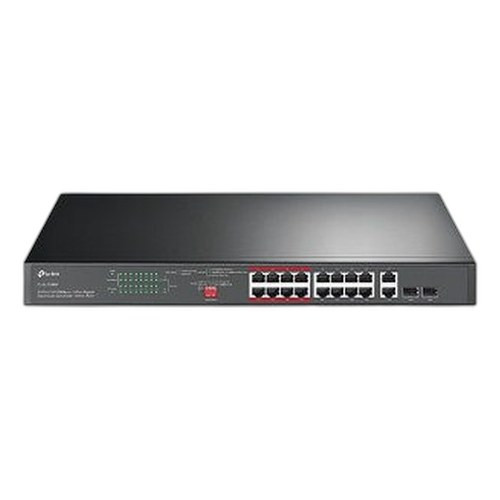
The TL-SL1218MP provides 16 access ports at 10/100 Mbps with 2 Gigabit combo uplinks (RJ-45/SFP). Its switching capacity is 7.2 Gbps. PoE budget is 192 W total across all 16 ports, with a per-port maximum of 30 W (802.3at/PoE+). An Extend Mode feature stretches reach to 250 m on ports operating at 10 Mbps.
The AT-x530L-18GHXm-10 provides 16 multi-gigabit access ports rated at 100 M/1/2.5/5 Gbps with 2 × 10 Gbps SFP+ uplinks and 2 stacking ports. Switching fabric is 200 Gbps with a forwarding rate of 148.8 Mpps. PoE budget is 720 W total. Per-port PoE delivery is tiered: all 16 ports support up to 30 W (802.3at); 12 ports support 60 W (802.3bt Tier 3); 8 ports support 90 W (802.3bt Tier 4). The gap in switching fabric alone is 200 Gbps vs. 7.2 Gbps—a 27× difference.
What are the power consumption, physical footprint, and environmental operating requirements of each unit?
The TL-SL1218MP is rated for 100–240 V AC, 50/60 Hz input. Chassis dimensions are 440 × 180 × 44 mm (17.3 × 7.1 × 1.7 in). It operates with 2 internal fans. Operating temperature range is 0 °C to 40 °C (32 °F to 104 °F); storage temperature is −40 °C to 70 °C. Maximum power consumption is not explicitly stated in the provided specs beyond the 192 W PoE budget. Acoustic noise level is not specified.
The AT-x530L-18GHXm-10 chassis measures 441 × 256 × 44 mm (17.36 × 10.07 × 1.73 in)—notably deeper at 256 mm vs. 180 mm. Unpackaged weight is 4.3 kg (9.48 lbs). Maximum total power consumption is rated at 970 W, with maximum heat dissipation of 3,317 BTU/h. Acoustic noise is specified at 42 dBA. Input voltage and operating temperature range are not provided in the supplied specs. The depth difference (76 mm) is relevant for shallow-depth rack cabinets common in physical-security closets.
How do management capability, stacking, and deployment flexibility differ between these switches?
The TL-SL1218MP is explicitly unmanaged—no CLI, no SNMP, no VLAN configuration, no QoS policy engine. It offers two operating modes selectable at the hardware level: Priority Mode (ports 1–8 receive priority) and Extend Mode (250 m reach at reduced speed). There is no stacking capability. This makes it a plug-and-play device unsuitable for segmented networks, 802.1Q VLANs, or centralized NMS integration.
The AT-x530L-18GHXm-10 includes 2 stacking ports (noted with an asterisk in the provided specs, suggesting optional or module-dependent capability—confirm with Allied Telesis documentation). The presence of stacking ports implies managed-switch architecture supporting unified management of multiple units. Forwarding rate of 148.8 Mpps and a 200 Gbps fabric are consistent with a fully managed L2/L3 platform, though specific management protocols (CLI, SNMP version, web GUI, AlliedWare Plus OS) are not enumerated in the provided specifications. Buyers requiring VLAN segmentation for camera/access-control isolation or integration with a network management system should verify managed-feature depth with Allied Telesis documentation.
Which should you choose: the SL1218MP or the AT-x530L-18GHXm-10?
Our take: The AT-x530L-18GHXm-10 is the stronger choice when the deployment demands high PoE power density, multi-gigabit device connectivity, or managed network segmentation. Three concrete spec deltas define the gap: (1) PoE budget is 720 W vs. 192 W—3.75× more headroom, enabling devices up to 90 W per port such as PTZ cameras with heaters or Wi-Fi 6E APs; (2) switching fabric is 200 Gbps vs. 7.2 Gbps, supporting wire-speed multi-gigabit throughput the TL-SL1218MP cannot approach; (3) multi-gigabit access ports (up to 5 Gbps per port) vs. 100 Mbps access ports on the TP-Link. The TL-SL1218MP is the appropriate choice for small, budget-constrained installations running standard IP cameras at 10/100 Mbps where plug-and-play simplicity, a shallower chassis (180 mm depth), and a 192 W PoE+ budget are sufficient—and where no VLAN or management capability is required.
Side-by-Side Comparison
Spec-for-spec, from manufacturer data.
| Specification | TP-Link SL1218MP | Allied Telesis AT-x530L-18GHXm-10 |
|---|---|---|
| Product Type | Unmanaged PoE+ Switch | Managed PoE++ Switch |
| Access Port Count | 16 | 16 |
| Access Port Speed | 10/100 Mbps | 100M / 1 / 2.5 / 5 Gbps |
| Uplink Ports | 2× Gigabit combo (RJ-45/SFP) | 2× 10G SFP+ |
| Stacking Ports | — | 2 (see datasheet for module req.) |
| PoE Standard | 802.3af / 802.3at (PoE+) | 802.3af / 802.3at / 802.3bt (PoE++) |
| PoE Budget (Total) | 192 W | 720 W |
| Max PoE Per Port | 30 W | 90 W (8 ports) / 60 W (12 ports) / 30 W (16 ports) |
| Switching Fabric | 7.2 Gbps | 200 Gbps |
| Forwarding Rate | — | 148.8 Mpps |
| Management | Unmanaged | Managed (feature detail not specified in supplied specs) |
| Max Power Consumption | Not specified in supplied specs | 970 W |
| Heat Dissipation | Not specified in supplied specs | 3,317 BTU/h |
| Acoustic Noise | Not specified in supplied specs | 42 dBA |
| Chassis Dimensions (W×D×H) | 440 × 180 × 44 mm | 441 × 256 × 44 mm |
| Operating Temperature | 0 °C to 40 °C | Not specified in supplied specs |
Frequently Asked Questions
Which should you choose: the SL1218MP or the AT-x530L-18GHXm-10?
The AT-x530L-18GHXm-10 is the stronger choice when the deployment demands high PoE power density, multi-gigabit device connectivity, or managed network segmentation. Three concrete spec deltas define the gap: (1) PoE budget is 720 W vs. 192 W—3.75× more headroom, enabling devices up to 90 W per port such as PTZ cameras with heaters or Wi-Fi 6E APs; (2) switching fabric is 200 Gbps vs. 7.2 Gbps, supporting wire-speed multi-gigabit throughput the TL-SL1218MP cannot approach; (3) multi-gigabit access ports (up to 5 Gbps per port) vs. 100 Mbps access ports on the TP-Link. The TL-SL1218MP is the appropriate choice for small, budget-constrained installations running standard IP cameras at 10/100 Mbps where plug-and-play simplicity, a shallower chassis (180 mm depth), and a 192 W PoE+ budget are sufficient—and where no VLAN or management capability is required.
Is the TL-SL1218MP or AT-x530L-18GHXm-10 better suited for powering high-wattage PTZ cameras or multi-radio access points?
The AT-x530L-18GHXm-10 is the clear choice for high-wattage devices. It supports up to 90 W per port on 8 ports and up to 60 W on 12 ports (802.3bt PoE++), with a 720 W total budget. The TL-SL1218MP is limited to 30 W per port (802.3at PoE+) and a 192 W total budget, which is insufficient for most PoE++ devices.
Can either switch support VLAN segmentation to isolate camera traffic from general IT traffic?
The TL-SL1218MP is an unmanaged switch with no VLAN capability—all ports share a single broadcast domain. The AT-x530L-18GHXm-10's managed architecture and 200 Gbps fabric are consistent with VLAN support, but specific VLAN feature details (802.1Q, private VLAN, etc.) are not enumerated in the provided specifications; verify with Allied Telesis product documentation before specifying.
Which switch fits better in a shallow-depth security equipment rack or IDF closet?
The TL-SL1218MP is shallower at 180 mm depth vs. 256 mm for the AT-x530L-18GHXm-10—a 76 mm difference. Both are 1U in height (44 mm). For wall-mount or shallow 2-post racks common in physical-security closets, the TL-SL1218MP is more likely to fit without modification. Confirm rack depth clearance before deploying the AT-x530L-18GHXm-10.
More Network Switch Comparisons
- Vivotek GEL-205A-260 vs TP-Link SL1218MP
- Vivotek GEL-205A-260 vs Allied Telesis AT-x530L-18GHXm-10
- Vivotek GEL-205A-260 vs Ubiquiti USW-LITE-16-POE
- Vivotek GEL-205A-260 vs Ubiquiti USW-16-POE
- TP-Link SL1218MP vs Ubiquiti USW-LITE-16-POE
- TP-Link SL1218MP vs Ubiquiti USW-16-POE
Network Switch Buying Guides
Get a Second Opinion on Your Camera Choice
Share your site layout, coverage goals, and budget. Our team will validate the camera selection, flag anything we would change, and recommend products that match the use case.