
Vivotek GEL-205A-260 vs Ubiquiti USW-LITE-16-POE: Specification Comparison
Both the Vivotek AW-GEL-205A-260 and the Ubiquiti USW-LITE-16-POE are 16-port Gigabit PoE managed switches aimed at installers who need to power IP cameras, access-control readers, and similar edge devices over structured cabling. The Vivotek is a rack-mount unit targeting higher-power PoE loads and extended cable runs, while the Ubiquiti is a compact desktop/wall-mount unit designed for low-power, space-constrained deployments. Both are genuine Layer-2 managed switches a buyer would reasonably cross-shop before committing to a network closet or equipment rack.

In This Guide
- Which switch delivers more PoE power, and how is that power distributed across ports?
- How do the two switches compare on switching fabric, throughput, and Layer-2 feature depth?
- Which unit is better suited to the physical installation environment: rack space, mounting options, temperature range, and certifications?
- Which should you choose: the GEL-205A-260 or the USW-LITE-16-POE?
- Side-by-Side Specs
- FAQ
Which switch delivers more PoE power, and how is that power distributed across ports?
The AW-GEL-205A-260 provides a 260W PoE budget across all 16 PoE ports, with a tiered architecture: ports 1–4 deliver up to 90W each (IEEE 802.3bt), supporting high-draw devices such as pan-tilt-zoom cameras, multi-sensor units, or PoE-powered access points, while ports 5–16 deliver up to 30W each (IEEE 802.3at). The switch's internal power supply is rated at 280W maximum draw, underwriting that full 260W budget. Each PoE port also carries 4KV surge protection, and the switch supports an Extend PoE Mode that stretches PoE delivery to 250 metres over standard cabling—a meaningful field advantage for perimeter cameras on long cable runs.
The USW-LITE-16-POE offers a 45W total PoE budget shared across all 16 ports, each capped at 30W (IEEE 802.3at, no 802.3bt). Its internal 60W supply powers both the switch fabric (15W without PoE) and the PoE output. At 45W total, simultaneous full-power operation of more than one or two 30W devices is not feasible without careful load planning. No per-port surge protection rating is listed in the provided specifications, and no extended-reach mode is documented.
How do the two switches compare on switching fabric, throughput, and Layer-2 feature depth?
The AW-GEL-205A-260 presents a 40 Gbps switching bandwidth across its 20 total ports (16 PoE RJ45 + 2 uplink RJ45 + 2 SFP). Buffer memory is 4.1 Mb, MAC table capacity is 8K addresses, and jumbo frame support reaches 9,216 bytes. Layer-2 feature depth is extensive: 802.1Q tag-based VLANs across 4,096 IDs, port-based VLAN, IEEE 802.1d STP, IEEE 802.1w RSTP, Link Aggregation Control Protocol (LACP), CoS port-based/802.1p/DSCP, loop protection, storm control, flow control, port-based mirroring, port isolation, bandwidth control, static MAC binding, PoE On/Off control, PoE auto-checking, and Non-Stop PoE. The two SFP uplinks add fibre or long-distance uplink flexibility. Forwarding rate is not stated in the provided specifications.
The USW-LITE-16-POE specifies a 32 Gbps non-blocking switching capacity and a forwarding rate of 24 Mpps. All 16 ports are PoE-capable; there are no dedicated SFP uplink ports listed in the provided specifications. VLAN support is noted at 1,000 IDs. Beyond VLAN and the management plane, no additional Layer-2 feature list (STP/RSTP variants, LACP, QoS queuing, mirroring, storm control, loop protection) is enumerated in the provided specifications. Management is described only as 'Ethernet'; the extent of the software feature set is not derivable from the data provided.
Which unit is better suited to the physical installation environment: rack space, mounting options, temperature range, and certifications?
The AW-GEL-205A-260 ships in a 1U rack-mount chassis measuring 440 × 210 × 44 mm and weighs 2.67 kg. A rack-mount kit is included. Operating temperature range is 0°C to 50°C; storage range is −20°C to 70°C; operating humidity is 10–90% RH. The chassis colour is white. Certifications listed are CE, FCC, LVD, and VCCI. Warranty is explicitly stated as 24 months. NDAA compliance status is not stated in the provided specifications.
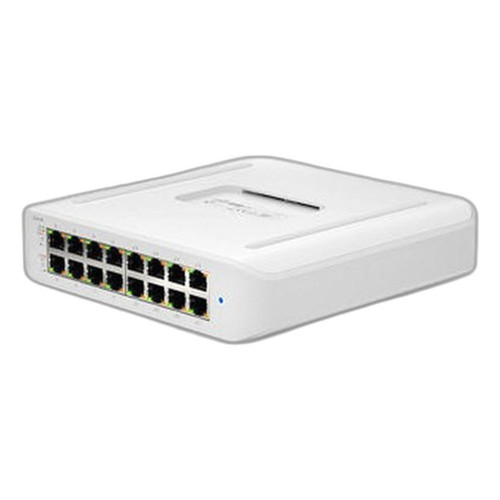
The USW-LITE-16-POE occupies a compact polycarbonate desktop/wall-mount enclosure measuring 192 × 185 × 44 mm and weighs 1.2 kg—approximately half the footprint and less than half the weight of the Vivotek unit. No rack-mount kit is referenced in the provided specifications. Operating temperature range is −15°C to 40°C, which extends 15°C lower than the Vivotek at the cold end but is 10°C narrower at the upper end. The USW-LITE-16-POE is explicitly NDAA compliant, carrying certifications of CE, FCC, IC, and Anatel. Warranty duration is listed only as 'Manufacturer Warranty' with no specific term stated in the provided specifications.
Which should you choose: the GEL-205A-260 or the USW-LITE-16-POE?
Our take: The AW-GEL-205A-260 is the stronger choice when the installation requires high-power PoE loads, long cable runs, or a deep Layer-2 managed feature set in a racked enclosure. Spec delta one: the Vivotek delivers 260W of PoE budget versus 45W on the Ubiquiti—a 5.8× advantage that matters immediately when powering 802.3bt PTZ cameras or multi-radio APs. Spec delta two: the Vivotek's switching bandwidth is 40 Gbps versus 32 Gbps, and it adds two SFP uplink ports absent from the Ubiquiti's listed specifications. Spec delta three: the Vivotek documents a 24-month warranty and 4KV per-port surge protection; neither figure appears in the Ubiquiti's provided specifications. The USW-LITE-16-POE is the appropriate pick for compact, cost-sensitive deployments with a light PoE load (under 45W total), wall- or desktop-mount requirements, hard NDAA compliance mandates, and operation in sub-zero environments down to −15°C. Integrators standardised on Ubiquiti's UniFi management platform should note that platform compatibility is not derivable from the provided Ubiquiti specifications alone.
Side-by-Side Comparison
Spec-for-spec, from manufacturer data.
| Specification | Vivotek GEL-205A-260 | Ubiquiti USW-LITE-16-POE |
|---|---|---|
| Total Ports | 20 (16 PoE + 2 RJ45 + 2 SFP) | 16 (all PoE) |
| PoE Port Count | 16 | 16 |
| PoE Standard | 802.3af / 802.3at / 802.3bt | 802.3at |
| PoE Budget (Total) | 260W | 45W |
| Max PoE Per Port | 90W (ports 1–4); 30W (ports 5–16) | 30W (all ports) |
| SFP Uplink Ports | 2 | — |
| Switching Bandwidth | 40 Gbps | 32 Gbps |
| Forwarding Rate | — | 24 Mpps |
| Buffer Memory | 4.1 Mb | — |
| MAC Table | 8K | — |
| VLAN IDs | 4,096 | 1,000 |
| STP / RSTP | 802.1d + 802.1w | — |
| Extended PoE Reach | 250 m | — |
| PoE Surge Protection | 4KV per port | — |
| Form Factor | 1U rack-mount (440×210×44 mm) | Desktop / wall-mount (192×185×44 mm) |
| Operating Temperature | 0°C to 50°C | −15°C to 40°C |
| Weight | 2.67 kg | 1.2 kg |
| NDAA Compliant | — | Yes |
| Warranty | 24 months | Manufacturer Warranty (term not specified) |
| Certifications | CE, FCC, LVD, VCCI | CE, FCC, IC, Anatel |
Frequently Asked Questions
Which should you choose: the GEL-205A-260 or the USW-LITE-16-POE?
The AW-GEL-205A-260 is the stronger choice when the installation requires high-power PoE loads, long cable runs, or a deep Layer-2 managed feature set in a racked enclosure. Spec delta one: the Vivotek delivers 260W of PoE budget versus 45W on the Ubiquiti—a 5.8× advantage that matters immediately when powering 802.3bt PTZ cameras or multi-radio APs. Spec delta two: the Vivotek's switching bandwidth is 40 Gbps versus 32 Gbps, and it adds two SFP uplink ports absent from the Ubiquiti's listed specifications. Spec delta three: the Vivotek documents a 24-month warranty and 4KV per-port surge protection; neither figure appears in the Ubiquiti's provided specifications. The USW-LITE-16-POE is the appropriate pick for compact, cost-sensitive deployments with a light PoE load (under 45W total), wall- or desktop-mount requirements, hard NDAA compliance mandates, and operation in sub-zero environments down to −15°C. Integrators standardised on Ubiquiti's UniFi management platform should note that platform compatibility is not derivable from the provided Ubiquiti specifications alone.
Is the AW-GEL-205A-260 or USW-LITE-16-POE better for powering multiple high-wattage PTZ cameras?
The AW-GEL-205A-260 is the clear choice. It provides 260W total PoE budget with four ports rated at 90W each (802.3bt), which can simultaneously power multiple high-draw PTZ cameras or multi-sensor units. The USW-LITE-16-POE's 45W total budget (802.3at only, 30W per port maximum) cannot sustain even two 30W devices simultaneously without exceeding its aggregate limit.
Which switch should I choose for a wall-mount installation in a small utility closet with no rack?
The USW-LITE-16-POE is better suited for that scenario. Its polycarbonate enclosure measures only 192 × 185 × 44 mm, weighs 1.2 kg, and is explicitly designed for desktop or wall-mount deployment. The AW-GEL-205A-260 is a 1U rack-mount unit (440 × 210 × 44 mm, 2.67 kg) that ships with a rack-mount kit; no wall-mount option is referenced in the provided specifications.
Which switch meets NDAA Section 889 compliance requirements for federal or government-adjacent projects?
The USW-LITE-16-POE is explicitly listed as NDAA compliant in its provided specifications. No NDAA compliance status is stated in the AW-GEL-205A-260's provided specifications, so that claim cannot be made for the Vivotek unit without verification from the manufacturer.
More Network Switch Comparisons
- Vivotek GEL-205A-260 vs TP-Link SL1218MP
- Vivotek GEL-205A-260 vs Allied Telesis AT-x530L-18GHXm-10
- Vivotek GEL-205A-260 vs Ubiquiti USW-16-POE
- TP-Link SL1218MP vs Allied Telesis AT-x530L-18GHXm-10
- TP-Link SL1218MP vs Ubiquiti USW-LITE-16-POE
- TP-Link SL1218MP vs Ubiquiti USW-16-POE
Network Switch Buying Guides
Get a Second Opinion on Your Camera Choice
Share your site layout, coverage goals, and budget. Our team will validate the camera selection, flag anything we would change, and recommend products that match the use case.