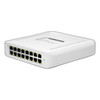
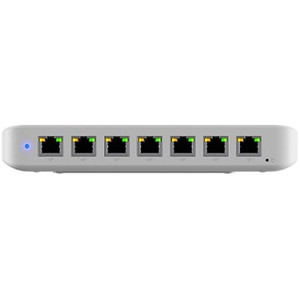
Ubiquiti USW-LITE-16-POE 16-Port Gigabit PoE+ Switch
Overview
The Ubiquiti USW-LITE-16-POE is a compact managed Layer 2 switch purpose-built for distributed access-layer deployments where rack space is scarce or unavailable. All 16 ports run at 1 Gbps full duplex with 32 Gbps aggregate switching capacity—enough to feed a small cluster of PoE devices without the footprint penalty of larger managed switches. The USW-LITE-16-POE (MPN USW-LITE-16-POE, often searched as USW LITE 16 POE) measures just 192 × 185 × 44 mm and weighs 1.2 kg, making it practical for wall-mounted cabinet installations, network closets, or shelf placement in branch offices. The integrated 60W AC power supply (100–240V, 50/60 Hz) and 45W PoE+ budget allow you to power up to 16 802.3at PoE+ devices simultaneously—no separate PoE injectors needed. The non-blocking architecture guarantees full duplex throughput between any two ports under heavy load, eliminating throughput bottlenecks common in lower-tier unmanaged switches.
Key Features
- PoE+ Power Delivery (45W budget): Supplies up to 802.3at power on all 16 ports, eliminating the need for separate power infrastructure at each endpoint. Real benefit: one cable per device (Ethernet carries both data and 30W per port) simplifies installation in retail, warehouse automation, and remote office environments where running power runs parallel to data cables is costly or infeasible.
- Non-blocking 32 Gbps switching fabric: Wire-speed throughput ensures no congestion between ports even during sustained multi-gigabit transfers. Matters if you're aggregating traffic from multiple IP cameras, access points, or VoIP clusters feeding upstream—no hidden packet loss during peak traffic windows.
- 1,000 VLAN support: Enables micro-segmentation across multi-tenant deployments or security-zoned networks (e.g., separating guest Wi-Fi, IP camera traffic, and corporate data on the same physical switch without broadcast bleed). Essential for compliance-heavy environments (healthcare, finance) where traffic isolation is mandatory.
- Managed Layer 2 switching: Integrates directly into Ubiquiti UniFi controller for centralized VLAN configuration, QoS policies, and port monitoring. No CLI required—push policies from the controller dashboard across all connected switches simultaneously, reducing per-device configuration overhead in multi-site rollouts.
- 15W low idle power draw (excluding PoE output): Minimal operational cost in always-on deployments; a $0.15/kWh site paying for 24/7 runtime incurs roughly $20 per year in switch overhead alone—negligible for branch sites but visible across dozens of locations.
- NDAA compliance and CE/FCC/IC/Anatel certifications: Meets U.S. federal procurement rules (government/defense contractors) and international regulatory gates. Mandatory if your customer base includes federal agencies, armed services integrators, or international installations.
- Polycarbonate enclosure, -15°C to +40°C operating range: Durable in light industrial and sheltered outdoor settings (e.g., covered loading docks, parking structure entry points). Not rated for direct rain or extreme cold, but covers typical office-to-light-warehouse environments where an unheated closet or ventilated cabinet is sufficient.
Integration & Compatibility
The USW-LITE-16-POE appears in the UniFi controller dashboard immediately upon Ethernet connection to an active UniFi network. All ports are discoverable; no management IP assignment or CLI login is required for basic discovery. VLAN, traffic shaping, and port-level monitoring are pushed from the controller, making it ideal for organizations already running UniFi network infrastructure. If you're integrating IP cameras or wireless access points into a distributed UniFi ecosystem, this switch consolidates both data and power delivery in a single compact unit.
Ethernet management (no proprietary console or serial port) simplifies cabling discipline and reduces per-switch complexity. The 16 × 1G port layout is straightforward—no SFP uplinks, no hierarchical port tiers, meaning your integration team won't need to design around port limitations.
Deployment Scenarios
Branch office or remote site: Replace bulky managed switches with a wall-mounted USW-LITE-16-POE feeding PoE-powered access points, IP phones, and cameras. Reduced footprint, lower power, easier UPS integration.
Multi-floor access point distribution: A single switch per floor or building zone powers clusters of wireless controllers and access points, each connected to an upstream core switch via a single trunk. The 45W budget supports 1–2 high-power access points per switch, with headroom for future PoE camera additions.
Warehouse or retail edge distribution: Deploy at the edge of a warehouse or retail location where IP cameras, card readers, and mobile device charging docks all converge. PoE consolidation reduces sprawl of separate 12V DC power supplies and outlet requirements.
Micro-segmented security zones: Use VLAN capabilities to isolate guest networks, PCI-compliant payment terminals, and internal corporate traffic on the same physical switch without broadcast interference.
When to Consider Alternatives
If your deployment requires 10 Gbps uplink ports, redundant power supplies, or a larger PoE budget (over 45W), look to higher-capacity models in the UniFi Switch family. If you need a completely passive (unmanaged) PoE distribution point without VLAN or QoS control, an unmanaged PoE+ injector may reduce cost. If operating temperature extremes (below -15°C or above 40°C) are necessary, outdoor-rated variants should be evaluated separately.
FAQ
Q: Does the USW-LITE-16-POE require a UniFi controller to operate?
A: No. Basic Layer 2 switching works out of the box without a controller. However, VLAN configuration, traffic shaping, and centralized monitoring require an active UniFi controller (cloud or on-premises).
Q: Can I mix the USW-LITE-16-POE with non-Ubiquiti network equipment?
A: Yes. It is a standards-compliant gigabit switch. It will bridge traffic to any 802.3 Ethernet device. Controller integration and advanced features are UniFi-specific, but basic switching is vendor-neutral.
Q: What is the maximum PoE power per port?
A: 802.3at (PoE+) supplies up to 30W per port. Total switch PoE budget is 45W, so you may not simultaneously max out all 16 ports. Typical deployments power 1–2 high-draw devices (access points, IP cameras) and fill the remainder with lower-power endpoints (phones, card readers).
Q: Is the USW-LITE-16-POE NDAA Section 889 compliant?
A: Yes. Ubiquiti explicitly states NDAA compliance for this model, required for U.S. federal and defense sector procurement.
Q: Does this switch support link aggregation (LAG)?
A: Verify with the latest UniFi controller release notes. Management features are controller-driven; if LAG is required, confirm support in your target controller version before procurement.
Q: What is included in the box?
A: The USW-LITE-16-POE ships with wall-mount hardware and an AC power cord. RJ-45 cables are not included; plan cabling separately.
Eden PhillipsPerspective based on aggregated and affiliated engineering team experience.
The USW-LITE-16-POE fills a genuine gap in distributed network infrastructure. Its 45W PoE+ budget and non-blocking 32 Gbps fabric make it a practical choice for organizations rolling out edge switches in multi-site or multi-floor deployments where space and power efficiency are hard requirements. The compact form factor and Ethernet-only management keep installation friction low—no serial console hunting, no proprietary power connectors. NDAA compliance is a real asset if your customer base includes federal integrators or government contracts.
Technical Highlights:
- 45W PoE+ budget across all 16 ports: Enough to power two simultaneous high-draw access points (20W each) plus four or five IP cameras or card readers on the remainder. Many branch deployments fit entirely within that envelope, eliminating the cost and complexity of separate PoE+ injectors or larger modular switches.
- Non-blocking 32 Gbps switching with 1G per-port throughput: Zero packet loss during full duplex saturation across all 16 ports—critical if you're consolidating real-time traffic (VoIP, wireless controller sync, IP camera streams) on a single access layer switch. Cheaper alternatives often oversubscribe and drop packets during traffic spikes.
- 1,000 VLAN capacity: Enables true micro-segmentation without trunking complexity. Guest Wi-Fi, IP cameras, and corporate traffic each get their own broadcast domain on one physical switch—no need for parallel switches or managed VLANs split across devices.
- 15W idle power (switch only): Runs on a single UPS circuit breaker indefinitely; total operational cost is genuinely negligible across multi-site deployments compared to heavier managed switches drawing 40–60W.
Deployment Considerations:
- PoE budget is shared: All 16 ports draw from the same 45W total. Two 802.3at devices (30W each) will exceed the budget; you'll need to prioritize or add a PoE injector for additional high-power devices. Size your deployment upfront or plan for controlled rollout.
- No uplink redundancy: A single upstream connection means a cable failure isolates the entire switch. If your site requires fault tolerance, deploy two USW-LITE-16-POE units with dual uplinks and configure link aggregation (if your controller version supports it) or use spanning tree. Otherwise, accept the single point of failure for branch sites or cover it with a low-cost spare.
- Temperature range is office-friendly: Operating range -15°C to +40°C covers most climates but not heated/cooled enclosures in extreme climates or unprotected outdoor cabinets. Verify your site environment before mounting.
This switch is well-suited for a warehouse automation or retail deployment where you're consolidating access point, camera, and reader power feeds at a central edge location. If you're integrating Ubiquiti APs or cameras, the UniFi controller visibility is a bonus—not mandatory, but it removes friction from multi-device provisioning and troubleshooting across dozens of locations.