
TP-Link SL1218MP vs Ubiquiti USW-LITE-16-POE: Specification Comparison
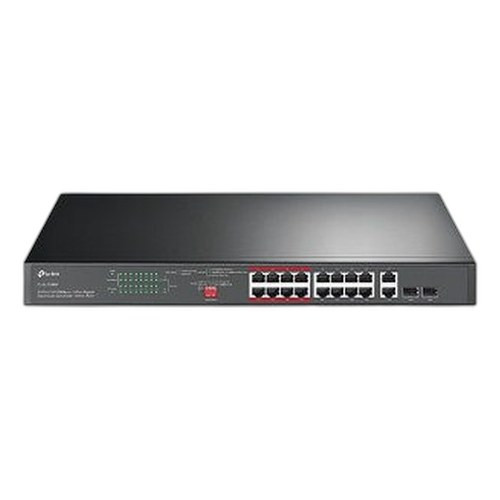
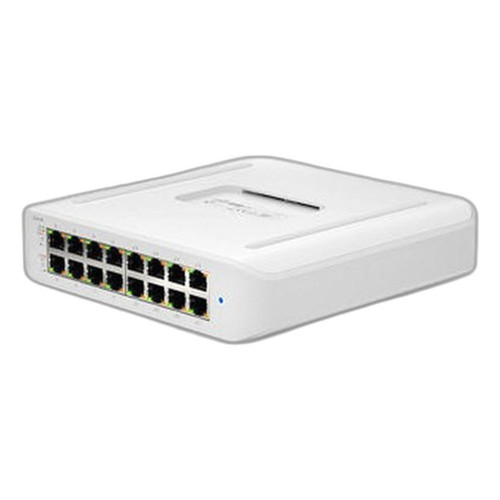
Both the TP-Link TL-SL1218MP and the Ubiquiti USW-LITE-16-POE are 16-port PoE+ switches targeting small-to-medium security and networking deployments. The TP-Link is an unmanaged, rack-mount unit with Fast Ethernet access ports and gigabit uplinks, while the Ubiquiti is a fully managed, compact desktop/wall-mount switch with all-gigabit ports. Buyers cross-shopping these are typically weighing plug-and-play simplicity and higher PoE budget against managed features, gigabit-to-every-port performance, and form-factor flexibility.
In This Guide
- How do port speed, PoE budget, and switching throughput compare between the two switches?
- Which switch offers more network management and VLAN capability?
- How do form factor, operating environment, and certifications differ?
- Which should you choose: the SL1218MP or the USW-LITE-16-POE?
- Side-by-Side Specs
- FAQ
How do port speed, PoE budget, and switching throughput compare between the two switches?
The TL-SL1218MP provides 16 access ports rated at 10/100 Mbps plus 2 Gigabit combo SFP/RJ-45 uplinks, yielding a total switching capacity of 7.2 Gbps. Its PoE budget is 192 W across those 16 ports, with a per-port maximum of 30 W (802.3af/at). An Extend Mode pushes PoE reach to 250 m on the access ports, which is relevant for perimeter camera runs.
The USW-LITE-16-POE delivers 1 Gbps on all 16 ports with a 32 Gbps non-blocking switching fabric and a forwarding rate of 24 Mpps. However, its total PoE budget is only 45 W across those 16 ports, also capped at 30 W per port (802.3at). A buyer powering more than one or two high-draw PoE devices simultaneously will exhaust the Ubiquiti's PoE headroom quickly, while the TP-Link's 192 W budget can sustain 6–7 ports at full 30 W load concurrently.
The trade-off is straightforward on paper: the TP-Link offers 4.3× more PoE power but 4.4× less switching capacity, and its access ports are capped at 100 Mbps. Modern IP cameras rarely need more than 10–20 Mbps per stream, so the 100 Mbps ceiling is rarely a bottleneck for pure surveillance workloads; however, it becomes a limitation in mixed IT environments where endpoints need gigabit.
Which switch offers more network management and VLAN capability?
The TL-SL1218MP is explicitly unmanaged. There is no web interface, CLI, or SNMP access. Configuration is limited to physical switch modes: Priority Mode (prioritizes ports 1–8 for PoE) and Extend Mode (250 m reach on ports 1–8). There is no VLAN support, QoS configuration, or remote monitoring capability documented in the provided specifications.
The USW-LITE-16-POE is a managed switch supporting up to 1,000 VLANs. The provided specifications list management via Ethernet, consistent with UniFi Controller-based management (the platform dependency is implicit in the spec set; no standalone web-UI capability is confirmed or denied from the provided data alone). The 1,000-VLAN ceiling covers virtually any enterprise segmentation scenario.
For installers who need to isolate camera VLANs from corporate traffic, enforce QoS for video streams, or centrally monitor port status, the Ubiquiti is the only option of the two. The TP-Link's plug-and-play model suits flat networks where simplicity outweighs control.
How do form factor, operating environment, and certifications differ?
The TL-SL1218MP is a 1U rack-mount chassis measuring 440 × 180 × 44 mm (17.3 × 7.1 × 1.7 in.) with two internal cooling fans. Its operating temperature range is 0°C to 40°C (32°F to 104°F) and storage temperature spans −40°C to 70°C. No weight is specified in the provided data. Certifications are not listed in the provided specifications.
The USW-LITE-16-POE has a compact desktop/wall-mountable polycarbonate enclosure measuring 192 × 185 × 44 mm and weighing 1.2 kg (2.6 lb). Its operating temperature range is −15°C to 40°C (5°F to 104°F), giving it a 15°C cold-side advantage over the TP-Link. It carries CE, FCC, IC, Anatel, and NDAA compliance certifications. NDAA compliance is a hard procurement requirement for U.S. federal and many state/local government security projects.
The TP-Link's rack form factor suits IDF/MDF closets with standard 19-inch rails and where active fan cooling is acceptable. The Ubiquiti's fanless (no fan quantity is specified in its provided data, implying passive cooling) wall-mount compact body fits tight closets, retail back-rooms, or above-ceiling deployments where rack space and noise are constraints. The Ubiquiti's broader cold-temperature rating also makes it more suitable for unconditioned spaces.
Which should you choose: the SL1218MP or the USW-LITE-16-POE?
Our take: The TL-SL1218MP is the stronger choice when powering a large number of PoE devices is the primary constraint: its 192 W PoE budget is 4.3× the Ubiquiti's 45 W ceiling, meaning it can simultaneously power up to six 30 W devices versus the Ubiquiti's practical single-device limit at full draw. Conversely, the USW-LITE-16-POE is the stronger choice when network management, segmentation, or gigabit edge ports matter: it delivers 32 Gbps non-blocking switching versus 7.2 Gbps, supports 1,000 VLANs versus none, and provides all-gigabit access ports versus 100 Mbps on the TP-Link. The Ubiquiti also holds a −15°C cold-start rating and NDAA compliance, making it eligible for government and federal deployments where the TP-Link is not. Platform qualifier: the Ubiquiti requires UniFi ecosystem management infrastructure; the TP-Link requires no software at all.
Side-by-Side Comparison
Spec-for-spec, from manufacturer data.
| Specification | TP-Link SL1218MP | Ubiquiti USW-LITE-16-POE |
|---|---|---|
| Product Type | Unmanaged PoE+ Switch | Managed PoE+ Switch |
| Total Ports | 18 (16 × 10/100 + 2 × 1G uplink) | 16 (all 1 Gbps) |
| Access Port Speed | 10/100 Mbps | 1 Gbps |
| Uplink / SFP | 2× Gigabit combo (RJ-45 / SFP) | — |
| PoE Standard | 802.3af / 802.3at | 802.3at |
| Total PoE Budget | 192 W | 45 W |
| Per-Port PoE Max | 30 W | 30 W |
| Switching Capacity | 7.2 Gbps | 32 Gbps |
| Forwarding Rate | — | 24 Mpps |
| VLAN Support | None (unmanaged) | 1,000 VLANs |
| Management | None (plug-and-play) | Managed (Ethernet / UniFi) |
| Form Factor | 1U rack-mount | Compact desktop / wall-mount |
| Dimensions | 440 × 180 × 44 mm | 192 × 185 × 44 mm |
| Operating Temp | 0°C to 40°C | −15°C to 40°C |
| Cooling | 2 internal fans | Not specified in provided specs |
| NDAA Compliant | — | Yes |
| Certifications | — | CE, FCC, IC, Anatel |
| Power Supply | 100–240V AC, 50/60 Hz | 100–240V AC, 50/60 Hz (60W internal) |
| Weight | — | 1.2 kg (2.6 lb) |
Frequently Asked Questions
Which should you choose: the SL1218MP or the USW-LITE-16-POE?
The TL-SL1218MP is the stronger choice when powering a large number of PoE devices is the primary constraint: its 192 W PoE budget is 4.3× the Ubiquiti's 45 W ceiling, meaning it can simultaneously power up to six 30 W devices versus the Ubiquiti's practical single-device limit at full draw. Conversely, the USW-LITE-16-POE is the stronger choice when network management, segmentation, or gigabit edge ports matter: it delivers 32 Gbps non-blocking switching versus 7.2 Gbps, supports 1,000 VLANs versus none, and provides all-gigabit access ports versus 100 Mbps on the TP-Link. The Ubiquiti also holds a −15°C cold-start rating and NDAA compliance, making it eligible for government and federal deployments where the TP-Link is not. Platform qualifier: the Ubiquiti requires UniFi ecosystem management infrastructure; the TP-Link requires no software at all.
Can either switch power multiple high-wattage PoE cameras simultaneously?
The TL-SL1218MP's 192 W budget supports up to six ports simultaneously at the maximum 30 W per-port rate. The USW-LITE-16-POE's 45 W total budget limits concurrent full-draw ports to one, with remaining budget shared across all others. For deployments with multiple PTZ cameras, pan-tilt mounts, or high-power PoE access points, the TP-Link has a decisive power advantage based on the provided specifications.
Does the Ubiquiti USW-LITE-16-POE support VLANs for isolating camera traffic from the corporate network?
Yes. The USW-LITE-16-POE supports up to 1,000 VLANs per the provided specifications. The TL-SL1218MP is unmanaged and has no VLAN capability documented in its specifications. If network segmentation is a requirement—common in enterprise and government security installations—only the Ubiquiti meets that need of the two products compared here.
Is either switch approved for U.S. federal or government security projects under NDAA requirements?
The USW-LITE-16-POE is listed as NDAA Compliant in its provided specifications and also carries CE, FCC, IC, and Anatel certifications. No NDAA compliance status or equivalent certifications are listed in the provided specifications for the TL-SL1218MP. Buyers with federal, DoD, or NDAA-restricted procurement requirements should verify independently, but based solely on the provided specs, only the Ubiquiti carries an explicit NDAA compliance claim.
More Network Switch Comparisons
- Vivotek GEL-205A-260 vs TP-Link SL1218MP
- Vivotek GEL-205A-260 vs Allied Telesis AT-x530L-18GHXm-10
- Vivotek GEL-205A-260 vs Ubiquiti USW-LITE-16-POE
- Vivotek GEL-205A-260 vs Ubiquiti USW-16-POE
- TP-Link SL1218MP vs Allied Telesis AT-x530L-18GHXm-10
- TP-Link SL1218MP vs Ubiquiti USW-16-POE
Network Switch Buying Guides
Get a Second Opinion on Your Camera Choice
Share your site layout, coverage goals, and budget. Our team will validate the camera selection, flag anything we would change, and recommend products that match the use case.