
Ubiquiti USW-FLEX vs Altronix NETWAY5P: Specification Comparison
Both the Ubiquiti USW-FLEX and the Altronix NETWAY5P are 5-port Gigabit PoE switches aimed at distributed physical-security deployments — cameras, access control readers, and wireless APs. They share the same port count and the same underlying premise: deliver data and power over a single Ethernet run without a dedicated power supply at each endpoint. The critical differences lie in PoE generation and power budget, management depth, environmental ratings, and mounting flexibility, all of which directly affect where and how each switch fits into a real installation.
In This Guide
- Which switch delivers more PoE power, and does the standard matter for your devices?
- Where can each switch be physically installed, and how ruggged is it for outdoor or industrial sites?
- How do the two switches compare in management capability and switching throughput?
- Which should you choose: the USW-FLEX or the NETWAY5P?
- Side-by-Side Specs
- FAQ
Which switch delivers more PoE power, and does the standard matter for your devices?
The USW-FLEX is rated for 60W total PoE++ output across its 5 ports, operating on the 802.3bt standard. Its upstream power input is PoE+ (46W or 20W depending on source), and it outputs up to 60W downstream — enabling it to power high-draw single-port loads such as PTZ cameras or Wi-Fi 6 access points that exceed the 30W ceiling of 802.3at. Output voltage is specified at 54V, 1.11A per port.
The NETWAY5P is rated at a higher aggregate power budget of 120W and uses the PoE+ (802.3at) standard, which caps per-port delivery at 30W. All 5 ports deliver PoE+ power and data simultaneously. Power input is described as a single centralized PoE source; no per-port wattage cap is specified in the provided data.
In practice: if any single endpoint requires more than 30W (e.g., a high-draw PTZ or a 802.3bt-class AP), only the USW-FLEX can serve it. If the deployment runs entirely 802.3at-compatible devices and aggregate power matters more than per-port headroom, the NETWAY5P's 120W budget doubles what the USW-FLEX provides across the array.
Where can each switch be physically installed, and how ruggged is it for outdoor or industrial sites?
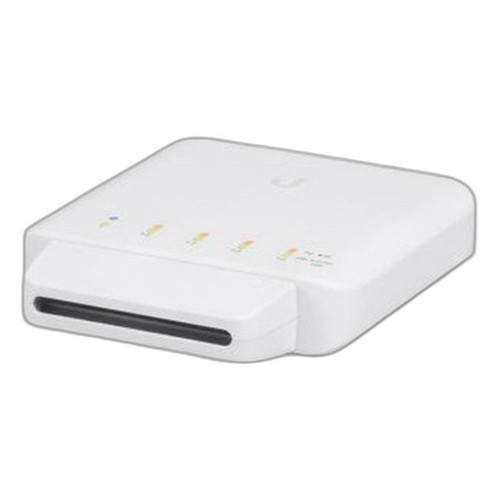
The USW-FLEX carries an operating temperature rating of -40°C to 55°C (at 46W PoE output) and a storage temperature range of -30°C to 70°C. ESD protection is specified at ±16kV air and ±16kV contact. Form factor is compact desktop/wall/pole at 122.5 × 107.1 × 28 mm, weighing 230 g. Certifications include CE, FCC, IC, and Anatel. The switch is NDAA compliant.
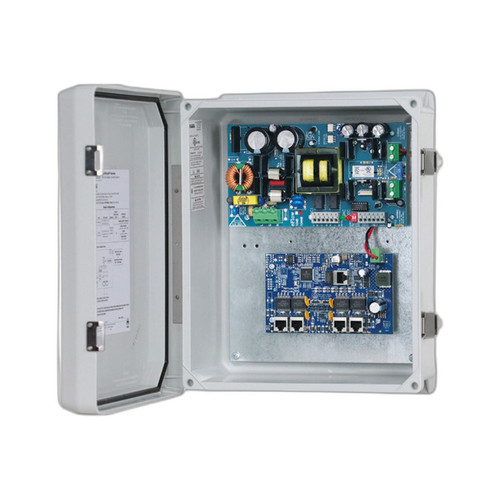
The NETWAY5P specifies DIN-rail and panel-mount compatibility, indicating it is designed for installation inside electrical enclosures — a common physical-security deployment pattern for access control panels. No outdoor operating temperature range, IP rating, or ESD protection value is provided in the available specifications. Mount type is listed as pole, though primary installation intent per the spec data appears enclosure-oriented.
For outdoor, unheated, or harsh-environment sites the USW-FLEX has documented cold-temperature and ESD ratings. For in-cabinet or control-panel installations the NETWAY5P's DIN-rail compatibility is a practical fit. Neither product lists an IP ingress-protection rating in the provided specs.
How do the two switches compare in management capability and switching throughput?
The USW-FLEX is a fully managed switch with 1,000 VLAN support, 10 Gbps switching capacity, 5 Gbps non-blocking throughput, and a forwarding rate of 7 Mpps. It is managed via the UniFi controller platform over Ethernet. Power consumption without PoE load is 5W.
The NETWAY5P is described as a managed Layer 2 switch with full-duplex Gigabit performance. Switching capacity, forwarding rate, and VLAN count are not specified in the available data. Management interface details beyond 'Managed Layer 2' are not provided in the supplied specifications.
The USW-FLEX provides concrete, verifiable throughput and VLAN figures. The NETWAY5P's Layer 2 managed claim cannot be quantitatively compared on switching capacity or VLAN scale given the specs provided. Buyers requiring documented throughput numbers or large VLAN segmentation will find more specificity in the USW-FLEX's datasheet.
Which should you choose: the USW-FLEX or the NETWAY5P?
Our take: The USW-FLEX is the stronger choice when endpoints require per-port power above 30W, the site demands documented cold-weather or outdoor operation, or the deployment is built on the UniFi management ecosystem. Spec deltas that drive this: the USW-FLEX supports 802.3bt PoE++ versus the NETWAY5P's 802.3at PoE+, delivering up to 60W downstream compared to a 30W-per-port ceiling; it carries a verified -40°C to 55°C operating range where the NETWAY5P lists no temperature rating; and it documents 10 Gbps switching capacity and 1,000 VLANs versus no equivalent figures for the NETWAY5P. Conversely, the NETWAY5P's 120W aggregate budget doubles the USW-FLEX's 60W total — a meaningful advantage in dense all-at-duty-power scenarios using 802.3at devices. Its DIN-rail mount targets panel-based access control installations. Specify the NETWAY5P for enclosure-mounted, all-802.3at security and access control panels; specify the USW-FLEX for outdoor or mixed high-draw UniFi deployments.
Side-by-Side Comparison
Spec-for-spec, from manufacturer data.
| Specification | Ubiquiti USW-FLEX | Altronix NETWAY5P |
|---|---|---|
| Port Count | 5 | 5 |
| Port Speed | 10/100/1000 Mbps (Gigabit) | 10/100/1000 Mbps (Gigabit) |
| PoE Standard | PoE++ (802.3bt) | PoE+ (802.3at) |
| Total PoE Output Budget | 60W | 120W |
| Switching Capacity | 10 Gbps | — |
| Throughput (non-blocking) | 5 Gbps | — |
| Forwarding Rate | 7 Mpps | — |
| VLAN Support | 1,000 VLANs | — |
| Management | Managed (UniFi / Ethernet) | Managed Layer 2 |
| Operating Temperature | -40°C to 55°C | — |
| ESD Protection | ±16kV Air, ±16kV Contact | — |
| Mount Type | Desktop / Wall / Pole | DIN-rail / Panel |
| Dimensions | 122.5 x 107.1 x 28 mm | — |
| Weight | 230 g (8.1 oz) | — |
| Power Consumption (no PoE) | 5W | — |
| NDAA Compliant | Yes | — |
| Warranty | Manufacturer Warranty | Lifetime |
Frequently Asked Questions
Which should you choose: the USW-FLEX or the NETWAY5P?
The USW-FLEX is the stronger choice when endpoints require per-port power above 30W, the site demands documented cold-weather or outdoor operation, or the deployment is built on the UniFi management ecosystem. Spec deltas that drive this: the USW-FLEX supports 802.3bt PoE++ versus the NETWAY5P's 802.3at PoE+, delivering up to 60W downstream compared to a 30W-per-port ceiling; it carries a verified -40°C to 55°C operating range where the NETWAY5P lists no temperature rating; and it documents 10 Gbps switching capacity and 1,000 VLANs versus no equivalent figures for the NETWAY5P. Conversely, the NETWAY5P's 120W aggregate budget doubles the USW-FLEX's 60W total — a meaningful advantage in dense all-at-duty-power scenarios using 802.3at devices. Its DIN-rail mount targets panel-based access control installations. Specify the NETWAY5P for enclosure-mounted, all-802.3at security and access control panels; specify the USW-FLEX for outdoor or mixed high-draw UniFi deployments.
Can the USW-FLEX or NETWAY5P power a high-draw PTZ camera that needs more than 30W?
Only the USW-FLEX supports 802.3bt PoE++, which can deliver up to 60W on the downstream port. The NETWAY5P uses 802.3at PoE+, which caps per-port delivery at 30W. If your PTZ camera or other device requires more than 30W at a single port, the NETWAY5P cannot power it; the USW-FLEX can, provided its 60W total output budget is respected across all active ports.
Which switch is better suited for an outdoor enclosure or unheated equipment cabinet?
The USW-FLEX specifies an operating temperature range of -40°C to 55°C and carries CE, FCC, IC, and Anatel certifications along with ±16kV ESD protection — all documented for harsh-environment use. The NETWAY5P provides no operating temperature range or ESD rating in the available specifications. For outdoor or unheated sites where environmental ratings are a bid or code requirement, the USW-FLEX has the documented credentials; the NETWAY5P does not.
Is the NETWAY5P or USW-FLEX a better fit for an access control panel installation with DIN-rail mounting?
The NETWAY5P specifies DIN-rail and panel-mount compatibility, making it a natural fit for installation inside the metal enclosures common to access control deployments. The USW-FLEX is designed for desktop, wall, and pole mounting and does not list DIN-rail compatibility in its specifications. If the installation requires the switch to live on a DIN rail inside a control panel, the NETWAY5P is the appropriate choice based on the specs provided.
More Network Switch Comparisons
- TP-Link ES205GP vs Ubiquiti USW-FLEX
- TP-Link ES205GP vs Ubiquiti USW-FLEX-MINI
- TP-Link ES205GP vs Ubiquiti USW-FLEX-3
- TP-Link ES205GP vs Ubiquiti USW-FLEX-MINI-3
- TP-Link ES205GP vs TP-Link SG105PP-M2
- TP-Link SG105PP-M2 vs Ubiquiti USW-FLEX
Network Switch Buying Guides
Get a Second Opinion on Your Camera Choice
Share your site layout, coverage goals, and budget. Our team will validate the camera selection, flag anything we would change, and recommend products that match the use case.