
Ubiquiti USW-FLEX-MINI vs Ubiquiti USW-FLEX-3: Specification Comparison
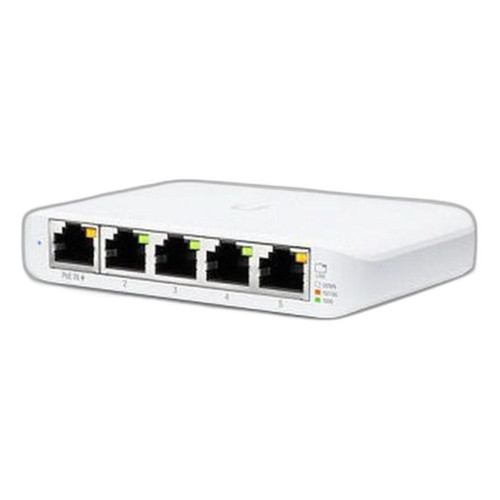
Both the USW-FLEX-MINI and the USW-FLEX-3 are Ubiquiti UniFi 5-port gigabit managed switches aimed at compact edge and remote-site deployments. The comparison centers on three dimensions that matter most to security integrators and IT buyers: port capability and throughput, power delivery and operating environment, and management depth. The FLEX-MINI is a USB-C-powered, non-PoE switch suited to low-power installs; the FLEX-3 is an AC-powered switch that delivers PoE on all five ports. Neither is an accessory or a different device class.

In This Guide
- Which switch delivers more usable bandwidth and can power connected devices?
- Which switch is better suited to harsh or constrained installation environments?
- How do these switches differ in management capability and ecosystem integration?
- Which should you choose: the USW-FLEX-MINI or the USW-FLEX-3?
- Side-by-Side Specs
- FAQ
Which switch delivers more usable bandwidth and can power connected devices?
Both models provide five 10/100/1000 Mbps gigabit Ethernet ports. The USW-FLEX-MINI is specified at 10 Gbps switching capacity, 5 Gbps non-blocking throughput, and a 7 Mpps forwarding rate. The USW-FLEX-3 does not publish equivalent switching capacity, non-blocking throughput, or forwarding-rate figures in the provided specifications, so a direct throughput comparison cannot be made from spec data alone.
On PoE, the difference is categorical. The USW-FLEX-MINI is rated at a maximum power consumption of 2.5W and is powered by USB-C (5V, 1A); it does not deliver PoE to downstream devices. The USW-FLEX-3 delivers Universal PoE (802.3af/at per the product name and Card_Bullet_1 notation of 802.3bt) on all five ports at an output of 54V/1.11A. Its total PoE power budget is not stated in the provided specifications. Buyers powering cameras, access points, or VoIP handsets from the switch must use the USW-FLEX-3; the FLEX-MINI cannot supply PoE to any port.
Which switch is better suited to harsh or constrained installation environments?
The USW-FLEX-MINI draws a maximum of 2.5W from a USB-C source (4.8–5.2V DC) and ships with an external 5W AC/DC adapter. Its polycarbonate enclosure is rated for -5 to 45°C (23 to 113°F). Weight is 150 g (5.3 oz). Form factor is compact desktop with no published alternative mount options.
The USW-FLEX-3 requires external AC power (voltage range not stated in provided specs). Its operating temperature range is -20 to 60°C (-4 to 140°F) — 15°C wider on the cold end and 15°C wider on the hot end than the FLEX-MINI. The FLEX-3 also carries ±16kV air and ±16kV contact ESD protection, a spec absent from the FLEX-MINI's published data. Storage temperature is rated -30 to 70°C. The FLEX-3 supports wall, pole, and rack mounting; the FLEX-MINI is desktop only. At 2.35 lb versus 150 g, the FLEX-3 is heavier. For outdoor enclosures, utility closets, or industrial edge sites with wide temperature swings, the FLEX-3's environmental envelope is broader by spec.
How do these switches differ in management capability and ecosystem integration?
Both switches carry Managed designation and belong to the Ubiquiti UniFi product family, enabling integration with the UniFi Network Controller. Both support VLAN segmentation; the FLEX-MINI specifies up to 1,000 VLANs. The FLEX-3 does not state a VLAN count in the provided specifications.
Management interface depth differs. The USW-FLEX-MINI lists 'Ethernet' as its management method without specifying a Web GUI or CLI in the provided specs. The USW-FLEX-3 explicitly lists Web GUI, CLI, and UniFi integration as management interfaces. For teams requiring direct CLI access or a standalone GUI without a UniFi controller, the FLEX-3's spec is more explicit. Both hold CE, FCC, and IC certifications. The FLEX-MINI additionally carries Anatel certification (14501-20-08356) and is marked NDAA compliant; NDAA compliance is not stated for the FLEX-3 in the provided specifications.
Which should you choose: the USW-FLEX-MINI or the USW-FLEX-3?
Our take: The USW-FLEX-MINI is the stronger choice when the installation requires an ultra-low-power, NDAA-compliant switch in a USB-C-powered environment with no need to power downstream devices. The USW-FLEX-3 is the stronger choice for any deployment requiring PoE delivery or a wider thermal envelope. Concretely: the FLEX-3 outputs 54V/1.11A PoE on all five ports while the FLEX-MINI delivers 0W PoE; the FLEX-3 operates to -20°C versus -5°C for the FLEX-MINI, a 15°C cold-side advantage; and the FLEX-3 adds ±16kV ESD protection not specified for the FLEX-MINI. Platform qualifier: buyers committed to UniFi can manage both models within the same controller, but only the FLEX-3 explicitly documents Web GUI and CLI access. NDAA-sensitive federal or government projects should note that only the FLEX-MINI carries a published NDAA compliant designation in the provided specifications.
Side-by-Side Comparison
Spec-for-spec, from manufacturer data.
| Specification | Ubiquiti USW-FLEX-MINI | Ubiquiti USW-FLEX-3 |
|---|---|---|
| Port Count | 5 | 5 |
| Port Speed | 1G Gigabit Ethernet | 10/100/1000 Mbps |
| PoE Delivery | None (no PoE output) | Universal PoE (802.3af/at) all 5 ports |
| PoE Output Voltage/Current | — | 54V, 1.11A |
| PoE Power Budget (Total) | — | Not specified |
| Switching Capacity | 10 Gbps | Not specified |
| Non-Blocking Throughput | 5 Gbps | Not specified |
| Forwarding Rate | 7 Mpps | Not specified |
| VLAN Support | Up to 1,000 VLANs | Not specified |
| Power Input | USB-C, 5V DC, 1A (2.5W max) | External AC (voltage not specified) |
| Operating Temperature | -5 to 45°C (23 to 113°F) | -20 to 60°C (-4 to 140°F) |
| ESD Protection | Not specified | ±16kV Air, ±16kV Contact |
| Mount Options | Desktop | Wall; Pole; Rack |
| Management Interfaces | Ethernet (management method) | Web GUI; CLI; UniFi |
| NDAA Compliant | Yes | Not specified |
| Weight | 150 g (5.3 oz) | 2.35 lb (1.07 kg) |
| Enclosure Material | Polycarbonate | Not specified |
| Certifications | CE, FCC, IC, Anatel | CE, FCC, IC |
Frequently Asked Questions
Which should you choose: the USW-FLEX-MINI or the USW-FLEX-3?
The USW-FLEX-MINI is the stronger choice when the installation requires an ultra-low-power, NDAA-compliant switch in a USB-C-powered environment with no need to power downstream devices. The USW-FLEX-3 is the stronger choice for any deployment requiring PoE delivery or a wider thermal envelope. Concretely: the FLEX-3 outputs 54V/1.11A PoE on all five ports while the FLEX-MINI delivers 0W PoE; the FLEX-3 operates to -20°C versus -5°C for the FLEX-MINI, a 15°C cold-side advantage; and the FLEX-3 adds ±16kV ESD protection not specified for the FLEX-MINI. Platform qualifier: buyers committed to UniFi can manage both models within the same controller, but only the FLEX-3 explicitly documents Web GUI and CLI access. NDAA-sensitive federal or government projects should note that only the FLEX-MINI carries a published NDAA compliant designation in the provided specifications.
Can the USW-FLEX-MINI power cameras or access points over PoE?
No. Based on the provided specifications, the USW-FLEX-MINI has a maximum power consumption of 2.5W and is itself powered by USB-C at 5V/1A. It does not deliver PoE to any downstream port. The USW-FLEX-3 delivers Universal PoE on all five ports at 54V/1.11A and is the correct choice if connected devices require PoE.
Which switch handles colder outdoor or industrial environments better?
The USW-FLEX-3, based on published specs. Its operating temperature range is -20 to 60°C (-4 to 140°F) compared to the USW-FLEX-MINI's -5 to 45°C (23 to 113°F). The FLEX-3 also adds ±16kV ESD protection, which is not specified for the FLEX-MINI. For installations in unheated enclosures or outdoor cabinets subject to temperature extremes, the FLEX-3's environmental ratings are broader by specification.
Is the USW-FLEX-MINI or USW-FLEX-3 required for NDAA-compliant federal deployments?
Based on the provided specifications, only the USW-FLEX-MINI is marked NDAA Compliant. The USW-FLEX-3's specifications do not include an NDAA compliance designation. Buyers with federal procurement requirements that mandate NDAA compliance should verify current compliance status directly with Ubiquiti, as specifications may change, but the FLEX-MINI is the model with a published NDAA compliant claim in the data provided.
More Network Switch Comparisons
- TP-Link ES205GP vs Ubiquiti USW-FLEX
- TP-Link ES205GP vs Ubiquiti USW-FLEX-MINI
- TP-Link ES205GP vs Ubiquiti USW-FLEX-3
- TP-Link ES205GP vs Ubiquiti USW-FLEX-MINI-3
- TP-Link ES205GP vs TP-Link SG105PP-M2
- TP-Link SG105PP-M2 vs Ubiquiti USW-FLEX
Network Switch Buying Guides
Get a Second Opinion on Your Camera Choice
Share your site layout, coverage goals, and budget. Our team will validate the camera selection, flag anything we would change, and recommend products that match the use case.