
Ubiquiti USW-FLEX-3 vs Altronix NETWAY5P: Specification Comparison
Both the Ubiquiti USW-FLEX-3 and the Altronix NETWAY5P are 5-port managed Gigabit PoE switches targeting physical-security edge deployments — cameras, access controllers, and wireless APs. Each delivers PoE power on all five ports at 10/100/1000 Mbps and supports managed Layer 2 operation. The key differentiators a buyer must weigh are PoE standard and power budget, management ecosystem and integration depth, physical form factor and mounting options, and environmental tolerance — all examined below using only the supplied specifications.

In This Guide
- Which switch delivers more PoE power per port, and what PoE standard does each support?
- How does each switch integrate into a management platform, and what interfaces are available?
- Which switch is better suited to harsh or space-constrained installation environments?
- Which should you choose: the USW-FLEX-3 or the NETWAY5P?
- Side-by-Side Specs
- FAQ
Which switch delivers more PoE power per port, and what PoE standard does each support?
The USW-FLEX-3 is spec'd to PoE++ (802.3bt) on all five ports at a stated output of 54 V / 1.11 A. PoE++ (802.3bt) supports up to 90 W per port at the PSE, making it compatible with 802.3af, 802.3at, and 802.3bt end-devices. The tagline and card bullets confirm all five ports carry this capability simultaneously.
The NETWAY5P is rated to PoE+ (802.3at) on all five ports, with a total system power budget of 120 W. PoE+ (802.3at) caps at 30 W per port at the PSE. The 120 W budget shared across five ports averages 24 W per port at full load — sufficient for most standard PoE+ cameras and access-control panels but below the per-port ceiling a 802.3bt device like a high-wattage PTZ or Wi-Fi 6 AP may require.
No per-port wattage figure is published for the USW-FLEX-3 in the provided specs, nor is a total system PoE budget stated. Buyers powering 802.3bt devices should verify the USW-FLEX-3's total power budget with the manufacturer datasheet before selecting it for high-draw endpoints.
How does each switch integrate into a management platform, and what interfaces are available?
The USW-FLEX-3 is a managed switch with Web GUI and CLI interfaces and is explicitly positioned within Ubiquiti's UniFi ecosystem. UniFi integration enables centralised network visibility, remote management, and topology mapping alongside other UniFi devices — a meaningful advantage for sites already standardised on UniFi controllers or cloud-managed UniFi infrastructure.
The NETWAY5P is described as a Managed Layer 2 switch. No specific management interface (Web GUI, CLI, SNMP, or proprietary app) is named in the provided specifications beyond that designation. Buyers requiring a specific management protocol or software integration should request clarification from the manufacturer, as the provided specs do not detail the management stack.
For installations where ecosystem lock-in is not a concern and where Altronix's enclosure-centric power architecture is already deployed, the NETWAY5P's managed Layer 2 capability may be adequate. For sites requiring software-defined visibility and remote control from a unified dashboard, the USW-FLEX-3's documented UniFi integration is the more substantiated option.
Which switch is better suited to harsh or space-constrained installation environments?
The USW-FLEX-3 supports wall, pole, and rack mounting and is rated for an operating temperature range of -20 to 60°C (-4 to 140°F) with storage down to -30°C. It also carries ESD protection of ±16 kV air and ±16 kV contact, and holds CE, FCC, and IC certifications. Weight is 2.35 lb. The stated dimensions of 122.5" × 107.1" × 28.0" appear inconsistent with the stated compact form factor and 2.35 lb weight; buyers should verify physical dimensions against the manufacturer datasheet.
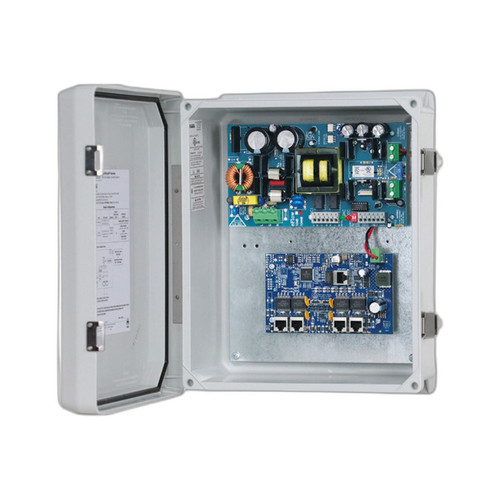
The NETWAY5P supports DIN-rail and panel mount, and its product type is listed as 'Enclosure,' indicating it is designed to mount inside security enclosures or control panels — common in access-control and intrusion-detection infrastructure. No operating temperature range, storage temperature, or ESD specification is provided in the supplied specs.
For outdoor, pole-mount, or wide-temperature deployments, the USW-FLEX-3 has documented environmental ratings. For enclosure-integrated security panel installations where DIN-rail mounting is standard, the NETWAY5P's form factor is the purposeful fit — though the absence of a published temperature spec requires buyers to confirm suitability for their environment directly with Altronix.
Which should you choose: the USW-FLEX-3 or the NETWAY5P?
Our take: The USW-FLEX-3 is the stronger choice when PoE++ device support, documented environmental tolerance, and a unified cloud-managed ecosystem are required. It supports 802.3bt (PoE++) versus the NETWAY5P's 802.3at (PoE+), tolerates -20 to 60°C versus no published temperature spec for the NETWAY5P, and provides an explicitly documented UniFi Web GUI and CLI management interface versus the NETWAY5P's unspecified management stack. Conversely, the NETWAY5P's 120 W total PoE budget is an explicit published figure — the USW-FLEX-3 provides no equivalent figure in the supplied specs — and its DIN-rail / panel-mount form factor is specifically engineered for security enclosure integration, where the NETWAY5P is the purpose-built option. Specify the USW-FLEX-3 for UniFi-standardised sites with demanding endpoints; specify the NETWAY5P where Altronix enclosure integration, a known 120 W power budget, and lifetime warranty coverage are the deciding factors.
Side-by-Side Comparison
Spec-for-spec, from manufacturer data.
| Specification | Ubiquiti USW-FLEX-3 | Altronix NETWAY5P |
|---|---|---|
| Port Count | 5 | 5 |
| Port Speed | 10/100/1000 Mbps | 10/100/1000 Mbps |
| PoE Standard | PoE++ (802.3bt) | PoE+ (802.3at) |
| PoE on All Ports | Yes (all 5) | Yes (all 5) |
| Total PoE Budget | — | 120 W |
| Output Voltage / Current | 54 V / 1.11 A | — |
| Management Type | Managed; Web GUI; CLI; UniFi | Managed Layer 2 |
| Ecosystem Integration | UniFi | — |
| Mount Type | Wall; Pole; Rack | DIN-rail; Panel |
| Form Factor | Compact desktop / rack | Enclosure |
| Operating Temp | -20 to 60°C (-4 to 140°F) | — |
| Storage Temp | -30 to 70°C (-22 to 158°F) | — |
| ESD Protection | ±16 kV Air; ±16 kV Contact | — |
| Certifications | CE, FCC, IC | — |
| Weight | 2.35 lb | — |
| Warranty | Manufacturer Warranty (duration not stated) | Lifetime |
Frequently Asked Questions
Which should you choose: the USW-FLEX-3 or the NETWAY5P?
The USW-FLEX-3 is the stronger choice when PoE++ device support, documented environmental tolerance, and a unified cloud-managed ecosystem are required. It supports 802.3bt (PoE++) versus the NETWAY5P's 802.3at (PoE+), tolerates -20 to 60°C versus no published temperature spec for the NETWAY5P, and provides an explicitly documented UniFi Web GUI and CLI management interface versus the NETWAY5P's unspecified management stack. Conversely, the NETWAY5P's 120 W total PoE budget is an explicit published figure — the USW-FLEX-3 provides no equivalent figure in the supplied specs — and its DIN-rail / panel-mount form factor is specifically engineered for security enclosure integration, where the NETWAY5P is the purpose-built option. Specify the USW-FLEX-3 for UniFi-standardised sites with demanding endpoints; specify the NETWAY5P where Altronix enclosure integration, a known 120 W power budget, and lifetime warranty coverage are the deciding factors.
Can the USW-FLEX-3 or NETWAY5P power a high-wattage PTZ camera that requires more than 30 W?
Based on the provided specifications, the USW-FLEX-3 supports PoE++ (802.3bt), which allows up to 90 W per port at the PSE and is backward-compatible with 802.3af and 802.3at devices — making it the candidate for high-wattage PTZ cameras. The NETWAY5P is rated to PoE+ (802.3at), which caps at 30 W per port. However, no total system PoE budget is published for the USW-FLEX-3 in the supplied specs; verify that figure with Ubiquiti before specifying for high-draw loads.
Which switch is better for a site that already uses Ubiquiti UniFi access points and cameras?
The USW-FLEX-3 is the direct fit. The provided specifications explicitly state UniFi ecosystem integration with Web GUI and CLI management, meaning it will appear in an existing UniFi controller or UniFi Network application alongside other UniFi devices. The NETWAY5P's specifications do not mention UniFi compatibility or any specific third-party management integration, so it would operate as a standalone managed switch outside that ecosystem.
Does either switch carry a better warranty, and does that affect total cost of ownership for a long-term installation?
Yes — the warranty terms differ significantly. The NETWAY5P is listed with a Lifetime warranty per the provided specifications. The USW-FLEX-3 is listed only as 'Manufacturer Warranty' with no duration stated in the supplied specs. Buyers should confirm the USW-FLEX-3 warranty term directly with Ubiquiti. For installations where long-term support and replacement assurance factor into total cost of ownership, the NETWAY5P's lifetime warranty is a documented advantage based on the specs provided.
More Network Switch Comparisons
- TP-Link ES205GP vs Ubiquiti USW-FLEX
- TP-Link ES205GP vs Ubiquiti USW-FLEX-MINI
- TP-Link ES205GP vs Ubiquiti USW-FLEX-3
- TP-Link ES205GP vs Ubiquiti USW-FLEX-MINI-3
- TP-Link ES205GP vs TP-Link SG105PP-M2
- TP-Link SG105PP-M2 vs Ubiquiti USW-FLEX
Network Switch Buying Guides
Get a Second Opinion on Your Camera Choice
Share your site layout, coverage goals, and budget. Our team will validate the camera selection, flag anything we would change, and recommend products that match the use case.