
Ubiquiti USW-FLEX-2.5G-8-POE vs Ubiquiti USW-ULTRA: Specification Comparison
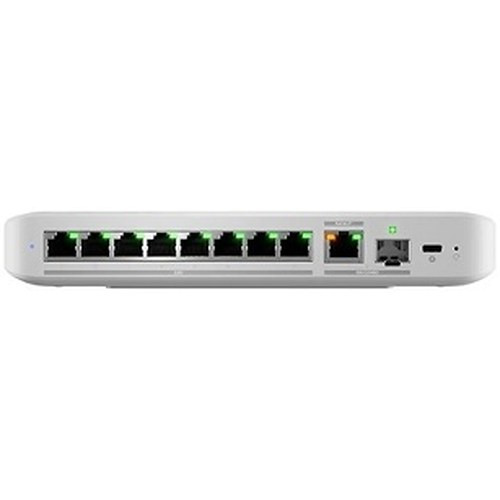
Both products are Ubiquiti 8-port PoE++ compact switches managed via UniFi, making them genuine cross-shop candidates for edge and distributed network deployments. The USW-FLEX-2.5G-8-POE targets higher-bandwidth edge nodes—IP cameras, Wi-Fi 6E APs, multi-gig endpoints—with 2.5 GbE per-port speeds and a 10 GbE uplink. The USW-ULTRA addresses infrastructure-light edge sites where cabling AC power is impractical, running entirely off a single PoE++ upstream feed at Gigabit speeds. The core trade-off is port throughput and uplink capacity versus cableless AC-free deployment flexibility.

In This Guide
- Which switch delivers the port speeds and fabric capacity your edge devices actually need?
- How do the PoE power budgets compare for powering downstream devices?
- Which switch better fits your physical installation environment and operating conditions?
- Which should you choose: the USW-FLEX-2.5G-8-POE or the USW-ULTRA?
- Side-by-Side Specs
- FAQ
Which switch delivers the port speeds and fabric capacity your edge devices actually need?
The USW-FLEX-2.5G-8-POE provides eight 2.5 Gbps PoE++ ports plus a 10 GbE RJ45/SFP+ combo uplink, with a 60 Gbps switching capacity, 30 Gbps non-blocking throughput, and a forwarding rate of 45 Mpps. This fabric is sized to handle simultaneous multi-gig traffic across all eight ports without congestion.
The USW-ULTRA provides eight Gigabit (10M/100M/1G auto-negotiating) PoE++ ports with a 16 Gbps switching capacity, 8 Gbps non-blocking throughput, and a forwarding rate of 12 Mpps. No dedicated uplink port is specified in the provided specs; the fabric is sized for Gigabit-class endpoints only.
For deployments running 4K/8K IP cameras, Wi-Fi 6E access points, or any multi-gig endpoint, the FLEX-2.5G-8-POE's per-port bandwidth is 2.5× higher and its non-blocking throughput is 3.75× greater. The USW-ULTRA is adequate for standard 1G endpoints but will bottleneck multi-gig devices by design.
How do the PoE power budgets compare for powering downstream devices?
The USW-FLEX-2.5G-8-POE carries a 210W total power budget when connected to AC, with up to 90W per port and 76W native PoE+++ support, and requires an external AC/DC adapter (excluded from box).
The USW-ULTRA's PoE output budget depends entirely on its upstream power input: 42W per port maximum when fed via PoE++ input, or 16W per port when fed via PoE+ input. Its own power consumption is 9W excluding PoE output. No AC adapter is required or used—the switch is entirely PoE-powered. A separate spec value of 60W (labeled Power Watts in the product data) is present but conflicts with the per-port figures; the per-port and input-mode values from the datasheet reference are used here as primary.
For powering high-draw devices such as PTZ cameras, high-wattage APs, or 802.3bt endpoints, the FLEX-2.5G-8-POE's 90W per-port ceiling and 210W aggregate AC budget provide substantially more headroom. The USW-ULTRA's 42W per-port ceiling under PoE++ input covers most standard PoE++ devices but cannot match the FLEX's aggregate capacity, and budget shrinks further to 16W per port if only a PoE+ upstream is available.
Which switch better fits your physical installation environment and operating conditions?
The USW-FLEX-2.5G-8-POE measures 212.9 × 99.4 × 33.5 mm and weighs 567 g. It supports desktop, wall, DIN-rail, and magnetic mounting, and is rated for operation from −20°C to +45°C (−4°F to +113°F). Its polycarbonate enclosure requires an external AC/DC adapter for power.
The USW-ULTRA measures 203 × 76 × 33 mm and weighs 320 g (43% lighter). It supports desktop, wall, and magnetic mounting (no DIN-rail option specified). It is rated for operation from −30°C to +60°C (−22°F to +140°F) when powered via PoE++ input—a meaningfully wider thermal window. It also carries an additional Anatel certification (06367-24-08356) not present on the FLEX.
The USW-ULTRA's wider temperature range (−30 to +60°C vs. −20 to +45°C) makes it better suited for uncontrolled environments such as outdoor enclosures, industrial spaces, or equatorial climates. Its AC-free operation eliminates the need to run mains power to the mounting location. The FLEX's DIN-rail option adds flexibility for panel or rack-adjacent installations where AC is available and higher throughput is the priority.
Which should you choose: the USW-FLEX-2.5G-8-POE or the USW-ULTRA?
Our take: The USW-FLEX-2.5G-8-POE is the stronger choice when port throughput, aggregate PoE power budget, and uplink speed are the primary requirements. Its 2.5 Gbps per-port speed versus the USW-ULTRA's 1 Gbps delivers 2.5× more bandwidth to each endpoint; its 30 Gbps non-blocking throughput versus 8 Gbps represents a 3.75× fabric advantage; and its 210W AC-fed budget versus the USW-ULTRA's 42W PoE++-fed ceiling provides far greater headroom for high-draw devices. The USW-ULTRA is the better fit for AC-infrastructure-free edge sites—remote IDF closets, pole-mounted enclosures, or any location where running mains power is impractical—and its wider −30 to +60°C operating range and lighter 320 g form factor reinforce that outdoor or space-constrained use case. Both switches support 256 VLANs and share the same UniFi management platform.
Side-by-Side Comparison
Spec-for-spec, from manufacturer data.
| Specification | Ubiquiti USW-FLEX-2.5G-8-POE | Ubiquiti USW-ULTRA |
|---|---|---|
| Port Count | 8 data ports | 8 data ports |
| Port Speed | 8 × 2.5 Gbps | 8 × 1 Gbps (10/100/1000) |
| Uplink Port | 1 × 10 GbE RJ45/SFP+ combo | Not specified |
| Switching Capacity | 60 Gbps | 16 Gbps |
| Non-Blocking Throughput | 30 Gbps | 8 Gbps |
| Forwarding Rate | 45 Mpps | 12 Mpps |
| PoE Standard | PoE++ (802.3bt) | PoE++ (802.3bt) |
| Max PoE per Port | 90W | 42W (PoE++ input) / 16W (PoE+ input) |
| Total PoE Budget | 210W (AC-fed) | 42W per port; aggregate not stated in specs |
| Power Source | External AC/DC adapter (excluded) | PoE++ input (no AC adapter) |
| Device Power Consumption | 14W | 9W (excluding PoE output) |
| Operating Temperature | −20 to +45°C | −30 to +60°C (PoE++ input) |
| Dimensions (mm) | 212.9 × 99.4 × 33.5 | 203 × 76 × 33 |
| Weight | 567 g (20 oz) | 320 g (11.3 oz) |
| Mount Options | Desktop, wall, DIN-rail, magnetic | Desktop, wall, magnetic |
| VLAN Support | 256 | 256 |
| NDAA Compliant | Yes | Yes |
| Certifications | CE, FCC, IC | CE, FCC, IC, Anatel 06367-24-08356 |
Frequently Asked Questions
Which should you choose: the USW-FLEX-2.5G-8-POE or the USW-ULTRA?
The USW-FLEX-2.5G-8-POE is the stronger choice when port throughput, aggregate PoE power budget, and uplink speed are the primary requirements. Its 2.5 Gbps per-port speed versus the USW-ULTRA's 1 Gbps delivers 2.5× more bandwidth to each endpoint; its 30 Gbps non-blocking throughput versus 8 Gbps represents a 3.75× fabric advantage; and its 210W AC-fed budget versus the USW-ULTRA's 42W PoE++-fed ceiling provides far greater headroom for high-draw devices. The USW-ULTRA is the better fit for AC-infrastructure-free edge sites—remote IDF closets, pole-mounted enclosures, or any location where running mains power is impractical—and its wider −30 to +60°C operating range and lighter 320 g form factor reinforce that outdoor or space-constrained use case. Both switches support 256 VLANs and share the same UniFi management platform.
Is the USW-FLEX-2.5G-8-POE or USW-ULTRA better for powering multiple high-wattage PoE++ cameras?
The USW-FLEX-2.5G-8-POE is the stronger choice for high-draw PoE cameras. Its AC-fed 210W total budget and 90W per-port ceiling exceed the USW-ULTRA's 42W per-port maximum (achieved only when the ULTRA is itself fed by a PoE++ upstream). If your cameras or APs draw more than 42W each, or you need aggregate budget beyond what a single upstream PoE++ port can supply, the FLEX is required.
Can the USW-ULTRA be installed in an outdoor or unheated enclosure where the USW-FLEX-2.5G-8-POE cannot?
Based on the provided specs, yes. The USW-ULTRA is rated −30 to +60°C when PoE++-powered, while the USW-FLEX-2.5G-8-POE is rated −20 to +45°C. The ULTRA's 15°C lower cold threshold and 15°C higher heat ceiling cover a wider range of uncontrolled environments. Neither product's specs describe an IP or NEMA weatherproof rating, so appropriate enclosure protection should still be verified for true outdoor exposure.
Do both switches support VLANs and use the same UniFi management platform?
Yes. Both the USW-FLEX-2.5G-8-POE and the USW-ULTRA support 256 VLANs and are managed via Ethernet within the UniFi ecosystem, per the provided specifications. Neither switch requires a dedicated controller appliance beyond the standard UniFi management infrastructure already in place for Ubiquiti deployments.
More Network Switch Comparisons
- Vivotek IHT-1271 vs TP-Link SG3210XHP-M2
- Vivotek IHT-1271 vs TP-Link S4500-8GP2F
- Vivotek IHT-1271 vs TP-Link SG1210P
- Vivotek IHT-1271 vs Allied Telesis AT-x530L-10GHXm-10
- Vivotek IHT-1271 vs Vivotek GEV-108A-130
- Vivotek IHT-1271 vs Vivotek IHT-1000
Network Switch Buying Guides
Get a Second Opinion on Your Camera Choice
Share your site layout, coverage goals, and budget. Our team will validate the camera selection, flag anything we would change, and recommend products that match the use case.