
Ubiquiti USW-FLEX-2.5G-8-POE vs Ubiquiti USW-LITE-8-POE: Specification Comparison
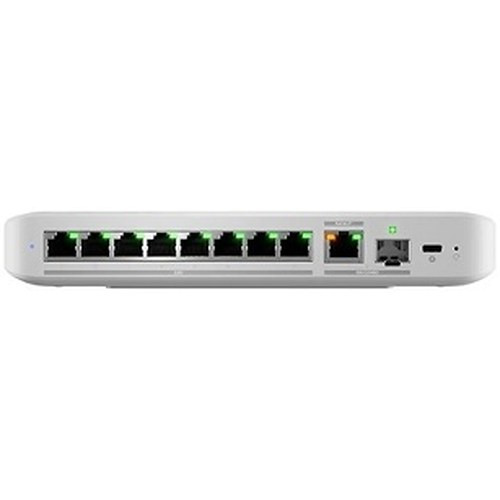
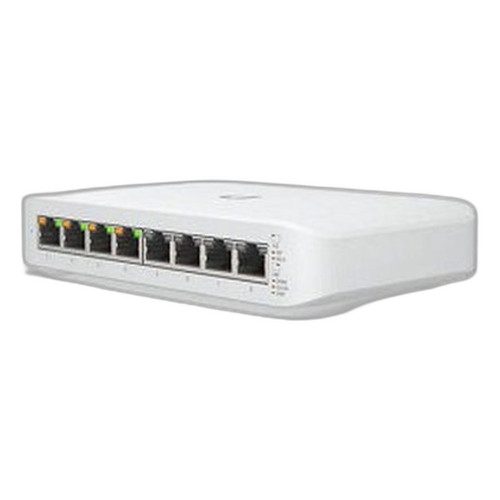
Both the USW-FLEX-2.5G-8-POE and the USW-LITE-8-POE are Ubiquiti-managed, 8-port PoE desktop/wall-mount switches targeted at distributed edge deployments in surveillance, wireless, and IoT environments. The comparison centers on a meaningful performance tier gap: the FLEX-2.5G-8-POE offers 2.5 GbE per-port speeds with PoE++ budget and a 10 GbE uplink, while the LITE-8-POE delivers 1 GbE ports with a PoE+ budget. Buyers cross-shopping these units are typically weighing bandwidth headroom and PoE wattage against cost and form-factor simplicity.
In This Guide
- Which switch delivers more port speed, uplink capacity, and switching throughput?
- How do the PoE budgets and per-port wattage compare for powering cameras, APs, and other devices?
- Where can each switch be physically installed, and what environmental conditions do they tolerate?
- Which should you choose: the USW-FLEX-2.5G-8-POE or the USW-LITE-8-POE?
- Side-by-Side Specs
- FAQ
Which switch delivers more port speed, uplink capacity, and switching throughput?
The USW-FLEX-2.5G-8-POE equips all eight access ports at 2.5 Gbps each, versus 1 Gbps on all eight ports of the USW-LITE-8-POE — a 2.5× per-port speed advantage. The FLEX also adds a combo 10 GbE RJ45/SFP+ uplink port, allowing copper or fiber connection to a core switch without hardware changes; the LITE-8-POE specifies no dedicated uplink beyond its standard ports.
Switching fabric reflects this gap directly: the FLEX-2.5G-8-POE carries a 60 Gbps switching capacity with 30 Gbps non-blocking throughput and a 45 Mpps forwarding rate. The LITE-8-POE provides 16 Gbps switching capacity, 8 Gbps non-blocking throughput, and 12 Mpps forwarding rate. For installations where multiple ports simultaneously stream 4K video or pass multi-gig Wi-Fi 6/6E backhaul, the FLEX's fabric is substantially less likely to become a bottleneck.
How do the PoE budgets and per-port wattage compare for powering cameras, APs, and other devices?
The USW-FLEX-2.5G-8-POE supports PoE++ (802.3bt) with a 210W total power budget and up to 90W per port. The spec also notes 76W native PoE+++ support within that envelope. This makes it capable of powering high-wattage devices such as PTZ cameras, Wi-Fi 6E tri-band APs, or video intercoms that exceed standard PoE+ limits.
The USW-LITE-8-POE supports PoE+ (802.3at) only, with a 52W total budget across all eight ports. Its external 60W AC/DC power supply sets the practical ceiling. Per-port maximum under 802.3at is 30W, roughly one-third the per-port ceiling of the FLEX. For deployments powered entirely by 802.3at devices such as standard IP cameras or basic APs, the LITE's budget may be sufficient if the aggregate draw stays under 52W, but it offers no headroom for higher-power endpoints.
Where can each switch be physically installed, and what environmental conditions do they tolerate?
The USW-FLEX-2.5G-8-POE supports desktop, wall, DIN-rail, and magnetic mounting and is specified for operation from −20°C to +45°C (−4°F to +113°F). The broader temperature range and DIN-rail and magnetic mount options make it more suitable for industrial enclosures, utility rooms, or outdoor-rated cabinets where ambient temperatures can drop below freezing.
The USW-LITE-8-POE is specified for desktop and wall-mount installation with an operating range of −15°C to +40°C (5°F to +104°F). Its lower-bound temperature tolerance is 5°C warmer than the FLEX, and it lacks DIN-rail and magnetic mount options per the provided specifications. Both units share polycarbonate enclosures. The LITE is lighter at 295 g versus the FLEX at 567 g, which may matter in tight or weight-sensitive wall-mount scenarios. Both carry CE, FCC, and IC certifications; the LITE-8-POE additionally lists Anatel (Brazil) certification.
Which should you choose: the USW-FLEX-2.5G-8-POE or the USW-LITE-8-POE?
Our take: The USW-FLEX-2.5G-8-POE is the stronger choice when port bandwidth, PoE wattage, or installation environment demand more than standard gigabit PoE+ can provide. Concretely: its per-port speed is 2.5 Gbps versus 1 Gbps, its total PoE budget is 210W versus 52W with up to 90W per port versus 30W under 802.3at, and its switching fabric is 60 Gbps versus 16 Gbps. It also adds a 10 GbE combo uplink absent from the LITE-8-POE and tolerates a wider temperature range (−20°C to +45°C vs. −15°C to +40°C) with additional DIN-rail and magnetic mounting options. The USW-LITE-8-POE remains a viable fit for cost-sensitive, low-density deployments where all endpoints are standard 802.3at devices, aggregate PoE draw stays under 52W, gigabit access is sufficient, and installation is limited to desktop or wall-mount in a controlled indoor environment. Both are NDAA-compliant Ubiquiti managed switches.
Side-by-Side Comparison
Spec-for-spec, from manufacturer data.
| Specification | Ubiquiti USW-FLEX-2.5G-8-POE | Ubiquiti USW-LITE-8-POE |
|---|---|---|
| Port Count (Access) | 8 | 8 |
| Port Speed | 2.5 Gbps | 1 Gbps |
| PoE Standard | PoE++ (802.3bt) | PoE+ (802.3at) |
| Total PoE Budget | 210W | 52W |
| Max PoE Per Port | 90W | 30W (802.3at max) |
| Uplink Port | 1 × 10 GbE RJ45/SFP+ combo | — |
| Switching Capacity | 60 Gbps | 16 Gbps |
| Non-Blocking Throughput | 30 Gbps | 8 Gbps |
| Forwarding Rate | 45 Mpps | 12 Mpps |
| VLAN Support | 256 | 1,000 |
| Operating Temperature | −20 to +45°C | −15 to +40°C |
| Mount Options | Desktop, wall, DIN-rail, magnetic | Desktop, wall |
| Power Consumption (Switch) | 14W | 8W (excl. PoE output) |
| Voltage Range | 50–57V DC/PoE | 50–57V DC |
| Weight | 567 g (20 oz) | 295 g (10.4 oz) |
| Certifications | CE, FCC, IC, NDAA | CE, FCC, IC, Anatel, NDAA |
Frequently Asked Questions
Which should you choose: the USW-FLEX-2.5G-8-POE or the USW-LITE-8-POE?
The USW-FLEX-2.5G-8-POE is the stronger choice when port bandwidth, PoE wattage, or installation environment demand more than standard gigabit PoE+ can provide. Concretely: its per-port speed is 2.5 Gbps versus 1 Gbps, its total PoE budget is 210W versus 52W with up to 90W per port versus 30W under 802.3at, and its switching fabric is 60 Gbps versus 16 Gbps. It also adds a 10 GbE combo uplink absent from the LITE-8-POE and tolerates a wider temperature range (−20°C to +45°C vs. −15°C to +40°C) with additional DIN-rail and magnetic mounting options. The USW-LITE-8-POE remains a viable fit for cost-sensitive, low-density deployments where all endpoints are standard 802.3at devices, aggregate PoE draw stays under 52W, gigabit access is sufficient, and installation is limited to desktop or wall-mount in a controlled indoor environment. Both are NDAA-compliant Ubiquiti managed switches.
Is the USW-FLEX-2.5G-8-POE or USW-LITE-8-POE better for powering PTZ cameras or high-watt APs?
The USW-FLEX-2.5G-8-POE is better suited for high-wattage endpoints. It supports PoE++ (802.3bt) with up to 90W per port and a 210W total budget. The USW-LITE-8-POE is limited to PoE+ (802.3at), which caps at 30W per port with a 52W total budget — insufficient for devices that require more than 30W or for installations where aggregate draw across several ports exceeds 52W.
Can the USW-LITE-8-POE handle multi-gig or Wi-Fi 6E backhaul traffic the way the USW-FLEX-2.5G-8-POE can?
No. The USW-LITE-8-POE provides 1 Gbps per port with an 8 Gbps non-blocking throughput, which caps each port at gigabit speeds. The USW-FLEX-2.5G-8-POE provides 2.5 Gbps per access port, a 10 GbE combo uplink, and 30 Gbps non-blocking throughput — significantly better matched to Wi-Fi 6/6E APs or multi-gig NVRs that can saturate a 1 Gbps link.
Which switch is more suitable for installation in an industrial enclosure or unheated space?
The USW-FLEX-2.5G-8-POE has a wider operating temperature range (−20°C to +45°C) and supports DIN-rail and magnetic mounting in addition to wall and desktop options. The USW-LITE-8-POE is rated only to −15°C and is specified for desktop and wall-mount installation, making it less suitable for cold environments or industrial-panel installations.
More Network Switch Comparisons
- Vivotek IHT-1271 vs TP-Link SG3210XHP-M2
- Vivotek IHT-1271 vs TP-Link S4500-8GP2F
- Vivotek IHT-1271 vs TP-Link SG1210P
- Vivotek IHT-1271 vs Allied Telesis AT-x530L-10GHXm-10
- Vivotek IHT-1271 vs Vivotek GEV-108A-130
- Vivotek IHT-1271 vs Vivotek IHT-1000
Network Switch Buying Guides
Get a Second Opinion on Your Camera Choice
Share your site layout, coverage goals, and budget. Our team will validate the camera selection, flag anything we would change, and recommend products that match the use case.