
Ubiquiti USW-48-POE vs Allied Telesis GS980M/52PS-10: Specification Comparison
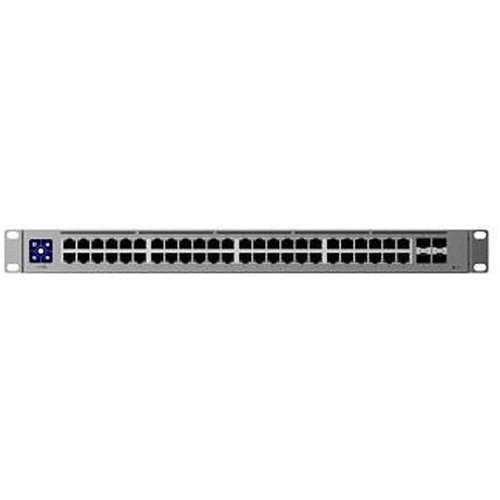
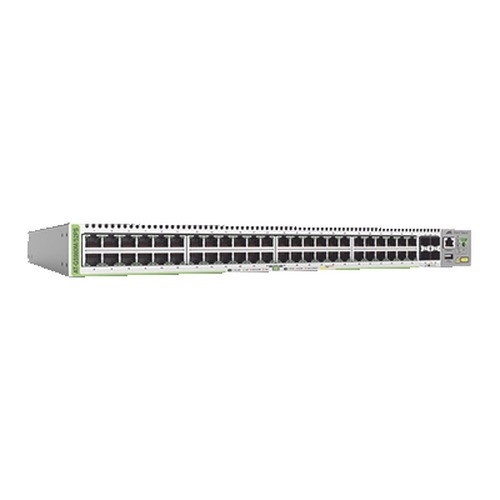
Both the Ubiquiti USW-48-POE and the Allied Telesis AT-GS980M/52PS-10 are 1U rack-mount, managed Gigabit switches offering 48 copper PoE+ ports and four SFP uplinks — a direct cross-shop pairing for access-layer deployments in IP surveillance, wireless, and enterprise LAN environments. The comparison turns on PoE power budget and port allocation, switching performance, and management ecosystem fit, where the two products diverge sharply despite sharing a common port-count and form factor.
In This Guide
- Which switch delivers more PoE power, and how many devices can it realistically run at full wattage?
- Are the two switches performance-equivalent at the silicon level, and how do their physical builds compare?
- How do the two switches integrate into existing management platforms, and what Layer 2/3 feature sets are documented in the provided specs?
- Which should you choose: the USW-48-POE or the GS980M/52PS-10?
- Side-by-Side Specs
- FAQ
Which switch delivers more PoE power, and how many devices can it realistically run at full wattage?
This is the most consequential difference between the two units. The Allied Telesis AT-GS980M/52PS-10 provides a maximum PoE budget of 740 W — enabling all 48 ports to run at 15 W simultaneously, or 24 ports at 30 W (PoE+). The Ubiquiti USW-48-POE caps its total PoE output at 195 W across only 32 of its 48 ports; the remaining 16 ports carry no PoE at all. At 30 W per port the USW-48-POE can support at most 6 simultaneous full-load PoE+ devices before its budget is exhausted.
For a mixed surveillance and wireless deployment with high-wattage PTZ cameras, multi-radio APs, or PoE-powered VoIP endpoints, the AT-GS980M/52PS-10's 740 W budget is 3.8× larger than the USW-48-POE's 195 W. Installers dimensioning a 48-camera floor with 15 W domes would fill the Allied Telesis comfortably within budget; the same load would require three or four USW-48-POE units and patch-panel planning to segregate PoE vs. non-PoE ports.
Are the two switches performance-equivalent at the silicon level, and how do their physical builds compare?
Switching fabric capacity is identical at 104 Gbps for both models. Forwarding rate is effectively identical as well — 77 Mpps (Ubiquiti) versus 77.4 Mpps (Allied Telesis) — a negligible 0.5% difference that will not manifest in any real-world access-layer scenario. Both units are non-blocking at full 48-port 1 GbE line rate.
The physical build differs more than the silicon. The USW-48-POE measures 442 × 285 × 44 mm and weighs 4.5 kg; its chassis is SGCC steel and it includes a 1.3-inch LCM color touchscreen for local status monitoring. The AT-GS980M/52PS-10 is slightly deeper at 441 × 359 × 44 mm and heavier at 5.8 kg — 74 mm deeper and 1.3 kg heavier — relevant when rack depth is constrained. The Allied Telesis unit specifies an acoustic noise figure of 42 dBA; no noise figure is provided for the USW-48-POE. Maximum power consumption also differs sharply: 240 W (internal supply) for the Ubiquiti versus 909 W for the Allied Telesis, reflecting the latter's far larger PoE capacity and driving meaningfully higher heat dissipation (3,102 BTU/h specified for the Allied Telesis; not specified for the Ubiquiti).
How do the two switches integrate into existing management platforms, and what Layer 2/3 feature sets are documented in the provided specs?
The Ubiquiti USW-48-POE is designed for integration with Ubiquiti's UniFi controller platform. The provided specs confirm 1,000 VLAN support and describe management via Ethernet. The UniFi ecosystem provides a unified dashboard for switch, wireless, and security gateway management — a significant workflow advantage for sites already standardized on UniFi. NDAA compliance is explicitly confirmed for the USW-48-POE.
The Allied Telesis AT-GS980M/52PS-10 specs reference VLAN and QoS as managed features, and Allied Telesis's GS980M series is known in the market for enterprise-grade L2+ management; however, the provided specification data does not enumerate VLAN count limits, specific QoS queues, or a named NMS platform. NDAA compliance status is not stated in the provided specs for the AT-GS980M/52PS-10. Buyers integrating into Allied Telesis's Vista Manager or third-party NMS environments should verify feature depth against the full AT-GS980M/52PS-10 datasheet before specifying.
Which should you choose: the USW-48-POE or the GS980M/52PS-10?
Our take: The AT-GS980M/52PS-10 is the stronger choice when PoE density and budget are the primary design constraint. Its 740 W PoE budget is 3.8× greater than the USW-48-POE's 195 W, it delivers PoE+ across all 48 ports versus only 32 on the Ubiquiti, and its 909 W total power draw reflects that capacity. Switching performance is essentially identical: both run 104 Gbps fabric at ~77 Mpps. The USW-48-POE is the stronger choice for Ubiquiti-standardized environments: it carries confirmed NDAA compliance, integrates natively into the UniFi controller, documents 1,000 VLAN support, is lighter (4.5 kg vs. 5.8 kg), shallower (285 mm vs. 359 mm depth), and draws only 45 W base power. Specify the AT-GS980M/52PS-10 for high-density PoE surveillance or AP deployments needing per-port power above 6 W average; specify the USW-48-POE for UniFi-ecosystem sites with moderate PoE loads or strict NDAA requirements.
Side-by-Side Comparison
Spec-for-spec, from manufacturer data.
| Specification | Ubiquiti USW-48-POE | Allied Telesis GS980M/52PS-10 |
|---|---|---|
| Device Type | Managed Gigabit Switch | Managed Gigabit Switch |
| Form Factor | 1U Rack-Mount | 1RU Rack-Mount |
| Total Copper Ports | 48 x 1GbE (RJ-45) | 48 x 10/100/1000T (RJ-45) |
| PoE-Enabled Ports | 32 of 48 | 48 of 48 |
| PoE Standard | PoE+ (802.3at, up to 30W/port) | PoE+ (802.3at, up to 30W/port) |
| Max PoE Budget | 195 W | 740 W |
| Simultaneous PoE+ @ 30W | ~6 ports (budget-limited) | 24 ports |
| Simultaneous PoE @ 15W | ~13 ports (budget-limited) | 48 ports |
| SFP Uplink Ports | 4 x 1G SFP | 4 x 100/1000X SFP |
| Switching Fabric | 104 Gbps | 104 Gbps |
| Forwarding Rate | 77 Mpps | 77.4 Mpps |
| Max Power Consumption | 240 W (internal supply) | 909 W |
| Dimensions (W x D x H mm) | 442 x 285 x 44 | 441 x 359 x 44 |
| Weight | 4.5 kg (10 lb) | 5.8 kg (12.79 lb) |
| VLAN Support | 1,000 VLANs | Supported (count not specified) |
| NDAA Compliant | Yes | Not specified in provided specs |
Frequently Asked Questions
Which should you choose: the USW-48-POE or the GS980M/52PS-10?
The AT-GS980M/52PS-10 is the stronger choice when PoE density and budget are the primary design constraint. Its 740 W PoE budget is 3.8× greater than the USW-48-POE's 195 W, it delivers PoE+ across all 48 ports versus only 32 on the Ubiquiti, and its 909 W total power draw reflects that capacity. Switching performance is essentially identical: both run 104 Gbps fabric at ~77 Mpps. The USW-48-POE is the stronger choice for Ubiquiti-standardized environments: it carries confirmed NDAA compliance, integrates natively into the UniFi controller, documents 1,000 VLAN support, is lighter (4.5 kg vs. 5.8 kg), shallower (285 mm vs. 359 mm depth), and draws only 45 W base power. Specify the AT-GS980M/52PS-10 for high-density PoE surveillance or AP deployments needing per-port power above 6 W average; specify the USW-48-POE for UniFi-ecosystem sites with moderate PoE loads or strict NDAA requirements.
Is the USW-48-POE or AT-GS980M/52PS-10 better for a 48-camera IP surveillance deployment?
For a full 48-camera deployment, the AT-GS980M/52PS-10 is the more appropriate choice based on the provided specs. Its 740 W PoE budget supports all 48 ports at 15 W simultaneously, covering standard fixed IP cameras across every port. The USW-48-POE provides only 195 W across 32 PoE-capable ports — insufficient to power 48 cameras concurrently even at modest per-camera draw, and it offers no PoE at all on the remaining 16 ports.
Can either switch support high-wattage PTZ cameras or multi-radio access points drawing close to 30 W per port?
The AT-GS980M/52PS-10 explicitly supports up to 24 ports simultaneously at 30 W (PoE+) within its 740 W budget. The USW-48-POE supports PoE+ (802.3at, up to 30 W per port) on its 32 PoE-capable ports, but its total 195 W budget limits simultaneous 30 W loads to approximately 6 devices before the budget ceiling is reached. For deployments requiring many high-wattage endpoints, the Allied Telesis unit offers substantially more headroom.
Which switch is the better fit if the site is already running Ubiquiti UniFi gear?
The USW-48-POE is purpose-built for UniFi environments: it integrates with the UniFi controller for unified management of switching, wireless, and routing. The provided specs for the AT-GS980M/52PS-10 do not reference UniFi compatibility or a named management platform. Unless the site requires the AT-GS980M/52PS-10's substantially higher PoE budget, an existing UniFi deployment will benefit from the workflow consistency, NDAA compliance confirmation, and controller-based VLAN management that the USW-48-POE provides.
More Network Switch Comparisons
- NETGEAR GS748PP-100NAS vs Ubiquiti USW-48-POE
- NETGEAR GS748PP-100NAS vs Ubiquiti USW-PRO-MAX-48-POE
- NETGEAR GS748PP-100NAS vs Ubiquiti USW-ENTERPRISE-48-POE
- NETGEAR GS748PP-100NAS vs Ubiquiti ES-48-500W
- NETGEAR GS748PP-100NAS vs NETGEAR GS348PP-100NAS
- Ubiquiti USW-48-POE vs NETGEAR GS348PP-100NAS
Network Switch Buying Guides
Get a Second Opinion on Your Camera Choice
Share your site layout, coverage goals, and budget. Our team will validate the camera selection, flag anything we would change, and recommend products that match the use case.