
TSC T6EX04-05-S0-60-10 vs TSC T6E6X4-1103-00: Specification Comparison
Both the TSC T6EX04-05-S0-60-10 and TSC T6E6X4-1103-00 are industrial thermal printers designed for warehouse and logistics label production. The T6EX04-05-S0-60-10 adds integrated RFID encoding to its thermal print engine, while the T6E6X4-1103-00 emphasizes high-resolution output at 600 DPI and 14 ips with Wi-Fi connectivity. Buyers evaluating either unit are typically choosing between RFID-capable label production and high-speed, high-resolution wireless label printing for distributed operations.
In This Guide
- Which printer delivers the print speed and resolution required for your label volume and barcode accuracy?
- Which printer supports RFID encoding, and how does each model connect to the production network?
- What operator interface and warranty coverage does each printer provide for sustained industrial deployment?
- Which should you choose: the T6EX04-05-S0-60-10 or the T6E6X4-1103-00?
- Side-by-Side Specs
- FAQ
Which printer delivers the print speed and resolution required for your label volume and barcode accuracy?
The T6E6X4-1103-00 specifies a print speed of 14 inches per second and a print resolution of 600 DPI, providing a concrete performance baseline for evaluating throughput and barcode scan quality. At 600 DPI, labels and barcodes will render with fine detail suitable for high-density symbologies and small human-readable text.
The T6EX04-05-S0-60-10 does not specify a print speed or print resolution in the provided specs. Its performance framing is described as 'industrial-grade continuous operation,' indicating a duty-cycle emphasis rather than a published throughput number. Buyers who require a confirmed speed-and-resolution specification before procurement cannot validate the T6EX04-05-S0-60-10 against line-rate requirements from the data available.
Which printer supports RFID encoding, and how does each model connect to the production network?
The T6EX04-05-S0-60-10 includes integrated RFID encoding, enabling simultaneous label printing and RFID tag programming in a single pass. This eliminates a separate encoding station for RFID-mandated supply chains. Its specified connectivity is USB; no wireless interface is listed in the provided specs.
The T6E6X4-1103-00 does not list RFID capability in its specifications. It connects via Wi-Fi, making it suitable for distributed or cable-averse deployments where the printer must communicate wirelessly with a host system or print server. Media width is specified at 1 to 4 inches and supported media types include labels and tickets. No RFID functionality is indicated.
What operator interface and warranty coverage does each printer provide for sustained industrial deployment?
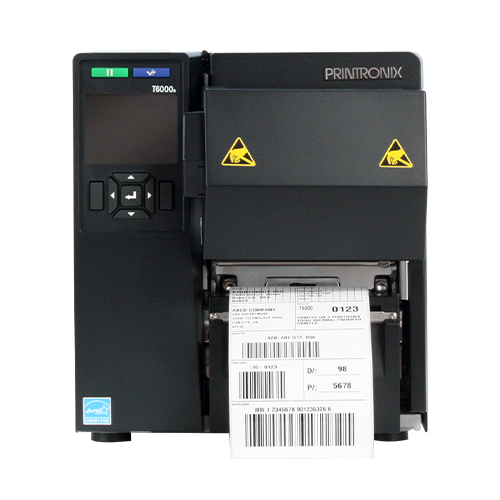
The T6EX04-05-S0-60-10 includes a touchscreen display described as providing real-time diagnostics and direct job management. Warranty coverage listed in the product-type fields is 2 years; an additional spec entry notes '5-Year On-Site Support,' though it is unclear from the provided data whether this is a standard inclusion or an optional service tier. Buyers should confirm scope with TSC before specifying.
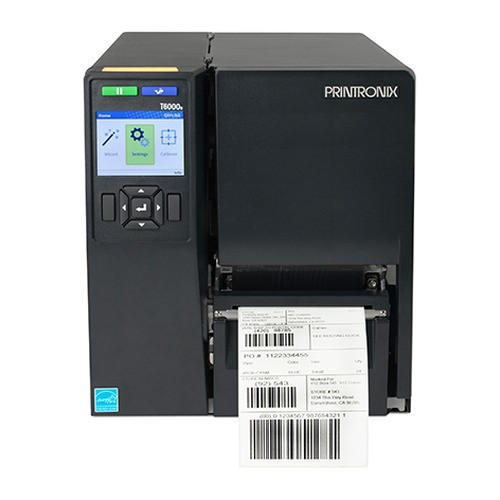
The T6E6X4-1103-00 provides a 4.3-inch color LCD with buttons as its operator interface. Its warranty is listed as 2 years. No on-site support option is referenced in the provided specs. The color LCD offers visual clarity for menu navigation but does not include the touchscreen interaction described for the T6EX04-05-S0-60-10.
Which should you choose: the T6EX04-05-S0-60-10 or the T6E6X4-1103-00?
Our take: The T6EX04-05-S0-60-10 is the stronger choice when RFID encoding is a supply-chain or compliance requirement, as it integrates tag programming into the print pass—a capability not listed for the T6E6X4-1103-00. Conversely, the T6E6X4-1103-00 is the stronger choice for operations that prioritize verified print performance: it specifies 14 ips and 600 DPI, while the T6EX04-05-S0-60-10 publishes neither figure. On connectivity, the T6E6X4-1103-00's Wi-Fi supports flexible placement across a facility floor, whereas the T6EX04-05-S0-60-10 lists USB only. Both carry a 2-year warranty. Buyers running RFID-required logistics or retail replenishment programs should specify the T6EX04-05-S0-60-10; buyers deploying high-speed, high-resolution label stations over a wireless network—without an RFID requirement—will find the T6E6X4-1103-00 better documented for those needs.
Side-by-Side Comparison
Spec-for-spec, from manufacturer data.
| Specification | TSC T6EX04-05-S0-60-10 | TSC T6E6X4-1103-00 |
|---|---|---|
| Brand | TSC | TSC |
| MPN | T6EX04-05-S0-60-10 | T6E6X4-1103-00 |
| Product Class | Industrial Thermal Printer with RFID | Thermal Transfer Industrial Printer |
| Print Technology | Thermal Transfer & Direct Thermal | Direct Thermal / Thermal Transfer |
| Print Speed | — | 14 ips |
| Print Resolution | — | 600 DPI |
| RFID Capability | Integrated RFID Encoding | — |
| Connectivity | USB | Wi-Fi |
| Display | Touchscreen with real-time diagnostics | 4.3-inch color LCD with buttons |
| Media Width | — | 1 to 4 inches |
| Media Types | — | Labels; Tickets |
| Warranty | 2-Year (+ 5-Year On-Site Support noted; confirm scope) | 2-Year |
| Country of Origin | US | — |
| Duty Cycle | Industrial-Grade Continuous Operation (no cycle rate specified) | — |
| Variable Data | ODV2D Dynamic Variable Printing Support | — |
| Form Factor | — | Printer |
Frequently Asked Questions
Which should you choose: the T6EX04-05-S0-60-10 or the T6E6X4-1103-00?
The T6EX04-05-S0-60-10 is the stronger choice when RFID encoding is a supply-chain or compliance requirement, as it integrates tag programming into the print pass—a capability not listed for the T6E6X4-1103-00. Conversely, the T6E6X4-1103-00 is the stronger choice for operations that prioritize verified print performance: it specifies 14 ips and 600 DPI, while the T6EX04-05-S0-60-10 publishes neither figure. On connectivity, the T6E6X4-1103-00's Wi-Fi supports flexible placement across a facility floor, whereas the T6EX04-05-S0-60-10 lists USB only. Both carry a 2-year warranty. Buyers running RFID-required logistics or retail replenishment programs should specify the T6EX04-05-S0-60-10; buyers deploying high-speed, high-resolution label stations over a wireless network—without an RFID requirement—will find the T6E6X4-1103-00 better documented for those needs.
Is the T6EX04-05-S0-60-10 or T6E6X4-1103-00 better for RFID-mandated supply chains?
The T6EX04-05-S0-60-10 is the correct choice for RFID requirements. It lists integrated RFID encoding that programs tags and prints labels in a single pass. The T6E6X4-1103-00 does not list any RFID capability in its provided specifications.
Which model is better for a wireless, distributed warehouse label station?
The T6E6X4-1103-00 specifies Wi-Fi connectivity, making it suitable for placement anywhere within network coverage without a direct cable run to a host. The T6EX04-05-S0-60-10 lists USB connectivity only; no wireless interface is specified in the available data.
Which printer has a confirmed print speed and resolution I can use to size throughput?
Only the T6E6X4-1103-00 publishes both figures: 14 inches per second and 600 DPI. The T6EX04-05-S0-60-10 does not list a print speed or resolution in its provided specifications, so throughput cannot be confirmed from the available data alone.
More Label Printer Comparisons
- Honeywell PX940 vs Sato WWCLP3B01-WAR
- Honeywell PX940 vs Sato WWCLP3801-NAR
- Honeywell PX940 vs Sato WWCLP3801-WAR
- Honeywell PX940 vs Wasp WPL408
- Honeywell PX940 vs Honeywell PX4654-020
- Honeywell PX940 vs Honeywell PX6654-000
Label Printer Buying Guides
Get a Second Opinion on Your Camera Choice
Share your site layout, coverage goals, and budget. Our team will validate the camera selection, flag anything we would change, and recommend products that match the use case.