
Transition Networks S4224 vs Transition Networks SM4T4DPA-NA: Specification Comparison
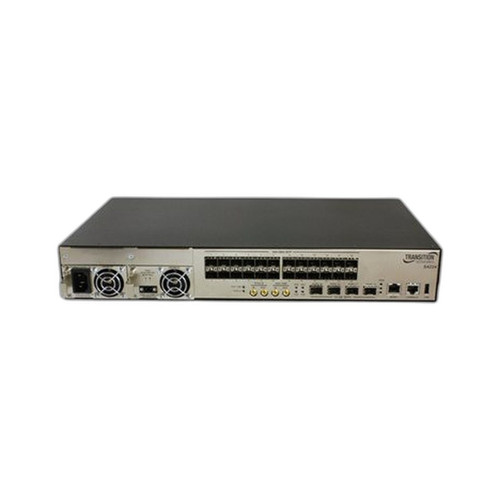
Both the Transition Networks S4224 and SM4T4DPA-NA are 24-port Gigabit unmanaged switches from the same manufacturer, targeting plug-and-play network deployments in security and industrial environments. The comparison centers on three decision-relevant axes: connectivity and fiber capability, physical form factor and environmental suitability, and switching performance. Buyers choosing between these two will primarily weigh the S4224's industrial-rated, DIN-rail-mounted fiber design against the SM4T4DPA-NA's rack-mount copper-only architecture with a specified 48 Gbps switching capacity.

In This Guide
- Which switch offers the right port mix and fiber reach for your cabling infrastructure?
- Which switch is built for the physical environment and mounting constraints of your installation site?
- Which switch delivers better throughput capacity and what management options are available?
- Which should you choose: the S4224 or the SM4T4DPA-NA?
- Side-by-Side Specs
- FAQ
Which switch offers the right port mix and fiber reach for your cabling infrastructure?
The S4224 provides 24 Gigabit Ethernet ports with multi-mode fiber connectivity reaching up to 1000m. This fiber uplink capability is a significant differentiator for deployments in electrically noisy environments—manufacturing floors, parking structures, or any run where copper would be susceptible to EMI. The fiber spec is listed as multi-mode, and maximum range is explicitly stated at 1000m.
The SM4T4DPA-NA offers 24 × Gigabit RJ45 (copper) ports only. The SFP slots field is listed as '00', indicating no SFP or fiber uplink slots are present based on the provided specs. All connectivity is copper-based at 1000 Mbps per port. Buyers requiring fiber connectivity or extended reach beyond standard copper limits will find no equivalent capability in the SM4T4DPA-NA based on available specifications.
Which switch is built for the physical environment and mounting constraints of your installation site?
The S4224 is DIN rail-mounted and explicitly rated for industrial operating temperatures. DIN rail mounting suits electrical panels, control cabinets, and industrial enclosures common in manufacturing, utilities, and transportation infrastructure. The industrial temperature rating means the switch is designed to operate reliably outside the narrow commercial temperature band, though specific min/max temperature values are not provided in the supplied specifications—refer to the datasheet at /content/product-datasheets/S4224.pdf for precise figures.
The SM4T4DPA-NA is rack-mountable, with mounting brackets noted as sold separately. No industrial temperature rating is listed in the provided specifications. Rack mounting suits IT closets, server rooms, and standard 19-inch rack enclosures. The SM4T4DPA-NA's weight is specified at 3.85 (units not stated in specs). The SM4T4DPA-NA is not specified for industrial environments based on available data, making it more appropriate for conditioned, climate-controlled spaces.
Which switch delivers better throughput capacity and what management options are available?
The SM4T4DPA-NA specifies a switching capacity of 48 Gbps and employs a store-and-forward switching architecture. At 24 ports × 1 Gbps full-duplex, 48 Gbps represents non-blocking throughput across all ports simultaneously. Store-and-forward switching validates each frame before forwarding, which filters corrupt or malformed frames—a reliability benefit in camera and access-control networks. No switching capacity figure is provided in the S4224's specifications.
Both switches are unmanaged with plug-and-play operation and carry lifetime warranties. Neither offers VLAN segmentation, QoS prioritization, SNMP monitoring, or any management interface, as both are explicitly unmanaged. The SM4T4DPA-NA's technology field notes a '-OZ = Australia' variant designation, indicating regional SKU variants exist. Neither switch lists PoE capability in the provided specifications.
Which should you choose: the S4224 or the SM4T4DPA-NA?
Our take: The S4224 is the stronger choice when the installation site demands fiber connectivity, extended reach up to 1000m, DIN rail mounting, or industrial temperature tolerance. Its multi-mode fiber uplink eliminates EMI vulnerability over long runs, and DIN rail form factor fits directly into industrial control panels without rack infrastructure. The SM4T4DPA-NA holds an advantage where a documented 48 Gbps non-blocking switching capacity is a procurement requirement—no equivalent figure is provided for the S4224—and where standard rack mounting in a conditioned IT space is the norm. The SM4T4DPA-NA's store-and-forward architecture also provides explicit frame-level error filtering, a spec absent from the S4224's listing. For physical security integrators deploying cameras in industrial or outdoor-cabinet environments with fiber runs, the S4224 is the fit. For IT-closet deployments on copper requiring documented throughput figures, the SM4T4DPA-NA is more appropriate.
Side-by-Side Comparison
Spec-for-spec, from manufacturer data.
| Specification | Transition Networks S4224 | Transition Networks SM4T4DPA-NA |
|---|---|---|
| Product Type | Switch | Switch |
| Total Ports | 24 | 24 |
| Port Type | Gigabit Ethernet | Gigabit RJ45 (copper) |
| Port Speed | Gigabit (1000 Mbps) | 1000 Mbps (Gigabit) |
| Fiber Connectivity | Multi-mode, up to 1000m | — |
| SFP Slots | — | 0 (none listed) |
| Switching Capacity | — | 48 Gbps |
| Switching Architecture | — | Store-and-forward |
| Management | Unmanaged | Unmanaged |
| Mount Type | DIN Rail | Rack-mount (brackets sold separately) |
| Operating Temperature | Industrial-rated | — |
| Form Factor | DIN Rail / Panel | Rack-mountable |
| Weight | — | 3.85 (units not specified) |
| Warranty | Lifetime | Lifetime |
| Datasheet | /content/product-datasheets/S4224.pdf | /content/product-datasheets/SM4T4DPA-NA.pdf |
Frequently Asked Questions
Which should you choose: the S4224 or the SM4T4DPA-NA?
The S4224 is the stronger choice when the installation site demands fiber connectivity, extended reach up to 1000m, DIN rail mounting, or industrial temperature tolerance. Its multi-mode fiber uplink eliminates EMI vulnerability over long runs, and DIN rail form factor fits directly into industrial control panels without rack infrastructure. The SM4T4DPA-NA holds an advantage where a documented 48 Gbps non-blocking switching capacity is a procurement requirement—no equivalent figure is provided for the S4224—and where standard rack mounting in a conditioned IT space is the norm. The SM4T4DPA-NA's store-and-forward architecture also provides explicit frame-level error filtering, a spec absent from the S4224's listing. For physical security integrators deploying cameras in industrial or outdoor-cabinet environments with fiber runs, the S4224 is the fit. For IT-closet deployments on copper requiring documented throughput figures, the SM4T4DPA-NA is more appropriate.
Can the SM4T4DPA-NA be used in outdoor or industrial cabinet installations like the S4224?
Based on the provided specifications, only the S4224 carries an industrial temperature rating and DIN rail mounting suitable for control-cabinet and harsh-environment installations. The SM4T4DPA-NA is specified as rack-mountable with no industrial temperature rating listed. Buyers should consult the SM4T4DPA-NA datasheet at /content/product-datasheets/SM4T4DPA-NA.pdf to confirm its operating temperature range before deploying it outside conditioned spaces.
Which switch is better for camera runs that exceed standard copper distance limits?
The S4224 is the appropriate choice. It specifies multi-mode fiber connectivity with a maximum range of 1000m, which extends well beyond the 100m copper Ethernet limit and eliminates EMI susceptibility on long runs. The SM4T4DPA-NA provides 24 × RJ45 copper ports only; no fiber or SFP capability is listed in its specifications.
Does either switch support PoE to power IP cameras directly?
Neither the S4224 nor the SM4T4DPA-NA lists PoE (Power over Ethernet) capability in the provided specifications. Both are non-PoE switches. A separate PoE injector, PoE midspan, or a different switch model with PoE ports would be required to power IP cameras directly from the switch.
More Network Switch Comparisons
- TP-Link S5500-24GP4XF vs NETGEAR GS728TP-300NAS
- TP-Link S5500-24GP4XF vs Comnet CNGE24FX12TX12MSPOE
- TP-Link S5500-24GP4XF vs Ubiquiti USW-24
- TP-Link S5500-24GP4XF vs Ubiquiti USW-ENTERPRISEXG-24
- TP-Link S5500-24GP4XF vs TP-Link SL2428P
- TP-Link S5500-24GP4XF vs TP-Link SG3428XPP-M2
Network Switch Buying Guides
Get a Second Opinion on Your Camera Choice
Share your site layout, coverage goals, and budget. Our team will validate the camera selection, flag anything we would change, and recommend products that match the use case.