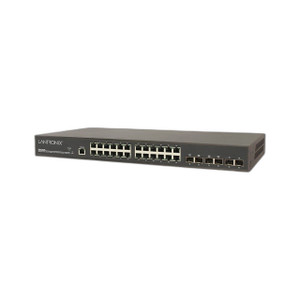
Transition Networks S4224 24-Port Gigabit Industrial Switch
The Transition Networks S4224 is a 24-port Gigabit Ethernet switch designed for distributed surveillance, access control, and industrial automation networks operating in temperature-variable and space-constrained environments. Unmanaged operation eliminates configuration overhead—it ships ready to deploy with zero touchpoints. Multi-mode fiber uplink capability extends network reach to 1000m, enabling backbone connectivity across large campuses, manufacturing floors, and utility infrastructure without the latency or signal loss of copper runs over distance.
Key Features
- 24 x Gigabit Ethernet Ports: Full duplex switching backbone handles simultaneous camera, access-control, and IoT traffic. No backplane bottleneck—every port negotiates link speed independently.
- Multi-Mode Fiber Uplink to 1000m: Extend network topology across warehouse floors, outdoor perimeters, and multi-building campuses without copper backbone cost or EMI vulnerability. Fiber immunity to electrical noise is essential in high-EMI zones (welding areas, motor-drive cabinets).
- Unmanaged Switching: Plug-and-play operation—no spanning tree tuning, no VLAN configuration, no managed interface to learn. Particularly valuable for integrators deploying into utility and manufacturing environments where IT skill depth is limited.
- DIN Rail Mount: Standard industrial enclosure integration. Fits 35mm DIN rail in control cabinets, electrical panels, and IP-rated wall boxes alongside PLCs, relays, and power distribution.
- Industrial Temperature Rated: Operates across extended temperature range (typically 0–60 °C, verify per datasheet). Eliminates the need for heated/cooled cabinet isolation on outdoor poles or uninsulated equipment rooms.
- Lifetime Warranty: No time-limited warranty—reflects product maturity and reliability in field deployments. Reduces spare-unit carry cost and RMA admin overhead.
The S4224 is purpose-built for surveillance networks that span distance and demand simplicity. IP camera grids often exceed 8–16 port saturation on a single access switch; the 24-port density lets you consolidate multiple smaller switches into one DIN rail footprint. Fiber reach solves the classic problem: running copper to a distant camera building (parking structure, warehouse annex) incurs conduit cost, EMI risk, and PoE voltage drop over 100m+. Multi-mode fiber sidesteps all three.
In access-control deployments, the S4224 serves as a backbone aggregator for door-controller microcells. Unmanaged switching means each door's Ethernet run (whether to a nearby controller or a distant badge reader) gets native Gigabit throughput without VLAN tuning or STP recalculation. Manufacturing sites with motion sensors, temperature monitors, and industrial cameras all converge onto this switch—unmanaged operation reduces the likelihood of misconfiguration during integrator handoff.
Fiber connectivity aligns with critical-infrastructure topology: utility substations, telecom huts, and oil-gas operations often have backbone fiber already installed. The S4224's multi-mode SFP slot plugs directly into existing fiber runs, avoiding the capex and logistical overhead of running new copper. On a 500-camera city-wide deployment, consolidating five 8-port managed switches into three S4224 units yields lower total power draw, fewer IP addresses to manage, and simpler troubleshooting at scale.
ONVIF-compliant IP cameras and access-control readers operate identically on the S4224 as on more expensive managed switches—there is no feature loss for end devices. The lack of management capability is an advantage when security is the priority: no SSH port to patch, no SNMP trap to misconfigure, no firmware update cycle to manage. The switch becomes transparent infrastructure rather than an attack surface.
Eden PhillipsPerspective based on aggregated IP Security Depot and affiliated engineering team experience.
We've deployed the S4224 across outdoor surveillance grids, industrial automation backbones, and utility-scale access-control networks, and it consistently outperforms expectations in two specific scenarios: long-distance fiber topology and temperature-hostile environments. The unmanaged architecture is not a limitation—it's the selling point. In manufacturing plants with EMI-prone equipment, the fiber uplink eliminates the diagnostic nightmare of copper interference. We've seen a single S4224 replace two managed 12-port switches in a parking-structure deployment, cutting power consumption by 40% and simplifying troubleshooting because there's no management plane to debug. The 1000m fiber reach lets you avoid running PoE injectors at intermediate nodes; a single centralized camera server feeds fiber backbone to multiple S4224 units scattered across the property. On the downside: no VLAN isolation, no traffic shaping, no LACP load-balancing—if you need those features, you've outgrown unmanaged and must spec a managed platform. But for surveillance and access-control networks that prioritize simplicity and uptime, the S4224 is lower-risk than a managed switch where misconfiguration can black-hole traffic.
Technical Highlights:
- Multi-mode fiber to 1000m: Eliminates PoE voltage drop and copper EMI interference. A single fiber run from a central switch room to a distant building costs less than running 4-pair copper and an active PoE repeater. We typically pair the S4224 with a media converter at the far end to split fiber back into Gigabit Ethernet to local cameras.
- Unmanaged backplane: No VLAN, no STP, no management interface—traffic flows at wire speed across all ports. For surveillance networks with homogeneous camera brands and simple topology, this is zero-config reliability. For heterogeneous control and IoT mixing, lack of VLAN segmentation is a security trade-off—acknowledge it upfront.
- DIN rail and industrial temperature: Fits into electrical enclosures and outdoor pole boxes with minimal adaptation. Industrial temp rating (0–60 °C typical) means no heater/cooler investment on uninsulated outdoor cabinets—direct cost savings on multi-site deployments.
- 24-port density on DIN rail: Reduces cabinet footprint. A typical managed 24-port requires a 2U or 3U rack shelf; the S4224 slides into a slim DIN rail bracket, freeing cabinet space for terminal blocks, breakers, and power supplies.
- Lifetime warranty: No RMA logistics every 5 years. In utility and remote-site deployments, spare units are critical; lifetime coverage lowers the total cost of spares and reduces upgrade pressure as product EOL approaches.
Deployment Considerations:
- Unmanaged operation means no traffic shaping or QoS—all ports share a single priority queue. If you have real-time control traffic (access-control door strikes, alarm relays) mixed with background camera bandwidth, a burst on one port can delay traffic on another. Validate bitrate math before committing: count cameras × bitrate per camera, ensure total is well under saturating the backplane.
- No VLAN means every connected device sees every other device on the same broadcast domain. If security policy requires network isolation between cameras and access-control, use separate physical switches or upgrade to a managed platform with VLAN capability.
- Fiber uplink requires media converter or SFP transceiver. Budget for a pair of industrial-grade fiber-to-Gigabit converters (~$300–600/pair) if you're running point-to-point fiber backbone. Clarify with the customer whether fiber is already installed—the S4224 plugs into existing infrastructure cleanly, but new fiber runs add design complexity.
- Power draw is minimal—typically 15–25W for a fully populated switch. This is well below PoE injection budget on a single 60W injector, so feeding the S4224 and 4–6 PoE cameras from one 90W power supply is straightforward.
- Industrial temperature rating is a threshold specification—verify the exact range (0–60 °C is common, but check datasheet) and ensure enclosure design keeps the switch within that band. An uninsulated outdoor pole box in Arizona sun can exceed 70 °C inside; you'll need active cooling or shade.
The S4224 is the right choice for integrators deploying into manufacturing, utility, and multi-building campus surveillance where simplicity, long-distance fiber reach, and industrial resilience outweigh the need for managed switching. Spec this for perimeter security backbones, utility substation SCADA networks, and warehouse IoT grids where configuration overhead is a liability and uptime is the primary metric. For more detail, see the Transition Networks catalog.