
TP-Link SX3832 vs Ubiquiti USW-24: Specification Comparison
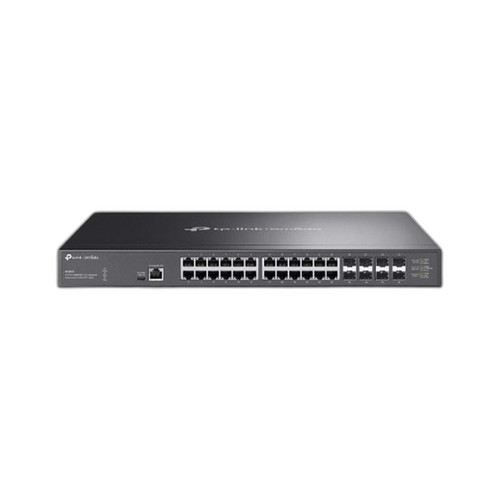
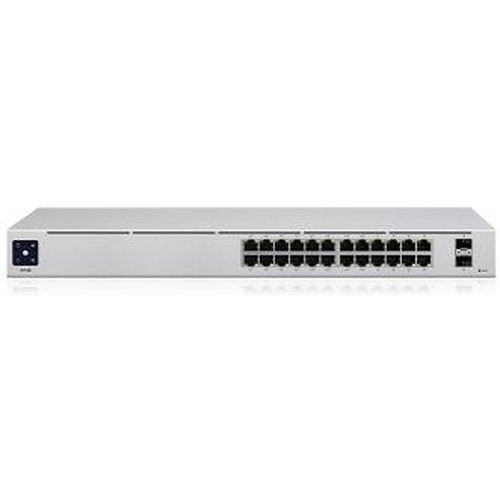
Both the TP-Link SX3832 and Ubiquiti USW-24 are 24-port, non-PoE, rack-mount managed switches targeted at enterprise and prosumer LAN deployments. The SX3832 leads with 10GBASE-T copper and an L2+ feature set under TP-Link's Omada SDN ecosystem, while the USW-24 delivers Gigabit copper under Ubiquiti's UniFi controller platform. Buyers cross-shopping these two are typically sizing a core or aggregation switch for IP camera backbones, access-layer deployments, or mixed IT/OT environments where port density, throughput tier, and management ecosystem are the primary decision axes.
In This Guide
- Which switch delivers the throughput and per-port speed your network actually needs?
- How do the two switches compare on power draw, physical build, and operating environment?
- Which management platform and compliance posture better fits your operational environment?
- Which should you choose: the SX3832 or the USW-24?
- Side-by-Side Specs
- FAQ
Which switch delivers the throughput and per-port speed your network actually needs?
The SX3832 provides 24 × 10GBASE-T RJ45 ports (auto-negotiating down to 1G/2.5G/5G/10G per the product type designation) plus 8 × SFP+ slots supporting 1G or 10G fiber transceivers, yielding a total switching capacity of 640 Gbps at 240 Mpps forwarding rate. Every copper port runs at native 10G, meaning uplink-class bandwidth is available at every edge position.
The USW-24 provides 24 × Gigabit Ethernet RJ45 ports with a switching fabric of 52 Gbps, non-blocking throughput of 26 Gbps, and a forwarding rate of 39 Mpps. No SFP or fiber uplink slots are specified in the provided data. The USW-24's fabric is sufficient for line-rate 1G across all ports, but it cannot scale individual ports beyond 1G.
For deployments running 10G NVRs, multi-gigabit APs, or 10G-capable servers, the SX3832's per-port speed advantage is 10×. For standard 1G edge access where no device exceeds 1G, the USW-24's 52 Gbps fabric is adequate and the SX3832's headroom goes unused.
How do the two switches compare on power draw, physical build, and operating environment?
The SX3832 consumes 104.9 W at 110 V/60 Hz and 106.5 W at 220 V/50 Hz, reflecting the power demands of 24 × 10GBASE-T PHYs. Its enclosure measures 440 × 220 × 44 mm (1U) and it is rated for operation from −5 °C to +50 °C (23 °F to 122 °F). Memory is specified as 32 MB Flash / 512 MB DRAM. Enclosure material is not stated in the provided specifications.
The USW-24 consumes 25 W typical with an internal 36 W AC/DC supply, making it roughly 4× more power-efficient than the SX3832 under real-load conditions. Its enclosure is SGCC steel, measures 442 × 200 × 44 mm (1U), and weighs 2.7 kg without mounting brackets. Operating temperature is rated −5 °C to +45 °C (23 °F to 113 °F), a 5 °C narrower upper bound than the SX3832.
For power-constrained deployments or sites with limited cooling headroom, the USW-24's 25 W draw is a material operational advantage. The SX3832's broader upper operating temperature (50 °C vs. 45 °C) provides a small environmental margin in warmer IDF or edge closets. Enclosure material for the SX3832 is not specified; the USW-24 is documented as SGCC steel.
Which management platform and compliance posture better fits your operational environment?
The SX3832 operates in Standalone mode or under TP-Link's Omada SDN, which supports both cloud-managed and on-premises controller deployment. L2+ management capabilities are cited and include SNMP Trap/Inform and password recovery. The SX3832 is managed via USB connectivity per the source spec. Specific certification marks and NDAA compliance status are not provided in the supplied specifications.
The USW-24 is managed exclusively through Ubiquiti's UniFi controller ecosystem (management interface listed as Ethernet). It supports up to 1,000 VLANs, carries certifications for CE, FCC, IC, and Anatel (17193-20-08356), and is explicitly marked NDAA Compliant in the provided specifications. The USW-24 carries a manufacturer warranty; specific warranty duration is not stated.
Buyers standardized on UniFi will find the USW-24 integrates natively into existing UniFi dashboards with zero additional licensing. Buyers on Omada—or those wanting dual deployment flexibility (cloud or on-premises)—will favor the SX3832. The USW-24's NDAA compliance is a hard requirement for U.S. federal, state, and many critical-infrastructure projects; the SX3832's NDAA status is not specified in the provided data and cannot be assumed.
Which should you choose: the SX3832 or the USW-24?
Our take: The SX3832 is the stronger choice when per-port speed and fiber uplink flexibility are the priority: it delivers 10GBASE-T on all 24 copper ports versus the USW-24's Gigabit-only copper, and its 640 Gbps / 240 Mpps fabric is 12× larger than the USW-24's 52 Gbps / 39 Mpps. However, the USW-24 carries a decisive 80 W power advantage (25 W vs. 104.9 W) critical to multi-switch deployments on shared PDU circuits, and it is the only model with a documented NDAA Compliant designation—a non-negotiable for government and critical-infrastructure sites. Platform lock-in is real: the SX3832 belongs to the Omada SDN ecosystem with cloud or on-premises flexibility; the USW-24 requires UniFi. Choose the SX3832 for 10G-capable access or aggregation layers; choose the USW-24 for power-efficient, compliance-sensitive, UniFi-standardized Gigabit access deployments.
Side-by-Side Comparison
Spec-for-spec, from manufacturer data.
| Specification | TP-Link SX3832 | Ubiquiti USW-24 |
|---|---|---|
| RJ45 Port Count | 24 | 24 |
| RJ45 Port Speed | 10GBASE-T (auto-neg) | Gigabit (1G) |
| SFP / Fiber Uplink Slots | 8 × 1/10GE SFP+ | — |
| Switching Capacity | 640 Gbps | 52 Gbps |
| Forwarding Rate | 240 Mpps | 39 Mpps |
| Non-Blocking Throughput | — | 26 Gbps |
| VLAN Support | — | Up to 1,000 |
| Power Consumption (typical) | 104.9 W @ 110V/60Hz | 25 W |
| Internal PSU Rating | — | 36 W |
| Input Voltage | 100–240 V AC, 50/60 Hz | 100–240 V AC, 50/60 Hz |
| Form Factor | 1U Rack (440 × 220 × 44 mm) | 1U Rack (442 × 200 × 44 mm) |
| Operating Temperature | −5 °C to +50 °C | −5 °C to +45 °C |
| Flash / DRAM Memory | 32 MB Flash / 512 MB DRAM | — |
| Management Ecosystem | Omada SDN (cloud or on-prem) | UniFi (controller-based) |
| NDAA Compliant | — | Yes |
| Certifications | — | CE, FCC, IC, Anatel |
Frequently Asked Questions
Which should you choose: the SX3832 or the USW-24?
The SX3832 is the stronger choice when per-port speed and fiber uplink flexibility are the priority: it delivers 10GBASE-T on all 24 copper ports versus the USW-24's Gigabit-only copper, and its 640 Gbps / 240 Mpps fabric is 12× larger than the USW-24's 52 Gbps / 39 Mpps. However, the USW-24 carries a decisive 80 W power advantage (25 W vs. 104.9 W) critical to multi-switch deployments on shared PDU circuits, and it is the only model with a documented NDAA Compliant designation—a non-negotiable for government and critical-infrastructure sites. Platform lock-in is real: the SX3832 belongs to the Omada SDN ecosystem with cloud or on-premises flexibility; the USW-24 requires UniFi. Choose the SX3832 for 10G-capable access or aggregation layers; choose the USW-24 for power-efficient, compliance-sensitive, UniFi-standardized Gigabit access deployments.
Is the SX3832 or USW-24 better for a 10G IP camera or NVR backbone?
The SX3832 is the appropriate choice. All 24 copper ports operate at 10GBASE-T, and its 8 SFP+ slots add 1G/10G fiber uplink capacity—total fabric is 640 Gbps at 240 Mpps. The USW-24 is capped at 1G per port with a 52 Gbps fabric, which is insufficient for aggregating multiple 10G-capable devices.
Which switch is better for a power-constrained rack or multi-site deployment?
The USW-24 draws 25 W typical versus the SX3832's 104.9 W, making it roughly 4× more efficient. For deployments where PDU capacity, UPS runtime, or utility cost are constraints—common in multi-site or edge-closet scenarios—the USW-24's power profile is the material advantage.
Can either switch be used on U.S. federal or NDAA-restricted projects?
The USW-24 is explicitly listed as NDAA Compliant in the provided specifications. NDAA compliance status for the SX3832 is not stated in the supplied spec data and cannot be assumed; buyers with federal or NDAA-restricted requirements should verify directly with TP-Link before specifying the SX3832.
More Network Switch Comparisons
- TP-Link S5500-24GP4XF vs NETGEAR GS728TP-300NAS
- TP-Link S5500-24GP4XF vs Comnet CNGE24FX12TX12MSPOE
- TP-Link S5500-24GP4XF vs Ubiquiti USW-24
- TP-Link S5500-24GP4XF vs Ubiquiti USW-ENTERPRISEXG-24
- TP-Link S5500-24GP4XF vs TP-Link SL2428P
- TP-Link S5500-24GP4XF vs TP-Link SG3428XPP-M2
Network Switch Buying Guides
Get a Second Opinion on Your Camera Choice
Share your site layout, coverage goals, and budget. Our team will validate the camera selection, flag anything we would change, and recommend products that match the use case.