
TP-Link SL2428P vs Comnet CNGE24FX12TX12MSPOE: Specification Comparison
Both the TP-Link SL2428P and the Comnet CNGE24FX12TX12MSPOE are managed PoE+ Ethernet switches targeted at physical-security and surveillance deployments. The SL2428P is a 24-port 10/100 Mbps access switch with four Gigabit uplinks and cloud-based management, suited to cost-conscious commercial installations. The CNGE24FX12TX12MSPOE is a hardened 24-port industrial switch combining 12 copper and 12 fiber SFP ports with a wide operating temperature range and rail/shock/vibration certifications, aimed at demanding outdoor or transit infrastructure environments.
In This Guide
- How do port architecture and switching throughput differ between the two switches?
- Which switch delivers more PoE headroom and handles harsher operating conditions?
- How do the two switches compare on management capabilities and security integration?
- Which should you choose: the SL2428P or the CNGE24FX12TX12MSPOE?
- Side-by-Side Specs
- FAQ
How do port architecture and switching throughput differ between the two switches?
The TP-Link SL2428P provides 24 × 10/100 Mbps copper ports plus 4 × Gigabit ports (2 × RJ45 and 2 × Combo RJ45/SFP), yielding a switching capacity of 12.8 Gbps and a forwarding rate of 9.52 Mpps. Flash memory is 32 MB and DRAM is 256 MB.
The Comnet CNGE24FX12TX12MSPOE offers 12 × 10/100/1000Base-TX copper ports and 12 × SFP fiber ports — a fundamentally different architecture where half the ports are fiber-native. Its switching bandwidth is 54 Gbps, with 1 GB DRAM and 128 MB Flash. MAC table size is 8K entries, maximum VLANs 256, and jumbo frame size 9.6 KB versus 9 KB on the SL2428P.
For pure copper-edge density the SL2428P wins on port count (24 copper vs. 12), but the Comnet's 54 Gbps fabric and 12 SFP slots make it the correct choice wherever fiber runs or high-bandwidth aggregation are required. The SL2428P's 10/100 Mbps access ports cap individual device bandwidth at 100 Mbps; the Comnet's copper ports are all Gigabit.
Which switch delivers more PoE headroom and handles harsher operating conditions?
The SL2428P has a 250 W total PoE+ budget across its 24 copper ports (up to 30 W per port, 802.3af/at), with a maximum power consumption of 250 W under full PoE load and 8.9 W standby. It operates from 100–240 V AC only, and its rated operating temperature is −5 °C to 50 °C (23 °F to 122 °F).
The CNGE24FX12TX12MSPOE supports PoE+ (802.3at, 30 W per port) on 12 of its 24 ports, with a maximum power consumption of 390 W. Its operating temperature range is −40 °C to +75 °C, and its storage temperature range is −40 °C to 85 °C. It carries IEC 60068-2-27 shock, IEC 60068-2-32 free-fall, IEC 60068-2-6 vibration, EN 50121-4 rail, and EN 60950-1 safety certifications, as well as full EN 61000-4-x EMS compliance. Operating humidity is rated to 95% non-condensing. MTBF is stated as greater than 100,000 hours. Power supply type (AC vs. DC options implied by the two weight variants) is not fully detailed in the provided specs.
Installers deploying cameras or access points in controlled indoor environments will find the SL2428P's 250 W budget sufficient for 24 edge devices. The Comnet's hardened envelope — 115 °C wider thermal range, shock/vibration/rail certifications, and stated MTBF — is required for outdoor enclosures, transit installations, or any site where ambient conditions exceed the TP-Link's 50 °C ceiling.
How do the two switches compare on management capabilities and security integration?
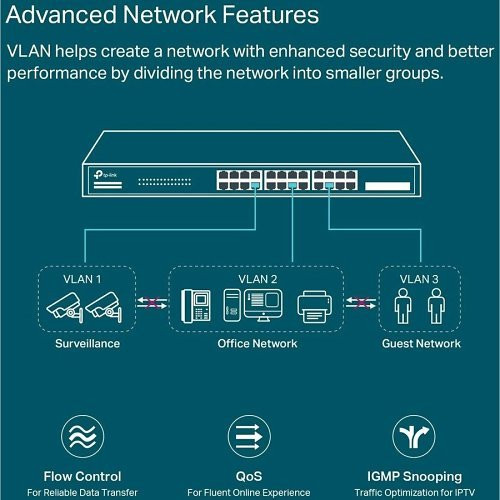
The TP-Link SL2428P supports Omada cloud management, standalone web GUI, CLI, SNMP, and RMON. Layer-2 features include 802.1Q VLAN, STP/RSTP/MSTP, IGMP Snooping, QoS (802.1p/DSCP), ACL, LACP, and Static Routing. Authentication is handled via 802.1X with RADIUS/TACACS+ backend support. ONVIF compatibility is listed in the provided specs. Jumbo frames are supported up to 9 KB.
The Comnet CNGE24FX12TX12MSPOE is described as a managed switch with 256 VLANs, 32 static routes, and 8K MAC table. The provided specifications do not detail the specific management interfaces (web GUI, SNMP version, CLI access), cloud management options, ONVIF status, or authentication protocol support beyond what is implied by 'managed.' Switching latency is specified at 7 μS.
The SL2428P's Omada ecosystem provides a documented cloud-management path and explicit ONVIF declaration, which are meaningful differentiators for integrators standardizing on TP-Link infrastructure or needing camera-network ONVIF compliance verification. The Comnet's management feature set is not fully enumerated in the provided specs; buyers should request the full datasheet before comparing management depth.
Which should you choose: the SL2428P or the CNGE24FX12TX12MSPOE?
Our take: The SL2428P is the stronger choice when the deployment is an indoor commercial site requiring 24 copper PoE+ edge ports, Omada cloud management, and a lower acquisition cost against a controlled budget. The CNGE24FX12TX12MSPOE is the correct choice when the site demands hardened operation: its −40 °C to +75 °C operating range versus the SL2428P's −5 °C to 50 °C is a 115 °C wider thermal envelope, its 54 Gbps switching fabric is 4.2× the SL2428P's 12.8 Gbps, and its 12 native SFP fiber ports eliminate media converters on long-run or inter-building segments. Note that the Comnet provides PoE+ on only 12 ports versus 24 on the TP-Link. For indoor enterprise or SMB camera networks on copper, the SL2428P fits; for transit, outdoor-enclosure, or mixed copper-fiber industrial deployments, the Comnet is the appropriate platform.
Side-by-Side Comparison
Spec-for-spec, from manufacturer data.
| Specification | TP-Link SL2428P | Comnet CNGE24FX12TX12MSPOE |
|---|---|---|
| Port Count — Copper (RJ45) | 24 × 10/100 Mbps + 2 × Gigabit RJ45 | 12 × 10/100/1000 Mbps RJ45 |
| Port Count — Fiber (SFP) | 2 × Combo Gigabit RJ45/SFP | 12 × SFP |
| PoE+ Ports | 24 (all copper ports) | 12 |
| PoE Standard | 802.3af/at | 802.3at |
| PoE Budget (Total) | 250 W | Not stated (max consumption 390 W) |
| PoE Power Per Port (Max) | 30 W | 30 W |
| Switching Capacity | 12.8 Gbps | 54 Gbps |
| Forwarding Rate | 9.52 Mpps | — |
| Switching Latency | — | 7 μS |
| Operating Temperature | −5 °C to 50 °C | −40 °C to +75 °C |
| DRAM | 256 MB | 1 GB |
| Flash | 32 MB | 128 MB |
| Max VLANs | Not stated in spec (802.1Q supported) | 256 |
| MAC Table Size | — | 8K |
| Hardening Certifications | None listed | IEC 60068-2-27 / -32 / -6; EN 50121-4; EN 61000-4-x |
| MTBF | — | > 100,000 hours |
Frequently Asked Questions
Which should you choose: the SL2428P or the CNGE24FX12TX12MSPOE?
The SL2428P is the stronger choice when the deployment is an indoor commercial site requiring 24 copper PoE+ edge ports, Omada cloud management, and a lower acquisition cost against a controlled budget. The CNGE24FX12TX12MSPOE is the correct choice when the site demands hardened operation: its −40 °C to +75 °C operating range versus the SL2428P's −5 °C to 50 °C is a 115 °C wider thermal envelope, its 54 Gbps switching fabric is 4.2× the SL2428P's 12.8 Gbps, and its 12 native SFP fiber ports eliminate media converters on long-run or inter-building segments. Note that the Comnet provides PoE+ on only 12 ports versus 24 on the TP-Link. For indoor enterprise or SMB camera networks on copper, the SL2428P fits; for transit, outdoor-enclosure, or mixed copper-fiber industrial deployments, the Comnet is the appropriate platform.
Is the SL2428P or CNGE24FX12TX12MSPOE better for outdoor or transit deployments?
The CNGE24FX12TX12MSPOE is specifically rated for outdoor and transit environments: it carries IEC 60068-2-27 shock, IEC 60068-2-6 vibration, and EN 50121-4 rail certifications, and operates from −40 °C to +75 °C. The SL2428P is rated only to −5 °C to 50 °C and carries no shock, vibration, or rail certifications per the provided specs, making it unsuitable for those environments.
Which switch supports more PoE-powered devices simultaneously?
The TP-Link SL2428P provides PoE+ on all 24 copper ports with a 250 W total budget. The Comnet CNGE24FX12TX12MSPOE provides PoE+ on 12 of its 24 ports at 30 W per port. If maximizing the number of simultaneously powered devices on a single switch is the priority, the SL2428P's 24 PoE-capable ports give it an advantage, provided the 250 W budget is managed across the port population.
Do both switches work with fiber uplinks or SFP transceivers?
The SL2428P includes 2 × Combo Gigabit RJ45/SFP ports, supporting single-mode or multi-mode SFP transceivers on those two uplink slots only. The CNGE24FX12TX12MSPOE provides 12 dedicated SFP fiber ports across the switching fabric, making fiber a primary connectivity medium rather than an uplink option. Installations requiring multiple fiber segments or long-distance inter-switch runs will find the Comnet's 12-port SFP architecture far more capable.
More Network Switch Comparisons
- TP-Link S5500-24GP4XF vs NETGEAR GS728TP-300NAS
- TP-Link S5500-24GP4XF vs Comnet CNGE24FX12TX12MSPOE
- TP-Link S5500-24GP4XF vs Ubiquiti USW-24
- TP-Link S5500-24GP4XF vs Ubiquiti USW-ENTERPRISEXG-24
- TP-Link S5500-24GP4XF vs TP-Link SL2428P
- TP-Link S5500-24GP4XF vs TP-Link SG3428XPP-M2
Network Switch Buying Guides
Get a Second Opinion on Your Camera Choice
Share your site layout, coverage goals, and budget. Our team will validate the camera selection, flag anything we would change, and recommend products that match the use case.