
TP-Link SL1218MP vs TP-Link SG1016PE: Specification Comparison
The TP-Link TL-SL1218MP and TL-SG1016PE are both 16-port rackmount PoE switches from TP-Link's JetStream and Easy Smart lines, frequently cross-shopped by integrators deploying IP cameras, access control panels, and wireless access points. The SL1218MP delivers PoE+ across all 16 access ports at Fast Ethernet speeds, while the SG1016PE provides full Gigabit throughput but restricts PoE to 8 of its 16 ports and adds lightweight Layer 2 management. The right choice depends on port-speed requirements, PoE device count, and whether VLAN or QoS control is needed.
In This Guide
- Which switch delivers the right port speed and PoE coverage for your device mix?
- Which switch has the headroom to power your devices and handle your traffic load?
- Which switch fits your management model, operating environment, and installation requirements?
- Which should you choose: the SL1218MP or the SG1016PE?
- Side-by-Side Specs
- FAQ
Which switch delivers the right port speed and PoE coverage for your device mix?
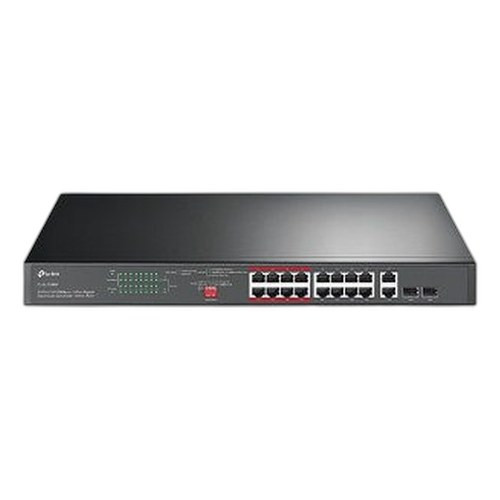
The TL-SL1218MP provides 16 access ports at 10/100 Mbps with PoE+ (802.3af/at) on every port, plus 2 dedicated Gigabit combo (RJ45/SFP) uplinks — 18 ports total. Every PoE device on the switch can draw up to 30 W per port, and the combined PoE budget is 192 W. This makes it well-suited to large camera arrays where devices are 1080p or lower resolution and do not require Gigabit bandwidth to the edge.
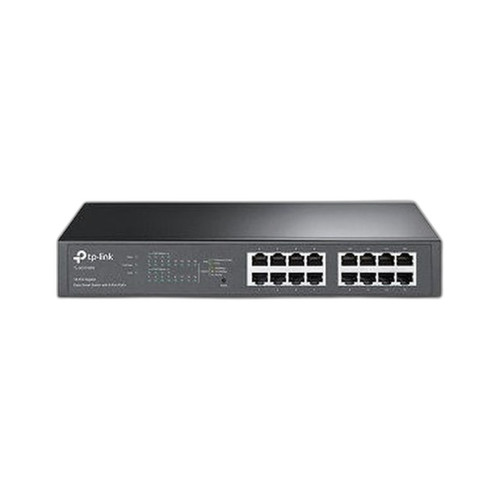
The TL-SG1016PE provides all 16 ports at 1 Gbps (full Gigabit), but PoE is available on only 8 of those ports per the product specification (Card_Bullet_1: '16-port gigabit easy smart switch with 8 PoE ports'). The PoE budget is 120 W across those 8 ports. Per-port PoE wattage is not specified. Buyers needing Gigabit to every edge device — high-resolution IP cameras, multi-gigabit NVRs, or Wi-Fi 6 APs — benefit from the SG1016PE's port speed, but must plan around its 8-port PoE ceiling.
The SL1218MP's Extend Mode stretches 10 Mbps PoE reaches to 250 m on Cat5e/Cat6, which can eliminate a mid-run switch in sparse outdoor surveillance runs. No equivalent extended-reach mode is documented for the SG1016PE.
Which switch has the headroom to power your devices and handle your traffic load?
On PoE budget, the TL-SL1218MP holds a significant advantage: 192 W total vs. the TL-SG1016PE's 120 W. Across 16 PoE ports the SL1218MP averages 12 W available per port if all ports are loaded simultaneously; peak per-port delivery is 30 W (802.3at). The SG1016PE's 120 W across 8 PoE ports averages 15 W per PoE port simultaneously; its per-port maximum is not stated in the provided specifications.
Switching capacity is documented only for the SL1218MP at 7.2 Gbps. The TL-SG1016PE's switching capacity is not provided in the supplied specifications. For reference, a fully non-blocking 16-port Gigabit switch requires 32 Gbps of switching fabric; whether the SG1016PE meets that threshold cannot be confirmed from available data.
Forwarding rate and packet buffer size are absent for both models in the provided specifications, so a full throughput comparison is not possible.
Which switch fits your management model, operating environment, and installation requirements?
The TL-SL1218MP is fully unmanaged — plug-and-play with no configuration interface. It offers two operating modes selectable via physical switch (Priority Mode prioritizes ports 1–8; Extend Mode enables 250 m reach on ports 1–8 at 10 Mbps), but neither mode requires software or a web UI. This suits installers who need zero-touch deployment and do not require per-VLAN segmentation or QoS policy.
The TL-SG1016PE is classified as 'Easy Smart' — TP-Link's lightweight Layer 2 management tier. Per the product card, it supports VLAN and QoS configuration. This is meaningful in mixed deployments where camera traffic must be isolated from corporate LAN traffic, or where voice/video prioritization is required. A web-based management interface is implied by the Easy Smart designation, though login credentials and protocol specifics (HTTP/HTTPS, SNMP version) are not detailed in the provided specifications.
Physically, the SL1218MP is documented at 440 × 180 × 44 mm (1U) with 2 cooling fans and an operating temperature of 0°C–40°C. The SG1016PE's physical dimensions, fan count, and operating temperature range are not provided in the supplied specifications, making an environmental comparison impossible from the available data.
Which should you choose: the SL1218MP or the SG1016PE?
Our take: The SL1218MP is the stronger choice when you need PoE+ on every access port and are deploying 16 or more PoE devices — cameras, door controllers, or intercoms — that do not require Gigabit edge bandwidth. Its 192 W PoE budget exceeds the SG1016PE's 120 W by 72 W (60% more headroom), it delivers 802.3at (30 W) on all 16 ports versus the SG1016PE's 8 PoE ports with unspecified per-port wattage, and its 250 m Extend Mode can reduce infrastructure cost in large outdoor perimeters. The SG1016PE is the correct pick when all 16 ports need full Gigabit throughput — high-resolution 4K cameras, multi-stream NVRs, or Wi-Fi 6 APs — and when VLAN segmentation or QoS policy is operationally required. If your deployment has more than 8 PoE devices or prioritizes PoE density, the SL1218MP wins on power architecture; if port speed and basic management matter more than PoE port count, the SG1016PE is the appropriate selection.
Side-by-Side Comparison
Spec-for-spec, from manufacturer data.
| Specification | TP-Link SL1218MP | TP-Link SG1016PE |
|---|---|---|
| PoE Access Ports | 16 (all ports) | 8 of 16 ports |
| Non-PoE Ports | 2× Gigabit uplink only | 8× Gigabit (non-PoE) |
| Access Port Speed | 10/100 Mbps | 1 Gbps |
| Uplink / Combo Slots | 2× Gigabit RJ45/SFP combo | — |
| PoE Standard | 802.3af / 802.3at (PoE+) | PoE (standard not specified) |
| PoE Budget (Total) | 192 W | 120 W |
| Max PoE Per Port | 30 W | — |
| Switching Capacity | 7.2 Gbps | — |
| Management | Unmanaged | Easy Smart (VLAN, QoS) |
| Extend Mode | Yes — 250 m on ports 1–8 at 10 Mbps | — |
| Priority Mode | Yes — ports 1–8 prioritized | — |
| Mount Type | Rack (1U) | — |
| Dimensions | 440 × 180 × 44 mm | — |
| Cooling | 2 fans | — |
| Operating Temperature | 0°C – 40°C | — |
| Power Supply Input | 100–240 V AC, 50/60 Hz | — |
Frequently Asked Questions
Which should you choose: the SL1218MP or the SG1016PE?
The SL1218MP is the stronger choice when you need PoE+ on every access port and are deploying 16 or more PoE devices — cameras, door controllers, or intercoms — that do not require Gigabit edge bandwidth. Its 192 W PoE budget exceeds the SG1016PE's 120 W by 72 W (60% more headroom), it delivers 802.3at (30 W) on all 16 ports versus the SG1016PE's 8 PoE ports with unspecified per-port wattage, and its 250 m Extend Mode can reduce infrastructure cost in large outdoor perimeters. The SG1016PE is the correct pick when all 16 ports need full Gigabit throughput — high-resolution 4K cameras, multi-stream NVRs, or Wi-Fi 6 APs — and when VLAN segmentation or QoS policy is operationally required. If your deployment has more than 8 PoE devices or prioritizes PoE density, the SL1218MP wins on power architecture; if port speed and basic management matter more than PoE port count, the SG1016PE is the appropriate selection.
Can the SL1218MP or SG1016PE power more PoE cameras simultaneously?
The SL1218MP can power up to 16 PoE cameras simultaneously with a 192 W total budget and up to 30 W per port (802.3at). The SG1016PE supports PoE on only 8 of its 16 ports with a 120 W total budget; per-port maximum wattage is not stated in the provided specifications. For deployments requiring more than 8 powered devices, the SL1218MP is the only option of the two.
Do I need the SG1016PE if I want to set up VLANs to isolate camera traffic?
Yes. The TL-SL1218MP is fully unmanaged and provides no VLAN or QoS configuration capability. The TL-SG1016PE's Easy Smart management layer includes VLAN and QoS support per its specification. If network segmentation between camera traffic and corporate LAN is a requirement, the SG1016PE is the appropriate choice between these two models.
Is the SL1218MP or SG1016PE better suited for cameras mounted far from the wiring closet?
The SL1218MP includes an Extend Mode that stretches PoE reach to 250 m (vs. the standard 100 m) on ports 1–8 at 10 Mbps. No equivalent extended-reach mode is documented for the SG1016PE in the provided specifications. For installations where camera runs exceed 100 m and re-running cable is not practical, the SL1218MP's Extend Mode is a documented differentiator.
More Network Switch Comparisons
- Vivotek GEL-205A-260 vs TP-Link SL1218MP
- Vivotek GEL-205A-260 vs Allied Telesis AT-x530L-18GHXm-10
- Vivotek GEL-205A-260 vs Ubiquiti USW-LITE-16-POE
- Vivotek GEL-205A-260 vs Ubiquiti USW-16-POE
- TP-Link SL1218MP vs Allied Telesis AT-x530L-18GHXm-10
- TP-Link SL1218MP vs Ubiquiti USW-LITE-16-POE
Network Switch Buying Guides
Get a Second Opinion on Your Camera Choice
Share your site layout, coverage goals, and budget. Our team will validate the camera selection, flag anything we would change, and recommend products that match the use case.