
TP-Link SG6428XHP vs Ubiquiti USW-ENTERPRISEXG-24: Specification Comparison
Both the TP-Link SG6428XHP and the Ubiquiti USW-ENTERPRISEXG-24 are 24-port, 1U rack-mount Layer 3 managed switches aimed at professional IP surveillance and enterprise LAN deployments. The comparison pivots on a fundamental design trade-off: the SG6428XHP delivers 802.3at PoE+ on all 24 GbE ports with a 720 W budget, while the USW-ENTERPRISEXG-24 drops PoE entirely in favor of 24 × 10GbE RJ45 ports and a 580 Gbps switching fabric. Buyers must decide whether edge-layer power delivery or raw per-port throughput is the primary constraint.
In This Guide
- Which switch delivers the right per-port speed and backplane headroom for your camera density?
- Which switch can power cameras and other PoE devices at the edge, and what are the power budget implications?
- How do the two switches compare on physical build, operating environment, management ecosystem, and compliance?
- Which should you choose: the SG6428XHP or the USW-ENTERPRISEXG-24?
- Side-by-Side Specs
- FAQ
Which switch delivers the right per-port speed and backplane headroom for your camera density?
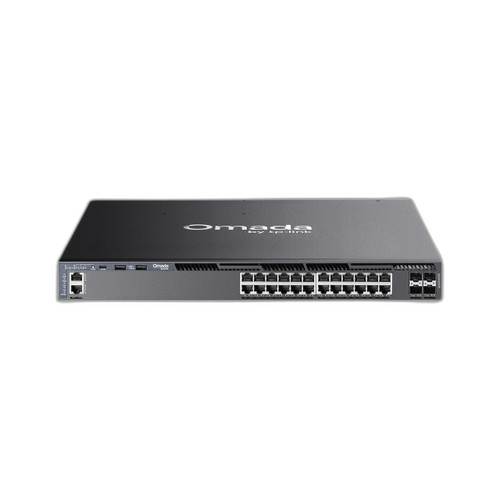
The SG6428XHP provides 24 × 10/100/1000 Mbps RJ45 ports plus 4 × 10G SFP+ uplinks, with a switching capacity of 128 Gbps. Each access port is capped at 1 Gbps, which comfortably sustains standard 1080p and 4MP IP cameras but may become a constraint as camera bitrates scale toward 4K H.265 streams at 20–30 Mbps per channel. The processor is a dual-core ARM at 1.5 GHz; storage is specified as 2 × 4 MB NOR flash plus 8,192 MB eMMC. Forwarding rate is not stated in the provided specs.
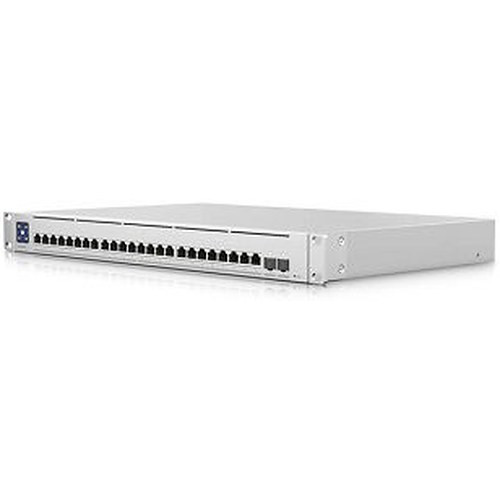
The USW-ENTERPRISEXG-24 runs 24 × 10GbE RJ45 ports — ten times the per-port bandwidth of the SG6428XHP — plus 2 × 25G SFP28 uplinks. Its switching capacity reaches 580 Gbps and forwarding rate is specified at 432 Mpps. This backplane headroom is substantially larger, making the USW-ENTERPRISEXG-24 more appropriate for high-density 4K or 8K camera streams, NVR aggregation tiers, or environments where multiple high-throughput devices share a port. Processor specs and onboard storage are not stated in the provided specs for the Ubiquiti unit.
Which switch can power cameras and other PoE devices at the edge, and what are the power budget implications?
The SG6428XHP supports 802.3af and 802.3at (PoE+) on all 24 RJ45 ports, with a total PoE budget of 720 W when equipped with 2 × PSM500-AC power supplies. At 30 W per port (802.3at maximum), all 24 ports can be fully loaded simultaneously. The switch also notes support for perpetual PoE (power maintained during switch reboot) and fast PoE (power delivered before the OS loads), which are operationally significant for cameras requiring uninterrupted power. The switch's total power draw spec beyond the PoE budget is not separately stated in the provided specs.
The USW-ENTERPRISEXG-24 provides no PoE capability on any port, as specified. Its total power consumption is listed at 100 W (AC/DC internal supply, 100–240 V AC). Deployers using this switch must provision PoE via external midspan injectors, PoE-capable media converters, or a separate PoE switch upstream of cameras. This adds cost and rack space that the SG6428XHP avoids. The absence of PoE is a fundamental architectural difference, not a minor feature gap.
How do the two switches compare on physical build, operating environment, management ecosystem, and compliance?
The SG6428XHP measures 440 × 420 × 44 mm (1U) and operates from −5 °C to 45 °C. Management is via the TP-Link Omada SDN platform through a dedicated RJ45 management port. The operating system is noted as 'PF' in the provided specs, with bandwidth controls including egress rate limiting and broadcast control. Stacking is mentioned in the product name but stacking port count and protocol are not detailed in the provided specs. NDAA compliance status is not stated in the provided specs.
The USW-ENTERPRISEXG-24 measures 442 × 285 × 44 mm (1U) and operates from −5 °C to 40 °C — a 5 °C narrower upper thermal limit. The enclosure and mounting brackets are SGCC steel. Management is via SNMP, CLI, Web UI, and UniFi Network integration. The switch is confirmed NDAA compliant and carries CE, FCC, IC, and Anatel certifications. Weight without brackets is 4.5 kg (9.9 lb). Management protocol detail for the SG6428XHP (SNMP version, CLI availability) is not stated in the provided specs. Stacking capability is not referenced in the Ubiquiti specs.
Which should you choose: the SG6428XHP or the USW-ENTERPRISEXG-24?
Our take: The SG6428XHP is the stronger choice when every camera port must deliver PoE+ power at the edge and total installed cost matters: its 720 W PoE budget across 24 × 802.3at ports eliminates the need for external midspan hardware that the USW-ENTERPRISEXG-24 requires. Conversely, the USW-ENTERPRISEXG-24 is the stronger choice when per-port throughput is the binding constraint — its 24 × 10GbE access ports and 580 Gbps switching fabric (versus 128 Gbps on the SG6428XHP) are 4.5× the backplane and ten times the per-port speed, and its 432 Mpps forwarding rate is not matched by any stated figure for the TP-Link. NDAA compliance is confirmed only for the Ubiquiti unit, which is a disqualifying factor for U.S. federal and NDAA-restricted deployments. Platform lock-in is also decisive: Omada SDN versus UniFi are incompatible ecosystems.
Side-by-Side Comparison
Spec-for-spec, from manufacturer data.
| Specification | TP-Link SG6428XHP | Ubiquiti USW-ENTERPRISEXG-24 |
|---|---|---|
| Access Port Count | 24 | 24 |
| Access Port Speed | 10/100/1000 Mbps (1GbE) | 10GbE (10,000 Mbps) |
| Uplink Ports | 4 × 10G SFP+ | 2 × 25G SFP28 |
| Switching Capacity | 128 Gbps | 580 Gbps |
| Forwarding Rate | — | 432 Mpps |
| PoE Standard | 802.3af / 802.3at (PoE+) | None |
| PoE Budget | 720 W (with 2 × PSM500-AC) | — |
| Total Power Consumption | — | 100 W |
| Power Input | 100–240 V AC, 50/60 Hz | 100–240 V AC |
| Layer | Layer 3 Managed | Layer 3 Managed |
| Management Ecosystem | TP-Link Omada SDN | UniFi Network (SNMP, CLI, Web UI) |
| Management Port | 1 × RJ45 dedicated | Ethernet (type not specified) |
| Processor | Dual-core ARM @ 1.5 GHz | — |
| Operating Temp | −5 °C to 45 °C | −5 °C to 40 °C |
| Dimensions (mm) | 440 × 420 × 44 | 442 × 285 × 44 |
| NDAA Compliant | — | Yes |
Frequently Asked Questions
Which should you choose: the SG6428XHP or the USW-ENTERPRISEXG-24?
The SG6428XHP is the stronger choice when every camera port must deliver PoE+ power at the edge and total installed cost matters: its 720 W PoE budget across 24 × 802.3at ports eliminates the need for external midspan hardware that the USW-ENTERPRISEXG-24 requires. Conversely, the USW-ENTERPRISEXG-24 is the stronger choice when per-port throughput is the binding constraint — its 24 × 10GbE access ports and 580 Gbps switching fabric (versus 128 Gbps on the SG6428XHP) are 4.5× the backplane and ten times the per-port speed, and its 432 Mpps forwarding rate is not matched by any stated figure for the TP-Link. NDAA compliance is confirmed only for the Ubiquiti unit, which is a disqualifying factor for U.S. federal and NDAA-restricted deployments. Platform lock-in is also decisive: Omada SDN versus UniFi are incompatible ecosystems.
Is the SG6428XHP or the USW-ENTERPRISEXG-24 better for powering IP cameras directly from the switch?
The SG6428XHP is the only option of the two that can power cameras directly. It supports 802.3af/at PoE+ on all 24 ports with a 720 W total budget. The USW-ENTERPRISEXG-24 has no PoE capability on any port per its specifications; cameras would require separate power sources or external PoE injectors.
Which switch handles high-density 4K or 8K IP camera streams without backplane saturation?
The USW-ENTERPRISEXG-24 is better suited for high-bitrate 4K/8K streams. Its 24 × 10GbE ports provide ten times the per-port bandwidth of the SG6428XHP's 24 × 1GbE ports, and its 580 Gbps switching capacity and 432 Mpps forwarding rate (versus 128 Gbps on the SG6428XHP, with forwarding rate not specified) provide substantially more headroom against backplane saturation.
Which switch is NDAA compliant for U.S. government or federally funded projects?
Only the USW-ENTERPRISEXG-24 is confirmed NDAA compliant in the provided specifications. NDAA compliance is not stated in the provided specifications for the SG6428XHP. Installers on federal contracts or NDAA-restricted projects should verify compliance status directly with TP-Link before specifying the SG6428XHP.
More Network Switch Comparisons
- TP-Link S5500-24GP4XF vs NETGEAR GS728TP-300NAS
- TP-Link S5500-24GP4XF vs Comnet CNGE24FX12TX12MSPOE
- TP-Link S5500-24GP4XF vs Ubiquiti USW-24
- TP-Link S5500-24GP4XF vs Ubiquiti USW-ENTERPRISEXG-24
- TP-Link S5500-24GP4XF vs TP-Link SL2428P
- TP-Link S5500-24GP4XF vs TP-Link SG3428XPP-M2
Network Switch Buying Guides
Get a Second Opinion on Your Camera Choice
Share your site layout, coverage goals, and budget. Our team will validate the camera selection, flag anything we would change, and recommend products that match the use case.