
TP-Link SG6428XHP vs Ubiquiti USW-24: Specification Comparison
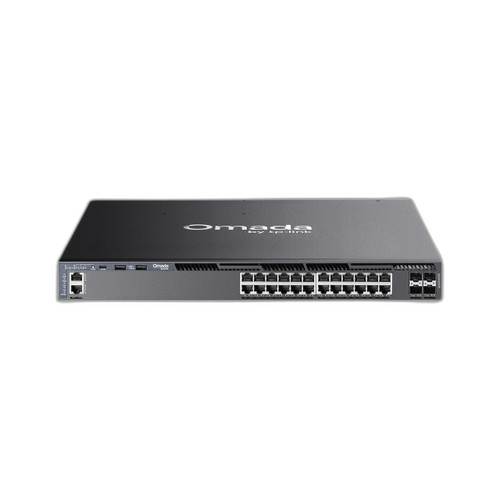
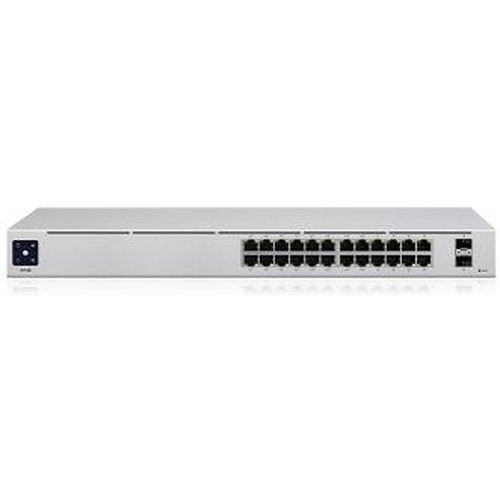
The TP-Link SG6428XHP and Ubiquiti USW-24 are both 1U rack-mount 24-port Gigabit managed switches targeting mid-scale enterprise, surveillance, and campus LAN deployments. The comparison pivots on three meaningful differences: PoE delivery capability and budget, switching fabric capacity and Layer 3 feature depth, and platform ecosystem lock-in. Buyers choosing between these two are typically deploying IP cameras, wireless access points, or VoIP endpoints and must decide how much PoE headroom, routing sophistication, and management-stack alignment they need.
In This Guide
- Which switch delivers more PoE power, and does the USW-24 support PoE at all?
- How do switching fabric, forwarding rate, and Layer 3 capability compare?
- Which management ecosystem is each switch locked into, and how does that affect deployment decisions?
- Which should you choose: the SG6428XHP or the USW-24?
- Side-by-Side Specs
- FAQ
Which switch delivers more PoE power, and does the USW-24 support PoE at all?
The SG6428XHP provides PoE+ (802.3at, also backward-compatible with 802.3af) on all 24 RJ45 ports with a rated PoE budget of 720 W when equipped with two PSM500-AC power supply modules. It also supports perpetual PoE and fast PoE as spec'd. At 30 W per port under 802.3at, that budget can theoretically power all 24 ports simultaneously at the maximum 802.3at draw — a meaningful advantage for dense IP camera or dual-radio AP deployments.
The USW-24 specs list '_Power: PoE' and '_Power Watts: 30W', but also show a 'Power Consumption: 25W' (device draw) and an internal 36 W power supply. These figures are irreconcilable with a full 24-port PoE switch; the 36 W internal supply cannot deliver meaningful PoE across 24 ports. No dedicated PoE budget figure appears in the provided USW-24 spec set, and Ubiquiti's USW-24 product line is publicly positioned as a non-PoE access switch. Buyers requiring PoE on downstream ports should treat the USW-24 PoE fields in this spec record as unverified and should not plan a PoE deployment around them without independent confirmation.
How do switching fabric, forwarding rate, and Layer 3 capability compare?
The SG6428XHP is specified with a switching capacity of 128 Gbps and a dual-core ARM processor running at 1.5 GHz. It is described as a stackable Layer 3 managed switch, implying routing capabilities (static routes, inter-VLAN routing) beyond Layer 2. Four 10G SFP+ uplink slots provide high-bandwidth aggregation to core switches or servers. No forwarding rate (Mpps) figure is provided in the supplied specs.
The USW-24 is specified at 52 Gbps switching capacity with a 39 Mpps forwarding rate and 26 Gbps non-blocking throughput. It supports up to 1,000 VLANs. The spec record does not describe the USW-24 as a Layer 3 switch, and no routing protocol support is listed. Its four unlisted uplink port types are not specified in the provided data. The SG6428XHP's 128 Gbps fabric is 2.46× the USW-24's 52 Gbps, and the 10G SFP+ slots give it a clear edge in uplink density for aggregation roles.
Which management ecosystem is each switch locked into, and how does that affect deployment decisions?
The SG6428XHP is managed through TP-Link's Omada SDN platform, which supports cloud-based or on-premises controller management. The spec lists an RJ45 management port and references egress rate limiting and broadcast control under bandwidth management. Storage is listed at 2×4 MB NOR flash plus 8,192 MB eMMC, which supports local logging and firmware. The operating system field lists 'PF', which is not further elaborated in the provided spec data.
The USW-24 is a UniFi platform device, managed through Ubiquiti's UniFi Network controller (self-hosted or via UniFi Site Manager). It carries CE, FCC, IC, and Anatel certifications and is listed as NDAA-compliant. No on-device management port type beyond 'Ethernet' is specified. Neither switch is cross-compatible with the other's controller. Shops already standardized on UniFi will absorb the USW-24 with zero additional tooling; Omada shops gain L3 routing and a much larger PoE budget with the SG6428XHP.
Which should you choose: the SG6428XHP or the USW-24?
Our take: The SG6428XHP is the stronger choice when PoE delivery, fabric headroom, and Layer 3 routing are required. Its 720 W PoE+ budget versus no credibly specified PoE budget on the USW-24 makes it the only verified option for powering 24 PoE endpoints. Its 128 Gbps switching capacity is 2.46× the USW-24's 52 Gbps, and its four 10G SFP+ slots support higher-speed aggregation links — no uplink speed is specified for the USW-24. Its stackable L3 designation adds inter-VLAN routing the USW-24 does not claim. The USW-24 has meaningful advantages in two areas: NDAA compliance (specified; not listed for the SG6428XHP) and native integration into existing UniFi deployments at a notably lower device power draw of 25 W. Choose the SG6428XHP for PoE-heavy surveillance or AP deployments on Omada; choose the USW-24 for non-PoE UniFi network expansion where NDAA compliance is a procurement requirement.
Side-by-Side Comparison
Spec-for-spec, from manufacturer data.
| Specification | TP-Link SG6428XHP | Ubiquiti USW-24 |
|---|---|---|
| Product Type | Managed L3 Switch | Managed Switch |
| PoE Standard | 802.3af/at (PoE+) | Not credibly specified |
| PoE Budget | 720 W (with 2× PSM500-AC) | — |
| PoE Ports | 24 × PoE+ RJ45 | Not specified |
| Switching Capacity | 128 Gbps | 52 Gbps |
| Non-Blocking Throughput | — | 26 Gbps |
| Forwarding Rate | — | 39 Mpps |
| RJ45 Ports | 24 × 10/100/1000 Mbps | 24 × Gigabit Ethernet |
| Uplink Slots | 4 × 10G SFP+ | Not specified |
| VLAN Support | — | Up to 1,000 VLANs |
| Layer | Layer 3 (stackable) | Layer 2 (implied) |
| Management Platform | Omada SDN | UniFi |
| Device Power Draw | — | 25 W typical |
| Power Supply | 100–240V AC, 50/60 Hz | 100–240V AC, 50/60 Hz (internal 36W) |
| Operating Temp | −5°C to 45°C | −5°C to 45°C |
| NDAA Compliant | — | Yes |
| Dimensions (W×D×H mm) | 440 × 420 × 44 | 442 × 200 × 44 |
| Form Factor | 1U Rack | 1U Rack |
Frequently Asked Questions
Which should you choose: the SG6428XHP or the USW-24?
The SG6428XHP is the stronger choice when PoE delivery, fabric headroom, and Layer 3 routing are required. Its 720 W PoE+ budget versus no credibly specified PoE budget on the USW-24 makes it the only verified option for powering 24 PoE endpoints. Its 128 Gbps switching capacity is 2.46× the USW-24's 52 Gbps, and its four 10G SFP+ slots support higher-speed aggregation links — no uplink speed is specified for the USW-24. Its stackable L3 designation adds inter-VLAN routing the USW-24 does not claim. The USW-24 has meaningful advantages in two areas: NDAA compliance (specified; not listed for the SG6428XHP) and native integration into existing UniFi deployments at a notably lower device power draw of 25 W. Choose the SG6428XHP for PoE-heavy surveillance or AP deployments on Omada; choose the USW-24 for non-PoE UniFi network expansion where NDAA compliance is a procurement requirement.
Is the USW-24 a PoE switch I can use to power IP cameras directly?
Based on the provided specs, the USW-24 has an internal power supply rated at 36 W with a device power consumption of 25 W, leaving no credible PoE headroom for 24 ports. No PoE budget figure is provided. The SG6428XHP, by contrast, specifies a 720 W PoE+ budget across all 24 ports. If powering IP cameras or APs via PoE is a requirement, the SG6428XHP is the switch with verified PoE capacity.
Can either switch perform inter-VLAN routing without a separate router?
The SG6428XHP is spec'd as a Layer 3 managed switch, which typically includes inter-VLAN routing and static route support. The USW-24 spec record does not describe Layer 3 capabilities or any routing protocol support — it appears to be a Layer 2 managed switch. For network segmentation requiring routed VLANs at the access layer, the SG6428XHP is the indicated choice based on the provided specifications.
Which switch is better suited for a government or federal deployment requiring NDAA compliance?
The USW-24 is explicitly listed as NDAA-compliant in its specifications. The SG6428XHP spec record does not include an NDAA compliance field. For deployments subject to NDAA Section 889 procurement restrictions, the USW-24 has a documented compliance claim while the SG6428XHP's compliance status cannot be confirmed from the provided data.
More Network Switch Comparisons
- TP-Link S5500-24GP4XF vs NETGEAR GS728TP-300NAS
- TP-Link S5500-24GP4XF vs Comnet CNGE24FX12TX12MSPOE
- TP-Link S5500-24GP4XF vs Ubiquiti USW-24
- TP-Link S5500-24GP4XF vs Ubiquiti USW-ENTERPRISEXG-24
- TP-Link S5500-24GP4XF vs TP-Link SL2428P
- TP-Link S5500-24GP4XF vs TP-Link SG3428XPP-M2
Network Switch Buying Guides
Get a Second Opinion on Your Camera Choice
Share your site layout, coverage goals, and budget. Our team will validate the camera selection, flag anything we would change, and recommend products that match the use case.