
TP-Link SG6428XHP vs Comnet CNGE24FX12TX12MSPOE: Specification Comparison
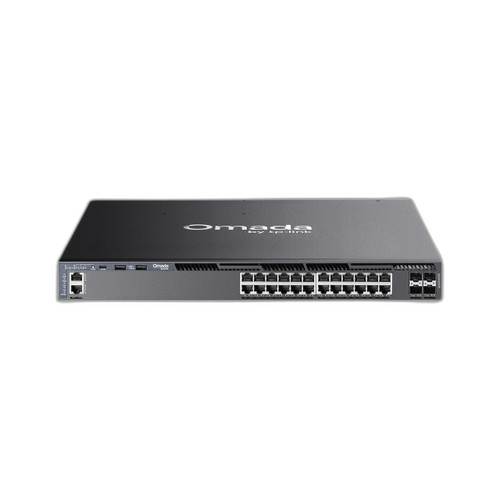
Both the TP-Link SG6428XHP and Comnet CNGE24FX12TX12MSPOE are managed, rack-mount Ethernet switches with PoE+ capability, making them legitimate cross-shop candidates for installers deploying IP cameras, access control, and wireless infrastructure. The SG6428XHP is a commercial-grade L3 stackable switch with 24 copper PoE+ ports and 10G uplinks, while the CNGE24FX12TX12MSPOE is a hardened industrial switch blending 12 copper PoE+ ports with 12 SFP fiber ports—each targeting meaningfully different deployment environments and port-mix requirements.
In This Guide
- How do the port counts, uplink speeds, and switching throughput compare?
- Which switch is better suited for harsh or outdoor-adjacent environments, and how do PoE budgets compare?
- How do L3 routing, VLAN capacity, management interfaces, and platform integration differ?
- Which should you choose: the SG6428XHP or the CNGE24FX12TX12MSPOE?
- Side-by-Side Specs
- FAQ
How do the port counts, uplink speeds, and switching throughput compare?
The SG6428XHP provides 24 RJ45 copper PoE+ ports plus 4× 10G SFP+ uplink slots, delivering 128 Gbps of switching capacity. Every copper port supports 10/100/1000 Mbps with 802.3at PoE+. The four 10G SFP+ slots make this switch suitable for high-density aggregation or stacking scenarios where upstream bandwidth is a bottleneck.
The CNGE24FX12TX12MSPOE offers a hybrid port architecture: 12× 10/100/1000Base-TX RJ45 ports (all PoE+-capable at 30 W each) and 12× SFP fiber ports, with a switching bandwidth of 54 Gbps. The integrated fiber ports eliminate the need for separate media converters in fiber-to-copper edge deployments but reduce available copper PoE+ drops to 12 versus the SG6428XHP's 24.
Switching capacity favors the SG6428XHP significantly—128 Gbps versus 54 Gbps—and uplink speed tops out at 10G SFP+ on the TP-Link versus standard SFP (speed not explicitly stated in provided specs) on the Comnet. Switching latency is specified only for the Comnet at 7 μs; no latency figure is provided for the SG6428XHP.
Which switch is better suited for harsh or outdoor-adjacent environments, and how do PoE budgets compare?
The SG6428XHP carries a PoE budget of 720 W (requiring dual PSM500-AC power supplies) across all 24 ports, allowing up to 30 W per port under 802.3at. Its operating temperature range is −5 °C to 45 °C, appropriate for climate-controlled wiring closets and server rooms but not for unheated enclosures or outdoor cabinets.
The CNGE24FX12TX12MSPOE is explicitly hardened: its operating temperature spans −40 °C to +75 °C, and it meets IEC60068-2-27 shock, IEC60068-2-6 vibration, and IEC60068-2-32 free-fall standards, plus EN50121-4 railway EMC compliance. Its PoE budget is not stated as a total watt figure in the provided specs; maximum power consumption is listed at 390 W, and PoE per port is 30 W across 12 PoE+ ports. EMI/EMS compliance (FCC Part 15, CISPR Class A, EN61000-4 series) is specified for the Comnet; no equivalent compliance data is provided for the SG6428XHP.
For any deployment where ambient temperature drops below −5 °C—outdoor enclosures, transit hubs, industrial facilities, or utility spaces—the Comnet's −40 °C lower bound is a hard requirement the SG6428XHP cannot meet. For indoor climate-controlled environments, the SG6428XHP's larger PoE budget (720 W) supports denser powered-device loads.
How do L3 routing, VLAN capacity, management interfaces, and platform integration differ?
The SG6428XHP is explicitly an L3 managed switch running TP-Link's Omada platform. It supports stacking, egress rate limiting, and broadcast control. Management is via a dedicated RJ45 console port. Storage includes 2× 4 MB NOR flash plus 8,192 MB eMMC, and the processor is a dual-core ARM at 1.5 GHz. Specific VLAN count, MAC table size, and static routing capacity are not provided in the supplied specs.
The CNGE24FX12TX12MSPOE provides 256 maximum VLANs, an 8K MAC address table, static routing capacity of 32 routes, 9.6K-byte jumbo frame support, 1 GB DRAM, and 128 MB flash. Its management platform and software ecosystem are not detailed in the provided specs. MTBF is stated as greater than 100,000 hours; no MTBF figure is provided for the SG6428XHP.
The SG6428XHP integrates into the Omada SDN ecosystem, which is relevant for installers already standardized on TP-Link infrastructure. The Comnet's management tooling, cloud integration, and stacking support are absent from the provided specifications and cannot be assessed here.
Which should you choose: the SG6428XHP or the CNGE24FX12TX12MSPOE?
Our take: The SG6428XHP is the stronger choice when deploying in a temperature-controlled environment that requires maximum PoE+ port density and 10G uplink headroom. It delivers 24 PoE+ copper ports versus the Comnet's 12, a 128 Gbps switching capacity versus 54 Gbps, and a 720 W PoE budget enabling denser IP camera and AP deployments from a single switch. The CNGE24FX12TX12MSPOE is the correct selection when the installation environment falls outside the SG6428XHP's −5 °C to 45 °C thermal window—the Comnet is rated to −40 °C to +75 °C with shock, vibration, and railway EMC certifications—or when the design calls for integrated fiber SFP ports at the edge without separate media converters. Buyers running Omada-standardized networks will find the SG6428XHP's platform integration relevant; the Comnet's management ecosystem is not specified and cannot be compared.
Side-by-Side Comparison
Spec-for-spec, from manufacturer data.
| Specification | TP-Link SG6428XHP | Comnet CNGE24FX12TX12MSPOE |
|---|---|---|
| Product Type | Managed L3 Switch | Hardened Managed Switch |
| Total Copper RJ45 Ports | 24 | 12 |
| Total SFP / Fiber Ports | 4× 10G SFP+ | 12× SFP |
| PoE+ Ports | 24 (802.3at) | 12 (802.3at) |
| PoE Per Port (Max) | 30 W | 30 W |
| Total PoE Budget | 720 W (dual PSM500-AC) | — |
| Max Power Consumption | — | 390 W |
| Switching Capacity | 128 Gbps | 54 Gbps |
| Switching Latency | — | 7 μs |
| MAC Table Size | — | 8K |
| Max VLANs | — | 256 |
| Operating Temperature | −5°C to +45°C | −40°C to +75°C |
| MTBF | — | > 100,000 hours |
| Shock / Vibration Rated | — | IEC60068-2-27 / IEC60068-2-6 |
| EMI/EMS Compliance | — | FCC Part 15, CISPR Class A; EN61000-4 series |
| Management Platform | Omada SDN (TP-Link) | — |
Frequently Asked Questions
Which should you choose: the SG6428XHP or the CNGE24FX12TX12MSPOE?
The SG6428XHP is the stronger choice when deploying in a temperature-controlled environment that requires maximum PoE+ port density and 10G uplink headroom. It delivers 24 PoE+ copper ports versus the Comnet's 12, a 128 Gbps switching capacity versus 54 Gbps, and a 720 W PoE budget enabling denser IP camera and AP deployments from a single switch. The CNGE24FX12TX12MSPOE is the correct selection when the installation environment falls outside the SG6428XHP's −5 °C to 45 °C thermal window—the Comnet is rated to −40 °C to +75 °C with shock, vibration, and railway EMC certifications—or when the design calls for integrated fiber SFP ports at the edge without separate media converters. Buyers running Omada-standardized networks will find the SG6428XHP's platform integration relevant; the Comnet's management ecosystem is not specified and cannot be compared.
Which switch supports more PoE+ powered devices in a single rack unit?
The SG6428XHP supports 24 PoE+ ports versus 12 on the CNGE24FX12TX12MSPOE, so it can power twice as many devices—cameras, access points, or access control panels—from a single 1U switch. The SG6428XHP also carries a higher total PoE budget of 720 W (with dual PSM500-AC supplies); a comparable total budget figure is not stated in the Comnet's provided specifications.
Can either switch be installed in an unheated outdoor cabinet or industrial enclosure?
Only the CNGE24FX12TX12MSPOE is rated for that scenario. It operates from −40 °C to +75 °C and meets IEC60068-2-27 shock and IEC60068-2-6 vibration standards, making it suitable for outdoor cabinets, transit environments, and industrial spaces. The SG6428XHP is rated only to −5 °C at the low end, which excludes unheated enclosures in cold climates.
Does the CNGE24FX12TX12MSPOE or SG6428XHP offer better fiber connectivity without add-on converters?
The CNGE24FX12TX12MSPOE has 12 built-in SFP fiber ports, eliminating the need for separate media converters when connecting fiber runs at the edge. The SG6428XHP's four SFP+ slots are 10G uplink ports, not intended as per-device fiber drops; fiber-to-device connections on the SG6428XHP would still require external converters or a separate fiber switch.
More Network Switch Comparisons
- TP-Link S5500-24GP4XF vs NETGEAR GS728TP-300NAS
- TP-Link S5500-24GP4XF vs Comnet CNGE24FX12TX12MSPOE
- TP-Link S5500-24GP4XF vs Ubiquiti USW-24
- TP-Link S5500-24GP4XF vs Ubiquiti USW-ENTERPRISEXG-24
- TP-Link S5500-24GP4XF vs TP-Link SL2428P
- TP-Link S5500-24GP4XF vs TP-Link SG3428XPP-M2
Network Switch Buying Guides
Get a Second Opinion on Your Camera Choice
Share your site layout, coverage goals, and budget. Our team will validate the camera selection, flag anything we would change, and recommend products that match the use case.