
TP-Link SG6428X vs TP-Link SL2428P: Specification Comparison
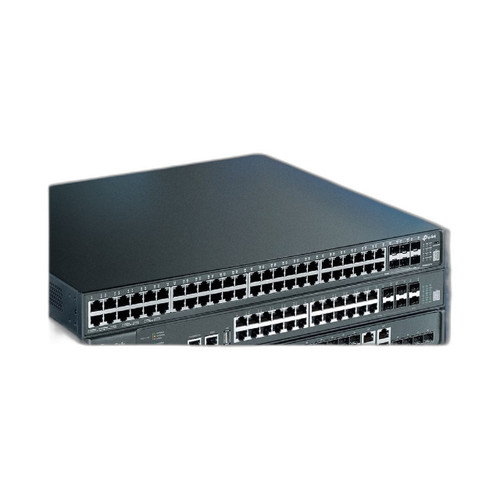
Both products are TP-Link Omada-managed rack-mount switches in a 24-port-plus-uplink form factor, making them plausible cross-shop candidates for IP security camera and access-control deployments. The SG6428X is a Layer 3 stackable gigabit switch with 10GE SFP+ uplinks, while the SL2428P is a Layer 2 PoE+ switch with 10/100 Mbps edge ports and gigabit uplinks. Buyers comparing the two are typically weighing performance-class and routing capability against PoE budget and lower-speed edge-port economics for camera-dense sites.
In This Guide
- Which switch delivers the port speeds and throughput your infrastructure actually requires?
- How do PoE power budget, operating environment, and physical form factor compare?
- What management depth, routing capability, and platform integration does each switch offer?
- Which should you choose: the SG6428X or the SL2428P?
- Side-by-Side Specs
- FAQ
Which switch delivers the port speeds and throughput your infrastructure actually requires?
The SG6428X provides 24 Gigabit (10/100/1000 Mbps) RJ45 edge ports plus 4×10GE SFP+ uplinks, with a non-blocking switching capacity of 128 Gbps and a dual-core ARM processor running at 1.5 GHz backed by 8 GB eMMC storage. This architecture supports high-density camera feeds, NVR uplinks, and multi-gigabit core interconnects without contention.
The SL2428P edge ports run at 10/100 Mbps only, with 4 gigabit uplinks (2×RJ45, 2×Combo RJ45/SFP). Its switching capacity is 12.8 Gbps with a forwarding rate of 9.52 Mpps and 32 MB Flash / 256 MB DRAM. The ten-times throughput gap (128 Gbps vs. 12.8 Gbps) and the 100 Mbps edge ceiling are the defining performance deltas between these two models. For 4K or multi-stream IP cameras generating sustained high bitrates per port, the SL2428P's 100 Mbps edge ports can become a bottleneck.
How do PoE power budget, operating environment, and physical form factor compare?
The SL2428P is purpose-built as a PoE switch: it carries a 250 W total PoE+ budget (802.3af/at), up to 30 W per port, with a standby draw of 8.9 W and a stated typical consumption of 250 W under full PoE load. It supports ONVIF and is rated for wall, ceiling, or rack mounting, with a shallower chassis depth of 7.1 in (180 mm) versus the SG6428X's 16.5 in (420 mm). Its operating temperature ceiling is 50 °C (122 °F).
The SG6428X specs list 802.3af/at PoE support with perpetual PoE and fast PoE, and a PoE budget listed in the source data as 1,440 W — however, the provided spec field shows 'Budget -' (value absent in the structured spec), so buyers should verify the confirmed PoE budget directly from the datasheet before sizing a deployment. Its operating temperature tops at 45 °C (113 °F), five degrees lower than the SL2428P. Both units accept 100–240 V AC, 50/60 Hz.
What management depth, routing capability, and platform integration does each switch offer?
The SG6428X is a Layer 3 managed switch supporting RIP, OSPF, VRRP, ECMP, PIM-SM/DM, Static Routing, and Policy-Based Routing (PBR). It is stackable and managed via CLI, SNMP v1/v2c/v3, RMON, and the Omada cloud controller, with a dedicated RJ45 management port. This makes it suitable as a distribution or core switch in a segmented security network requiring inter-VLAN routing without a separate router.
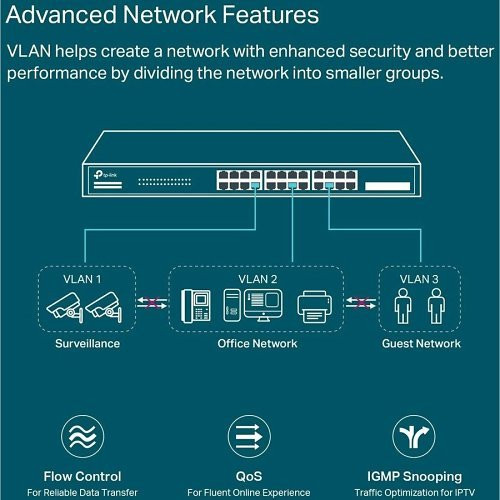
The SL2428P is a Layer 2 managed switch. Its operating modes include VLAN, STP/RSTP/MSTP, IGMP Snooping, QoS (802.1p/DSCP), ACL, LACP, Jumbo Frame (9 KB), and Static Routing only — no dynamic routing protocols. It supports 802.1X with RADIUS/TACACS+ authentication and is managed through Omada cloud, standalone web UI, CLI, SNMP, and RMON. Both switches are within the same Omada ecosystem, meaning they are co-manageable under the same Omada Software Controller or hardware controller.
Which should you choose: the SG6428X or the SL2428P?
Our take: The SG6428X is the stronger choice when the deployment requires gigabit edge speeds, dynamic Layer 3 routing, or high-density uplink throughput, while the SL2428P is better suited to cost-sensitive camera runs where 100 Mbps per port is sufficient and a confirmed 250 W PoE budget is the primary constraint. Key spec deltas: switching capacity is 128 Gbps (SG6428X) versus 12.8 Gbps (SL2428P) — a 10× difference; edge port speed is 1 Gbps versus 100 Mbps; and Layer 3 routing protocols (OSPF, RIP, VRRP, PIM) are present on the SG6428X but absent on the SL2428P. The SL2428P's confirmed 250 W PoE budget and shallower 180 mm chassis suit smaller IDF closets or wall-mount camera-floor deployments on an Omada platform. The SG6428X fits distribution or core roles; the SL2428P fits access-layer camera aggregation where 100 Mbps bitrates are acceptable.
Side-by-Side Comparison
Spec-for-spec, from manufacturer data.
| Specification | TP-Link SG6428X | TP-Link SL2428P |
|---|---|---|
| MPN | SG6428X | SL2428P |
| Product Type | Omada Stackable L3 Managed Switch | 24-Port 10/100 + 4-Port Gigabit PoE+ Managed Switch |
| Edge Port Speed | 24× Gigabit (10/100/1000 Mbps) RJ45 | 24× 10/100 Mbps RJ45 |
| Uplink Ports | 4× 10GE SFP+ | 2× Gigabit RJ45 + 2× Combo Gigabit RJ45/SFP |
| Total Ports | 28 (24 GbE + 4 SFP+) | 28 (24× 10/100 + 4× Gigabit) |
| Switching Capacity | 128 Gbps | 12.8 Gbps |
| Forwarding Rate | Not specified in provided specs | 9.52 Mpps |
| Layer | Layer 3 (OSPF, RIP, VRRP, ECMP, PIM-SM/DM, PBR) | Layer 2 + Static Routing only |
| PoE Standard | 802.3af/at, perpetual PoE, fast PoE | 802.3af/at |
| PoE Budget | 1,440 W (source data; structured field absent — verify) | 250 W total, up to 30 W per port |
| ONVIF Support | Not specified in provided specs | Yes |
| Memory / Storage | 2× 4 MB NOR + 8 GB eMMC | 32 MB Flash + 256 MB DRAM |
| Processor | Dual-core ARM @ 1.5 GHz | Not specified in provided specs |
| Mount Type | Rack | Wall, Ceiling, Rack |
| Dimensions (W×D×H) | 440 × 420 × 44 mm | 440 × 180 × 44 mm |
| Operating Temp | -5 °C to 45 °C (23 °F to 113 °F) | -5 °C to 50 °C (23 °F to 122 °F) |
Frequently Asked Questions
Which should you choose: the SG6428X or the SL2428P?
The SG6428X is the stronger choice when the deployment requires gigabit edge speeds, dynamic Layer 3 routing, or high-density uplink throughput, while the SL2428P is better suited to cost-sensitive camera runs where 100 Mbps per port is sufficient and a confirmed 250 W PoE budget is the primary constraint. Key spec deltas: switching capacity is 128 Gbps (SG6428X) versus 12.8 Gbps (SL2428P) — a 10× difference; edge port speed is 1 Gbps versus 100 Mbps; and Layer 3 routing protocols (OSPF, RIP, VRRP, PIM) are present on the SG6428X but absent on the SL2428P. The SL2428P's confirmed 250 W PoE budget and shallower 180 mm chassis suit smaller IDF closets or wall-mount camera-floor deployments on an Omada platform. The SG6428X fits distribution or core roles; the SL2428P fits access-layer camera aggregation where 100 Mbps bitrates are acceptable.
Is the SG6428X or SL2428P better for larger deployments?
The SG6428X is better suited to larger or multi-tier deployments. Its 128 Gbps switching capacity, 4×10GE SFP+ uplinks, stackable architecture, and full Layer 3 routing support (OSPF, RIP, VRRP, PBR) allow it to serve as a distribution or core switch aggregating multiple access-layer devices. The SL2428P, with 12.8 Gbps capacity and 100 Mbps edge ports, is designed for access-layer camera aggregation at smaller sites.
Can either switch power IP cameras directly, and how many?
Both switches support 802.3af/at PoE+. The SL2428P has a confirmed 250 W total PoE budget at up to 30 W per port across its 24 ports. The SG6428X lists PoE support including perpetual PoE and fast PoE, with a source-data figure of 1,440 W, but the structured spec field shows the budget value as absent — buyers should confirm the exact PoE budget from the SG6428X datasheet before sizing camera counts. At 30 W per port (PoE+ maximum), the SL2428P can sustain approximately 8 simultaneous full-power PoE+ devices within its 250 W budget.
Do both switches work with the same Omada management controller?
Yes. Both the SG6428X and SL2428P are part of TP-Link's Omada ecosystem and are manageable through the Omada Software Controller or compatible Omada hardware controller, as well as via standalone web UI, CLI, SNMP v1/v2c/v3, and RMON. This means a site running both models can manage them from a single Omada interface. The SG6428X adds a dedicated RJ45 out-of-band management port; the SL2428P does not list a dedicated management port in the provided specs.
More Network Switch Comparisons
- TP-Link S5500-24GP4XF vs NETGEAR GS728TP-300NAS
- TP-Link S5500-24GP4XF vs Comnet CNGE24FX12TX12MSPOE
- TP-Link S5500-24GP4XF vs Ubiquiti USW-24
- TP-Link S5500-24GP4XF vs Ubiquiti USW-ENTERPRISEXG-24
- TP-Link S5500-24GP4XF vs TP-Link SL2428P
- TP-Link S5500-24GP4XF vs TP-Link SG3428XPP-M2
Network Switch Buying Guides
Get a Second Opinion on Your Camera Choice
Share your site layout, coverage goals, and budget. Our team will validate the camera selection, flag anything we would change, and recommend products that match the use case.