
TP-Link SG3428XPP-M2 vs Ubiquiti USW-ENTERPRISEXG-24: Specification Comparison
Both the TP-Link SG3428XPP-M2 and the Ubiquiti USW-ENTERPRISEXG-24 are 1U rackmount managed switches targeting IP security and high-density network deployments, but they serve meaningfully different roles. The SG3428XPP-M2 leads with 2.5GbE copper PoE++ ports and a 770W PoE budget, making it an edge/access layer switch for powering cameras and APs directly. The USW-ENTERPRISEXG-24 offers 24 × 10GbE copper ports with Layer 3 routing and 25G uplinks, positioning it as a high-throughput aggregation or distribution layer switch without PoE. A buyer must decide which capability gap matters most for their deployment.

In This Guide
- Which switch delivers the port speeds and backplane throughput needed for your deployment tier?
- Which switch best matches your PoE power delivery requirements and operating environment?
- Which switch's management platform and network layer capabilities align with your existing infrastructure?
- Which should you choose: the SG3428XPP-M2 or the USW-ENTERPRISEXG-24?
- Side-by-Side Specs
- FAQ
Which switch delivers the port speeds and backplane throughput needed for your deployment tier?
The SG3428XPP-M2 provides 24 × 2.5 Gbps PoE++ RJ45 ports plus 4 × 10 Gbps SFP+ uplinks, with a switching capacity of 200 Gbps and a forwarding rate of 148.80 Mpps. This makes it well-suited for edge access layers feeding high-resolution IP cameras, multi-gig Wi-Fi 6/6E access points, and 802.3bt-powered intercoms where 2.5 Gbps per device is sufficient and PoE delivery is the primary constraint.
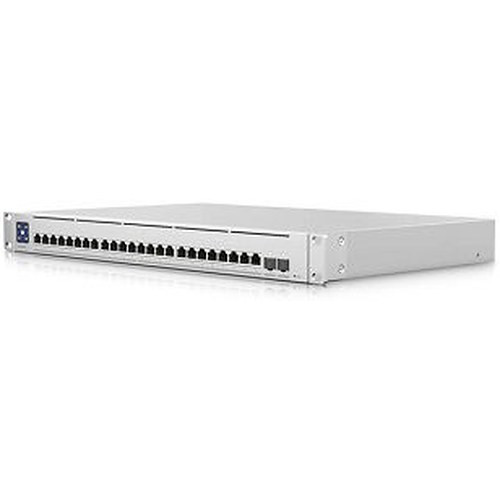
The USW-ENTERPRISEXG-24 runs every one of its 24 RJ45 ports at 10 Gbps, yielding a switching capacity of 580 Gbps and a forwarding rate of 432 Mpps — approximately 2.9× the backplane capacity of the TP-Link. Two 25G SFP28 uplink slots are also specified, which the TP-Link lacks entirely. For aggregation-layer roles or core switching in dense 4K/8K camera environments where NVR uplinks and inter-VLAN traffic volumes are high, the Ubiquiti's port speed and throughput headroom are substantively larger.
Which switch best matches your PoE power delivery requirements and operating environment?
PoE is the defining differentiator between these two products. The SG3428XPP-M2 supports 802.3af/at/bt (PoE++) on all 24 copper ports, with a total PoE budget of 770W and up to 90W per port. It also supports perpetual PoE and fast PoE per the provided specifications. Maximum power consumption is listed at 500W. This switch is explicitly designed to power end devices — cameras, APs, intercoms — without requiring separate injectors or midspans.
The USW-ENTERPRISEXG-24 has no PoE capability specified in the provided data. Its power consumption is listed at 100W from an internal AC/DC dual-input supply rated 100–240VAC. The absence of PoE means all attached devices require their own power source or a separate PoE injector, which adds cost and rack space. For any deployment where eliminating separate power runs is a requirement, the USW-ENTERPRISEXG-24 cannot serve that function as specified.
On operating environment, the SG3428XPP-M2 is rated –5°C to 45°C (23°F to 113°F) and the USW-ENTERPRISEXG-24 is rated –5°C to 40°C (23°F to 104°F). Both carry a 100–240V AC power input. The TP-Link spec includes mounting options of wall, ceiling, and rack; the Ubiquiti is specified as rack-mount 1U only.
Which switch's management platform and network layer capabilities align with your existing infrastructure?
The SG3428XPP-M2 is classified as an L2+ managed switch operating under TP-Link's Omada SDN ecosystem — available via Omada cloud controller or standalone. The specified feature set includes Static Routing, VLAN, ACL, QoS, IGMP Snooping, OAM, and DDM. Memory is listed as 32MB Flash and 256MB DRAM. The switch carries an ONVIF designation per the provided specs, which is relevant for IP camera interoperability workflows. Connectivity also includes a USB port.
The USW-ENTERPRISEXG-24 is specified as a full Layer 3 managed switch with routing capabilities, integrating into Ubiquiti's UniFi Network platform alongside SNMP, CLI, and Web UI management. Enclosure material is SGCC steel and the unit is NDAA compliant per its spec sheet — a procurement-relevant fact for government and regulated-sector projects that the TP-Link spec does not address. Certifications listed include CE, FCC, IC, and Anatel. No ONVIF designation is present in the Ubiquiti specs provided.
Buyers already invested in Omada-managed infrastructure will find the SG3428XPP-M2 integrates without friction; those running UniFi ecosystems will find the USW-ENTERPRISEXG-24 the natural fit. Neither switch is platform-neutral in practice, so the existing controller environment is a hard constraint for most installers.
Which should you choose: the SG3428XPP-M2 or the USW-ENTERPRISEXG-24?
Our take: The SG3428XPP-M2 is the stronger choice when PoE-powered edge devices — cameras, APs, intercoms — must be connected without separate power infrastructure, while the USW-ENTERPRISEXG-24 is the stronger choice when high-throughput aggregation or Layer 3 inter-VLAN routing at 10 Gbps per port is the primary requirement. Three concrete spec deltas define the divide: the TP-Link delivers 770W of PoE++ budget across 24 ports at up to 90W each, versus zero PoE on the Ubiquiti; the Ubiquiti's switching capacity is 580 Gbps at 432 Mpps against the TP-Link's 200 Gbps at 148.80 Mpps; and the Ubiquiti adds 2 × 25G SFP28 uplinks absent entirely from the TP-Link. Platform lock-in is also decisive — Omada sites should use the SG3428XPP-M2; UniFi environments the USW-ENTERPRISEXG-24. NDAA compliance, specified only for the Ubiquiti, may be a non-negotiable for government or regulated-sector bids.
Side-by-Side Comparison
Spec-for-spec, from manufacturer data.
| Specification | TP-Link SG3428XPP-M2 | Ubiquiti USW-ENTERPRISEXG-24 |
|---|---|---|
| Product Type | L2+ Managed Switch | Layer 3 Managed Switch |
| Form Factor | 1U Rackmount | 1U Rackmount |
| Copper Port Count | 24 | 24 |
| Copper Port Speed | 2.5 Gbps (2.5GBase-T) | 10 Gbps (10GbE) |
| Uplink Slots | 4 × 10G SFP+ | 2 × 25G SFP28 |
| Switching Capacity | 200 Gbps | 580 Gbps |
| Forwarding Rate | 148.80 Mpps | 432 Mpps |
| PoE Standard | 802.3af/at/bt (PoE++) | — |
| PoE Budget | 770W | — |
| Max PoE per Port | 90W | — |
| Max Power Consumption | 500W | 100W |
| Power Input | 100–240V AC, 50/60 Hz | 100–240V AC (dual input) |
| Operating Temperature | –5°C to 45°C (23°F to 113°F) | –5°C to 40°C (23°F to 104°F) |
| Management Platform | Omada SDN (cloud or standalone) | UniFi Network (SNMP, CLI, Web UI) |
| NDAA Compliant | — | Yes |
| ONVIF | Yes | — |
| Dimensions (mm) | 440 × 330 × 44 | 442 × 285 × 44 |
| Flash / DRAM | 32MB Flash / 256MB DRAM | — |
Frequently Asked Questions
Which should you choose: the SG3428XPP-M2 or the USW-ENTERPRISEXG-24?
The SG3428XPP-M2 is the stronger choice when PoE-powered edge devices — cameras, APs, intercoms — must be connected without separate power infrastructure, while the USW-ENTERPRISEXG-24 is the stronger choice when high-throughput aggregation or Layer 3 inter-VLAN routing at 10 Gbps per port is the primary requirement. Three concrete spec deltas define the divide: the TP-Link delivers 770W of PoE++ budget across 24 ports at up to 90W each, versus zero PoE on the Ubiquiti; the Ubiquiti's switching capacity is 580 Gbps at 432 Mpps against the TP-Link's 200 Gbps at 148.80 Mpps; and the Ubiquiti adds 2 × 25G SFP28 uplinks absent entirely from the TP-Link. Platform lock-in is also decisive — Omada sites should use the SG3428XPP-M2; UniFi environments the USW-ENTERPRISEXG-24. NDAA compliance, specified only for the Ubiquiti, may be a non-negotiable for government or regulated-sector bids.
Is the SG3428XPP-M2 or USW-ENTERPRISEXG-24 better for powering IP cameras directly from the switch?
The SG3428XPP-M2 is the only option of the two that supports PoE. It provides 802.3bt (PoE++) on all 24 copper ports with a total budget of 770W and up to 90W per port, covering high-wattage PTZ cameras, multi-radio APs, and 802.3bt intercoms. The USW-ENTERPRISEXG-24 has no PoE capability listed in its specifications, so cameras and other powered devices connected to it would require separate power sources or injectors.
Which switch handles higher traffic volumes for large NVR or aggregation deployments?
The USW-ENTERPRISEXG-24 is built for higher aggregate throughput: 580 Gbps switching capacity, 432 Mpps forwarding rate, 24 × 10 Gbps RJ45 ports, and 2 × 25G SFP28 uplinks. The SG3428XPP-M2 offers 200 Gbps and 148.80 Mpps across 2.5 Gbps access ports with 10G SFP+ uplinks. For aggregation layers, core interconnects, or environments where multiple 4K/8K streams from many cameras converge toward NVR or cloud storage, the Ubiquiti provides substantially more headroom.
Does either switch meet NDAA compliance requirements for government or regulated projects?
NDAA compliance is specified for the USW-ENTERPRISEXG-24. The SG3428XPP-M2 spec data provided does not include an NDAA compliance statement. Buyers with NDAA procurement mandates should verify compliance status directly with the manufacturer for any product where it is not explicitly listed in the specification sheet, and should treat the absence of the designation in the TP-Link specs as an unconfirmed item rather than a confirmed pass or fail.
More Network Switch Comparisons
- TP-Link S5500-24GP4XF vs NETGEAR GS728TP-300NAS
- TP-Link S5500-24GP4XF vs Comnet CNGE24FX12TX12MSPOE
- TP-Link S5500-24GP4XF vs Ubiquiti USW-24
- TP-Link S5500-24GP4XF vs Ubiquiti USW-ENTERPRISEXG-24
- TP-Link S5500-24GP4XF vs TP-Link SL2428P
- TP-Link S5500-24GP4XF vs TP-Link SG3428XPP-M2
Network Switch Buying Guides
Get a Second Opinion on Your Camera Choice
Share your site layout, coverage goals, and budget. Our team will validate the camera selection, flag anything we would change, and recommend products that match the use case.