
TP-Link SG3428XPP-M2 vs Ubiquiti USW-24: Specification Comparison
Both the TP-Link SG3428XPP-M2 and the Ubiquiti USW-24 are 1U rack-mount managed switches with 24 copper ports targeting enterprise and SMB LAN deployments. However, they sit at markedly different performance tiers: the SG3428XPP-M2 is a multi-gig PoE++ platform with 2.5 Gbps per port and 770 W of PoE budget, while the USW-24 is a non-PoE Gigabit switch optimized for low-power, high-density connectivity. This comparison evaluates port speed and throughput, PoE capability and power budget, and management and integration differences.

In This Guide
Which switch delivers higher port speeds and aggregate throughput?
The SG3428XPP-M2 provides 24 × 2.5 Gbps PoE++ RJ45 ports plus 4 × 10 Gbps SFP+ uplink slots, yielding a switching capacity of 200 Gbps and a forwarding rate of 148.80 Mpps. This multi-gig architecture is purpose-built for devices that saturate Gigabit links — high-resolution IP cameras, Wi-Fi 6/6E access points, and NVRs — without requiring fiber infrastructure on the access layer.
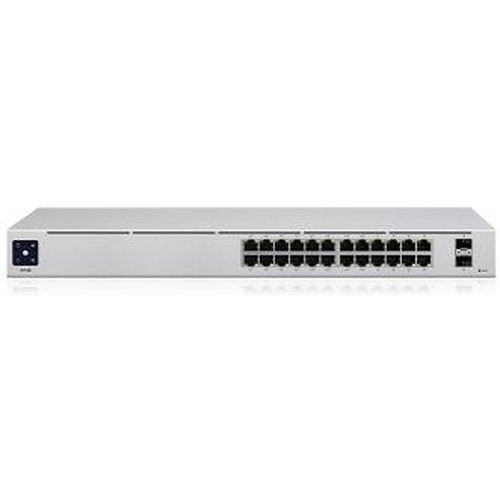
The USW-24 offers 24 × 1 Gbps Ethernet ports with a 52 Gbps switching fabric, 26 Gbps non-blocking throughput, and a forwarding rate of 39 Mpps. Uplink specifications (port count, speed, or SFP presence) are not stated in the provided specs. For standard 1 Gbps end-device environments the USW-24's fabric is non-blocking, but it provides no headroom for multi-gig edge devices.
On aggregate throughput the SG3428XPP-M2 exceeds the USW-24 by roughly 3.8× in switching capacity (200 Gbps vs. 52 Gbps) and 3.8× in forwarding rate (148.80 Mpps vs. 39 Mpps). Buyers expecting to connect 2.5G-capable cameras or Wi-Fi 6E APs should note that the USW-24 cannot serve those devices at rated speed.
Which switch supports PoE, and how much power can it deliver?
The SG3428XPP-M2 supports 802.3af, 802.3at, and 802.3bt (PoE++) on all 24 copper ports, with each port capable of delivering up to 90 W. The total PoE budget is 770 W, and the unit's maximum power consumption is 500 W. It also specifies support for perpetual PoE and fast PoE, which maintain power to connected devices during switch reboots — a relevant feature for always-on security cameras and intercoms.
The USW-24 spec sheet lists 'Power: PoE' and 'Power Watts: 30W' in one field, but the device's stated power consumption is 25 W typical with a 36 W internal supply. No PoE budget, PoE standard (802.3af/at/bt), or per-port PoE wattage is confirmed in the provided specifications. Buyers should not rely on the USW-24 to power PoE end-devices without verifying this against Ubiquiti's official datasheet, as the 36 W supply would be insufficient for meaningful PoE delivery.
For any deployment requiring PoE-powered cameras, access points, door controllers, or intercoms, the SG3428XPP-M2 provides a clearly specified and substantial 770 W budget across 24 ports. The USW-24's PoE capability, if any, is unconfirmed in the provided specs.
How do the two switches differ in management platform and integration?
The SG3428XPP-M2 is managed through TP-Link's Omada SDN platform, supporting both cloud-managed and standalone (local) operation. Feature set includes Static Routing, VLAN, ACL, QoS, IGMP Snooping, OAM, and DDM. It specifies ONVIF compliance, which is relevant in security installations where the switch must interoperate with ONVIF-compatible cameras and management systems. Memory is specified as 32 MB Flash and 256 MB DRAM.
The USW-24 is managed via Ethernet and integrates into the Ubiquiti UniFi ecosystem. It supports up to 1,000 VLANs. No ACL, QoS, IGMP Snooping, or routing feature details are provided in the supplied specs. The USW-24 is NDAA compliant and carries CE, FCC, IC, and Anatel certifications. Memory specifications are not provided.
Both switches are managed L2+ platforms, but they are ecosystem-locked: the SG3428XPP-M2 requires Omada controllers or standalone configuration, while the USW-24 requires a UniFi Network controller. Mixing ecosystems in a single managed network is not supported. The SG3428XPP-M2's explicit ONVIF callout is an advantage in physical security deployments; the USW-24's 1,000-VLAN support is well-suited to multi-tenant or segmented enterprise environments.
Which should you choose: the SG3428XPP-M2 or the USW-24?
Our take: The SG3428XPP-M2 is the stronger choice when the deployment requires PoE power delivery, multi-gig edge speeds, or physical security integration. It delivers 770 W of confirmed 802.3bt PoE++ budget versus the USW-24's unconfirmed PoE capability, operates at 200 Gbps switching capacity versus 52 Gbps, and forwards at 148.80 Mpps versus 39 Mpps — making it the clear choice for bandwidth-intensive camera, AP, or intercom deployments. The USW-24 is the appropriate choice when the environment already runs UniFi infrastructure, all edge devices operate at 1 Gbps and need no PoE from the switch, power consumption is a constraint (25 W vs. 500 W max), and NDAA compliance is required — a specification the SG3428XPP-M2 does not carry in the provided data. Platform lock-in is the deciding qualifier: neither switch is managed outside its own ecosystem.
Side-by-Side Comparison
Spec-for-spec, from manufacturer data.
| Specification | TP-Link SG3428XPP-M2 | Ubiquiti USW-24 |
|---|---|---|
| Product Type | L2+ Managed Switch, 1U Rackmount | Managed Switch, 1U Rack Mount |
| Copper Ports | 24 × 2.5 Gbps RJ45 | 24 × 1 Gbps Ethernet |
| Uplink Slots | 4 × 10 Gbps SFP+ | Not specified in provided specs |
| Switching Capacity | 200 Gbps | 52 Gbps |
| Non-Blocking Throughput | Not specified | 26 Gbps |
| Forwarding Rate | 148.80 Mpps | 39 Mpps |
| PoE Standard | 802.3af / at / bt (PoE++) | Not confirmed in provided specs |
| Max PoE Budget | 770 W | Not confirmed in provided specs |
| Max Per-Port PoE | 90 W | Not confirmed in provided specs |
| Max Power Consumption | 500 W | 25 W typical |
| Power Supply | 100–240 V AC, 50/60 Hz (internal) | 100–240 V AC, 50/60 Hz, 36 W internal |
| ONVIF | Yes | Not specified in provided specs |
| NDAA Compliant | Not specified in provided specs | Yes |
| VLAN Support | Yes (count not specified) | Up to 1,000 VLANs |
| Management Platform | TP-Link Omada (cloud or standalone) | Ubiquiti UniFi (controller-based) |
| Operating Temperature | –5°C to +45°C (23°F to 113°F) | –5°C to +45°C (23°F to 113°F) |
| Dimensions | 440 × 330 × 44 mm | 442 × 200 × 44 mm |
| Flash / DRAM | 32 MB Flash / 256 MB DRAM | Not specified in provided specs |
Frequently Asked Questions
Which should you choose: the SG3428XPP-M2 or the USW-24?
The SG3428XPP-M2 is the stronger choice when the deployment requires PoE power delivery, multi-gig edge speeds, or physical security integration. It delivers 770 W of confirmed 802.3bt PoE++ budget versus the USW-24's unconfirmed PoE capability, operates at 200 Gbps switching capacity versus 52 Gbps, and forwards at 148.80 Mpps versus 39 Mpps — making it the clear choice for bandwidth-intensive camera, AP, or intercom deployments. The USW-24 is the appropriate choice when the environment already runs UniFi infrastructure, all edge devices operate at 1 Gbps and need no PoE from the switch, power consumption is a constraint (25 W vs. 500 W max), and NDAA compliance is required — a specification the SG3428XPP-M2 does not carry in the provided data. Platform lock-in is the deciding qualifier: neither switch is managed outside its own ecosystem.
Can the USW-24 power my IP cameras directly, or do I need a separate PoE injector?
The provided USW-24 specifications do not confirm a usable PoE budget, PoE standard, or per-port PoE wattage. Its internal supply is rated at 36 W, which would not support meaningful multi-port PoE delivery. Verify against Ubiquiti's official datasheet before relying on it to power cameras. The SG3428XPP-M2, by contrast, specifies 770 W total PoE budget with up to 90 W per port under 802.3bt.
Is the SG3428XPP-M2 or USW-24 better for larger deployments with many VLANs?
The USW-24 explicitly supports up to 1,000 VLANs, which is well-suited to large multi-tenant or heavily segmented networks. The SG3428XPP-M2's VLAN capability is not quantified in the provided specifications beyond a general VLAN feature listing. If VLAN scale is the primary criterion and the network already uses UniFi, the USW-24 has a documented advantage on that single dimension.
Will either switch work with my existing TP-Link Omada or Ubiquiti UniFi controller?
Each switch is designed for its own ecosystem only. The SG3428XPP-M2 is managed exclusively through TP-Link's Omada SDN platform (cloud or standalone). The USW-24 is managed exclusively through Ubiquiti's UniFi Network controller. Neither switch can be adopted into the other's management platform. Deploying the SG3428XPP-M2 in a UniFi network, or the USW-24 in an Omada network, would require separate management infrastructure for that device.
More Network Switch Comparisons
- TP-Link S5500-24GP4XF vs NETGEAR GS728TP-300NAS
- TP-Link S5500-24GP4XF vs Comnet CNGE24FX12TX12MSPOE
- TP-Link S5500-24GP4XF vs Ubiquiti USW-24
- TP-Link S5500-24GP4XF vs Ubiquiti USW-ENTERPRISEXG-24
- TP-Link S5500-24GP4XF vs TP-Link SL2428P
- TP-Link S5500-24GP4XF vs TP-Link SG3428XPP-M2
Network Switch Buying Guides
Get a Second Opinion on Your Camera Choice
Share your site layout, coverage goals, and budget. Our team will validate the camera selection, flag anything we would change, and recommend products that match the use case.