
TP-Link SG105MPE vs Ubiquiti USW-FLEX-2.5G-5: Specification Comparison
Both the TP-Link TL-SG105MPE and the Ubiquiti USW-FLEX-2.5G-5 are 5-port desktop switches aimed at small-office and edge deployments, making them candidates a buyer might cross-shop when wiring a handful of IP cameras, access points, or workstations. The comparison turns on three meaningful divergences: port speed and throughput ceiling, PoE budget and power architecture, and depth of management and platform integration. Neither unit is a rack-mount appliance; both target compact, low-footprint installs.

In This Guide
- Which switch delivers more bandwidth per port and total throughput?
- Which switch can power more PoE devices, and how is the unit itself powered?
- Which switch offers deeper management features and suits more demanding environments?
- Which should you choose: the SG105MPE or the USW-FLEX-2.5G-5?
- Side-by-Side Specs
- FAQ
Which switch delivers more bandwidth per port and total throughput?
The USW-FLEX-2.5G-5 runs all five ports at 2.5 GbE with auto-negotiation down to 1G/100M/10M, yielding a switching capacity of 25 Gbps and a non-blocking forwarding throughput of 12.5 Gbps at 19 Mpps. This matters when uplinks to a NAS, Wi-Fi 6/6E access point, or a higher-speed core switch need headroom beyond gigabit.
The TL-SG105MPE is specified as Gigabit on all five ports. No switching capacity or forwarding-rate figures appear in the provided specs, so a direct numerical throughput comparison cannot be made. Buyers who move large video files or aggregate multiple 1G camera streams near line-rate should note that the Ubiquiti unit offers a 2.5× per-port speed advantage over the TP-Link on paper.
Which switch can power more PoE devices, and how is the unit itself powered?
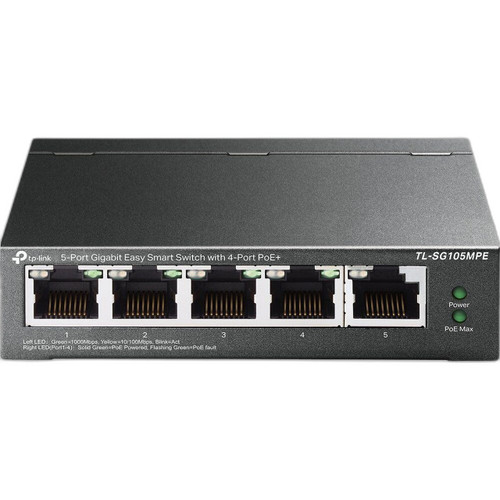
The TL-SG105MPE carries a 120 W PoE+ budget across four PoE+ ports. At 30 W per port (IEEE 802.3at), that budget can simultaneously power four cameras or access points at full draw. The unit is wall-mountable and draws up to 120 W from a standard AC circuit.
The USW-FLEX-2.5G-5 is specified with a power budget of 5 W (AC/DC input) or 6.4 W (PoE input) and its own consumption of 5 W. The specs list it as PoE 802.3af-capable but no downstream PoE output budget appears in the provided data — it is primarily positioned as a PoE-input-powered device (USB-C 5V/1A or PoE in), not a PoE-out sourcing switch. Buyers needing to power cameras or APs directly from the switch ports should treat the TL-SG105MPE as the candidate; the Ubiquiti unit's PoE output capability is not confirmed by the provided specifications.
Which switch offers deeper management features and suits more demanding environments?
The USW-FLEX-2.5G-5 is a Layer 2+ managed switch controlled through UniFi network management. It supports 256 VLANs and a 4,000-entry MAC table per the provided specs. It is rated −20 to 45 °C, carries NDAA compliance, and is certified CE, FCC, IC, and Anatel. Its polycarbonate enclosure weighs 206 g (117.1 × 90 × 21.2 mm), and it operates on 4.8–5.2 V DC/USB — making it suitable for edge, battery-backed, or solar-powered installations where AC is unavailable.
The TL-SG105MPE is classified as 'Easy Smart' — a limited web-managed tier below full Layer 2. VLAN count, MAC table size, operating temperature range, and certifications are absent from the provided specifications. The unit is wall-mountable but not DIN-rail capable. Buyers who require NDAA compliance, a confirmed temperature floor below 0 °C, or integration into a unified network management controller should note that these attributes are documented only for the Ubiquiti unit.
Which should you choose: the SG105MPE or the USW-FLEX-2.5G-5?
Our take: The TL-SG105MPE is the stronger choice when the primary requirement is delivering PoE+ power to IP cameras or access points: its 120 W budget across four 802.3at ports far exceeds the USW-FLEX-2.5G-5's documented 5–6.4 W total power draw, and it does so from a standard AC outlet without requiring an upstream PoE injector. The USW-FLEX-2.5G-5 is the stronger choice when bandwidth and management depth matter more than PoE sourcing: its 2.5 GbE ports (vs. 1 GbE), 25 Gbps switching capacity, 256-VLAN support, NDAA compliance, and −20 °C cold-start rating address edge deployments, Wi-Fi 6 uplinks, and regulated-environment installs that the TP-Link's spec sheet does not address. Buyers already in the UniFi ecosystem gain controller-based management with the Ubiquiti; TP-Link's Easy Smart tier requires its own separate utility.
Side-by-Side Comparison
Spec-for-spec, from manufacturer data.
| Specification | TP-Link SG105MPE | Ubiquiti USW-FLEX-2.5G-5 |
|---|---|---|
| Product Type | Easy Smart Desktop Switch | Layer 2+ Managed Desktop Switch |
| Ports | 5 (4 PoE+, 1 uplink) | 5 × 2.5 GbE (auto 2.5G/1G/100M/10M) |
| Port Speed | 1 Gbps (Gigabit) | 2.5 Gbps per port |
| Switching Capacity | — | 25 Gbps |
| Non-Blocking Throughput | — | 12.5 Gbps |
| Forwarding Rate | — | 19 Mpps |
| PoE Budget (downstream) | 120 W (PoE+, 802.3at) | Not specified in provided data |
| PoE Standard (downstream) | 802.3at (PoE+) | 802.3af (listed; output budget not confirmed) |
| Unit Power Consumption | 120 W (max) | 5 W (AC/DC input) |
| Input Power Options | AC (wall) | USB-C 5V/1A or PoE input |
| VLAN Support | — | 256 VLANs |
| MAC Table | — | 4,000 entries |
| Operating Temperature | — | −20 to 45 °C (−4 to 113 °F) |
| Enclosure / Weight | — | Polycarbonate, 206 g |
| Dimensions | — | 117.1 × 90 × 21.2 mm |
| NDAA Compliant | — | Yes |
| Certifications | — | CE, FCC, IC, Anatel |
| Mount Type | Wall | Desktop |
| DIN Rail | No | — |
| Management Platform | TP-Link Easy Smart utility | UniFi controller |
Frequently Asked Questions
Which should you choose: the SG105MPE or the USW-FLEX-2.5G-5?
The TL-SG105MPE is the stronger choice when the primary requirement is delivering PoE+ power to IP cameras or access points: its 120 W budget across four 802.3at ports far exceeds the USW-FLEX-2.5G-5's documented 5–6.4 W total power draw, and it does so from a standard AC outlet without requiring an upstream PoE injector. The USW-FLEX-2.5G-5 is the stronger choice when bandwidth and management depth matter more than PoE sourcing: its 2.5 GbE ports (vs. 1 GbE), 25 Gbps switching capacity, 256-VLAN support, NDAA compliance, and −20 °C cold-start rating address edge deployments, Wi-Fi 6 uplinks, and regulated-environment installs that the TP-Link's spec sheet does not address. Buyers already in the UniFi ecosystem gain controller-based management with the Ubiquiti; TP-Link's Easy Smart tier requires its own separate utility.
Is the TL-SG105MPE or USW-FLEX-2.5G-5 better for powering IP cameras directly from the switch?
The TL-SG105MPE is the documented choice for PoE sourcing: it provides 120 W across four PoE+ (802.3at) ports, enough to simultaneously power four 30 W cameras. The USW-FLEX-2.5G-5 specs show a total power budget of 5–6.4 W and position it as a PoE-input-powered device; its downstream PoE output capability is not confirmed in the provided specifications.
Will the USW-FLEX-2.5G-5 work without an AC outlet — for example, in a remote cabinet or solar-powered enclosure?
Yes, per spec: the USW-FLEX-2.5G-5 accepts 4.8–5.2 V DC via USB-C (5V/1A) or via PoE input (6.4 W budget), so it can be powered from a PoE uplink or a USB power bank without any AC circuit. The TL-SG105MPE's specs do not describe a DC or PoE-input power option.
Does either switch meet NDAA compliance requirements for government or regulated installations?
The USW-FLEX-2.5G-5 is listed as NDAA Compliant in the provided specifications. The TL-SG105MPE's specifications do not include an NDAA compliance statement.
More Network Switch Comparisons
- TP-Link SG2005P-PD vs Ubiquiti USW-FLEX-2.5G-5
- TP-Link SG2005P-PD vs TP-Link ES205G
- TP-Link SG2005P-PD vs TP-Link DS105G
- TP-Link ES205G vs Ubiquiti USW-FLEX-2.5G-5
- TP-Link ES205G vs TP-Link DS105G
- Ubiquiti USW-FLEX-2.5G-5 vs TP-Link DS105G
Network Switch Buying Guides
Get a Second Opinion on Your Camera Choice
Share your site layout, coverage goals, and budget. Our team will validate the camera selection, flag anything we would change, and recommend products that match the use case.