
TP-Link SG1016PE vs Ubiquiti USW-16-POE: Specification Comparison
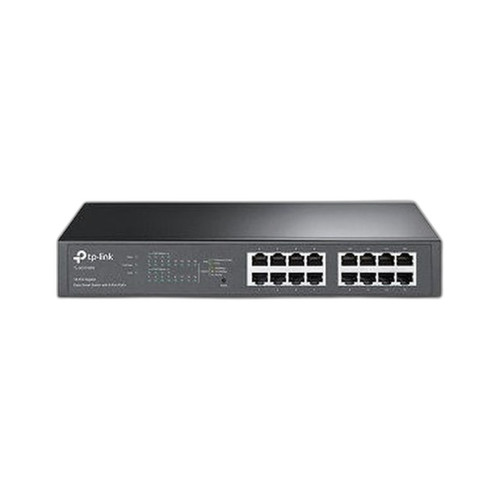
Both the TP-Link TL-SG1016PE and the Ubiquiti USW-16-POE are 16-port Gigabit PoE switches targeting commercial installers and IT buyers deploying IP cameras, access points, and edge devices at the access layer. The TP-Link delivers an Easy Smart managed feature set with a 120 W PoE budget across 8 ports, while the Ubiquiti offers a full UniFi-managed platform with 16 PoE+ ports, 2 SFP uplinks, and a 36 Gbps switching fabric—but only a 42 W total PoE budget. This comparison examines PoE capacity and port architecture, switching performance and uplink options, and management depth and ecosystem fit.

In This Guide
- Which switch can power more PoE devices, and at what wattage per port?
- How do the two switches compare on throughput, uplinks, and switching fabric?
- Which switch offers deeper management features and better ecosystem integration?
- Which should you choose: the SG1016PE or the USW-16-POE?
- Side-by-Side Specs
- FAQ
Which switch can power more PoE devices, and at what wattage per port?
The TL-SG1016PE provides a 120 W total PoE budget distributed across 8 of its 16 ports, with no PoE+ standard explicitly stated in the provided specs. At 120 W across 8 ports, the theoretical average per-port budget is 15 W, sufficient for standard 802.3af devices such as fixed IP cameras and basic access points. The remaining 8 ports are non-PoE data-only ports.
The USW-16-POE is specified as PoE+ (802.3at) across all 16 RJ45 ports, but carries a total PoE budget of only 42 W—as confirmed by both the structured spec field and the inline datasheet figures. At 42 W shared across 16 ports, the average available per-port budget is approximately 2.6 W under full port utilization, which is significantly below the 802.3at maximum of 30 W per port. Practically, the USW-16-POE can power a limited mix of low-draw PoE+ devices simultaneously before hitting its budget ceiling.
For deployments requiring high per-port PoE draw—such as pan-tilt-zoom cameras, dual-radio APs, or heated enclosure devices—the TL-SG1016PE's 120 W budget offers substantially more headroom despite powering only 8 ports. The USW-16-POE's 42 W budget is a hard constraint that buyers must plan around carefully. Note: the USW-16-POE spec sheet also lists an internal 60 W power supply and a separate figure of 180 W under 'Power Watts'; those values are inconsistent with the stated 42 W PoE budget, and since the authoritative spec field confirms 42 W, that figure is used here.
How do the two switches compare on throughput, uplinks, and switching fabric?
The USW-16-POE publishes detailed switching performance figures: 36 Gbps switching capacity, 18 Gbps non-blocking throughput, and a forwarding rate of 27 Mpps. These metrics confirm a fully non-blocking architecture across all 18 ports (16 GbE + 2 SFP) at line rate. The two SFP uplink ports enable fiber backbone aggregation for multi-building or inter-closet runs without consuming GbE ports.
The TL-SG1016PE's provided specs do not include switching capacity, forwarding rate, or non-blocking throughput figures. No uplink ports beyond the 16 GbE ports are specified. Buyers requiring fiber uplinks or documented non-blocking performance guarantees cannot confirm those capabilities from the available spec data for the TP-Link.
For deployments where backplane performance, uplink flexibility, or documented non-blocking fabric are decision criteria—such as video surveillance aggregation closets handling simultaneous multi-stream traffic—the USW-16-POE provides verifiable numbers. The TL-SG1016PE's performance envelope is unconfirmed from the supplied specifications.
Which switch offers deeper management features and better ecosystem integration?
The TL-SG1016PE is classified as 'Easy Smart' managed, which in TP-Link's product line typically covers web-GUI-based VLAN, QoS, and basic port control without a centralized controller. The provided specs reference VLAN and QoS capabilities via the card bullets but do not enumerate specific VLAN capacity, 802.1Q support depth, SNMP, or CLI access. Management interface details beyond 'Easy Smart' are absent from the supplied data.
The USW-16-POE is a UniFi platform device managed via Ubiquiti's UniFi Network controller (hardware or cloud-hosted). Specs confirm support for up to 1,000 VLANs and Ethernet management. The UniFi ecosystem provides centralized multi-site management, traffic analytics, guest portal, and integration with UniFi Protect (NVR), UniFi Access (door control), and UniFi Talk—relevant for integrators building unified physical-security stacks. NDAA compliance is confirmed for the USW-16-POE; no NDAA status is specified for the TL-SG1016PE.
The TL-SG1016PE carries a 'hide_reason: pricing_violation_2026-05-06' flag in the product record, indicating it was hidden from the storefront due to a pricing compliance issue as of that date; buyers should verify current availability and pricing compliance before specifying it. The USW-16-POE has no such flag.
Which should you choose: the SG1016PE or the USW-16-POE?
Our take: The TL-SG1016PE is the stronger choice when raw PoE wattage budget is the primary constraint: its 120 W budget is 2.86× the USW-16-POE's 42 W, making it far more capable of powering high-draw cameras, dual-radio APs, or PTZ devices without budget exhaustion. However, the USW-16-POE leads on documented switching performance (36 Gbps fabric, 18 Gbps non-blocking, 27 Mpps forwarding), adds 2 SFP fiber uplinks absent from the TP-Link spec, supports 1,000 VLANs, and carries confirmed NDAA compliance. The TP-Link's management depth and non-blocking performance are unconfirmed from supplied specs. Additionally, the TL-SG1016PE has an active pricing-violation hide flag that buyers must resolve before procurement. Choose the USW-16-POE for UniFi-ecosystem deployments requiring fiber uplinks, deep VLAN segmentation, and NDAA compliance; choose the TL-SG1016PE only when PoE wattage budget is decisive and the UniFi platform is not a requirement.
Side-by-Side Comparison
Spec-for-spec, from manufacturer data.
| Specification | TP-Link SG1016PE | Ubiquiti USW-16-POE |
|---|---|---|
| Total PoE Budget | 120 W | 42 W |
| PoE Standard | PoE (standard not specified in specs) | PoE+ (802.3at) |
| PoE-Capable Ports | 8 of 16 | 16 of 16 |
| Total RJ45 Ports | 16 | 16 |
| SFP Uplink Ports | — | 2 |
| Switching Capacity | — | 36 Gbps |
| Non-Blocking Throughput | — | 18 Gbps |
| Forwarding Rate | — | 27 Mpps |
| VLAN Support | VLAN (count not specified) | 1,000 VLANs |
| Management Type | Easy Smart (web GUI) | UniFi Controller (Ethernet) |
| Idle Power Consumption (excl. PoE) | — | 18 W |
| Operating Temperature | — | -5 to 40°C (23 to 104°F) |
| Form Factor | — | 1U Rack Mount |
| Dimensions | — | 442 x 200 x 44 mm |
| NDAA Compliant | — | Yes |
| Certifications | — | CE, FCC, IC, Anatel |
Frequently Asked Questions
Which should you choose: the SG1016PE or the USW-16-POE?
The TL-SG1016PE is the stronger choice when raw PoE wattage budget is the primary constraint: its 120 W budget is 2.86× the USW-16-POE's 42 W, making it far more capable of powering high-draw cameras, dual-radio APs, or PTZ devices without budget exhaustion. However, the USW-16-POE leads on documented switching performance (36 Gbps fabric, 18 Gbps non-blocking, 27 Mpps forwarding), adds 2 SFP fiber uplinks absent from the TP-Link spec, supports 1,000 VLANs, and carries confirmed NDAA compliance. The TP-Link's management depth and non-blocking performance are unconfirmed from supplied specs. Additionally, the TL-SG1016PE has an active pricing-violation hide flag that buyers must resolve before procurement. Choose the USW-16-POE for UniFi-ecosystem deployments requiring fiber uplinks, deep VLAN segmentation, and NDAA compliance; choose the TL-SG1016PE only when PoE wattage budget is decisive and the UniFi platform is not a requirement.
Which switch can power more IP cameras simultaneously?
Based on specified PoE budgets, the TL-SG1016PE's 120 W total budget across 8 PoE ports supports substantially more simultaneous high-draw devices than the USW-16-POE's 42 W budget shared across all 16 PoE+ ports. For example, at a typical 12–15 W per fixed IP camera, the TL-SG1016PE can power roughly 8 cameras at capacity; the USW-16-POE can power approximately 2–3 cameras at the same draw before exhausting its 42 W budget. No per-port PoE wattage figures beyond total budget are provided for either unit.
Does either switch support fiber uplinks for connecting to a core switch or IDF closet?
Yes—the USW-16-POE includes 2 SFP uplink ports per its specs, enabling fiber or direct-attach copper connections to an aggregation or core switch without consuming PoE ports. The TL-SG1016PE's supplied specifications list only 16 GbE RJ45 ports with no mention of SFP or fiber uplink capability. Buyers requiring fiber backbone connectivity should note this distinction.
Is either switch NDAA-compliant for federal or government installations?
The USW-16-POE is explicitly listed as NDAA Compliant: Yes in its specifications. The TL-SG1016PE's provided specifications contain no NDAA compliance statement. Buyers subject to NDAA Section 889 restrictions should not assume compliance for the TP-Link based on the available spec data and should verify directly with the manufacturer.
More Network Switch Comparisons
- Vivotek GEL-205A-260 vs TP-Link SL1218MP
- Vivotek GEL-205A-260 vs Allied Telesis AT-x530L-18GHXm-10
- Vivotek GEL-205A-260 vs Ubiquiti USW-LITE-16-POE
- Vivotek GEL-205A-260 vs Ubiquiti USW-16-POE
- TP-Link SL1218MP vs Allied Telesis AT-x530L-18GHXm-10
- TP-Link SL1218MP vs Ubiquiti USW-LITE-16-POE
Network Switch Buying Guides
Get a Second Opinion on Your Camera Choice
Share your site layout, coverage goals, and budget. Our team will validate the camera selection, flag anything we would change, and recommend products that match the use case.