
TP-Link S5500-24GP4F vs Transition Networks SM24DP4XA-NA: Specification Comparison
Both the TP-Link S5500-24GP4F and the Transition Networks SM24DP4XA-NA are 28-port Gigabit managed switches targeting enterprise and commercial LAN deployments. The comparison centers on three dimensions most relevant to installers and IT buyers: PoE delivery and port power budgeting, uplink and fiber connectivity, and management depth with security feature sets. One model is designed around Power over Ethernet endpoint feeding; the other positions itself as a fiber-aggregation and distribution-layer device with dual power-input flexibility.
In This Guide
- Which switch better supports powered endpoints such as IP cameras and access-control panels?
- How do the two switches handle high-speed uplinks and fiber connectivity?
- Which switch offers deeper management and stronger network security controls?
- Which should you choose: the S5500-24GP4F or the SM24DP4XA-NA?
- Side-by-Side Specs
- FAQ
Which switch better supports powered endpoints such as IP cameras and access-control panels?
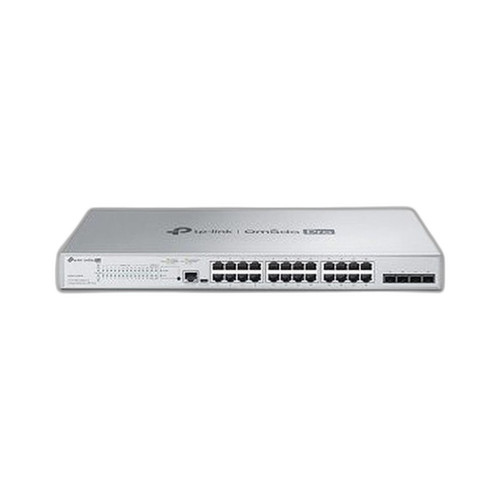
The S5500-24GP4F provides 24 PoE++ (802.3bt) ports rated to 95 W per port with an aggregate PoE budget of 58 W as stated in the supplied specifications. Note that a 58 W aggregate budget is unusually low for 24 IEEE 802.3bt ports; installers should verify the datasheet figure before design, as this may reflect a per-port or burst figure rather than the total switchable budget. The standard nonetheless guarantees up to 95 W to a single high-draw device such as a pan-tilt-zoom camera or a multi-radio Wi-Fi 6E access point.
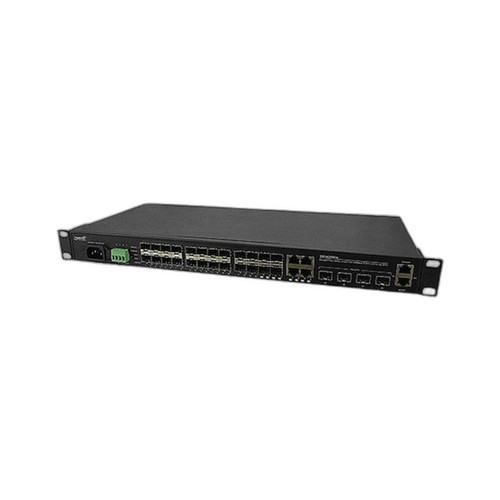
The SM24DP4XA-NA specifications do not list any PoE capability. The supplied data describes it as a fiber-aggregation and backbone switch with dual AC/DC input (110–240 VAC or 24–60 VDC) rather than a device that powers endpoints. Buyers requiring PoE delivery from this port count would need to source PoE injectors or a separate PoE switch tier, adding cost and rack space.
How do the two switches handle high-speed uplinks and fiber connectivity?
The S5500-24GP4F includes 4 Gigabit SFP uplink slots supporting both single-mode and multi-mode fiber transceivers. All uplinks are Gigabit-speed; no 10 Gigabit uplink is specified in the provided data despite '10G' appearing in a source tag. Buyers running high-density camera streams to an aggregation layer should verify whether Gigabit uplinks create a bottleneck given 24 active PoE devices.
The SM24DP4XA-NA spec sheet lists SFP Slots as '00', meaning the number of SFP slots is not confirmed in the supplied data. The product is described as a fiber-aggregation and backbone switch, and its compatible-accessories note references SFP Modules, but no port count, speed, or fiber-type detail is provided. Installers cannot size uplink capacity from the available specifications and should consult the datasheet directly.
Which switch offers deeper management and stronger network security controls?
The S5500-24GP4F is classified L2+ Managed and supports 802.1Q VLAN, STP/RSTP/MSTP, IGMP Snooping, 802.1p/DSCP QoS, ACL, LACP, CLI, SNMP, and Dual Image firmware. Authentication uses 802.1X with RADIUS and TACACS+ backends. The Omada Pro ecosystem implies cloud or controller-based management, though controller requirements are not detailed in the supplied specs.
The SM24DP4XA-NA is specified as Layer 2/3 Managed, giving it a routing tier the S5500-24GP4F does not claim. Its security stack includes SSH, SSL, 802.1X, RADIUS, and TACACS+, and it supports DHCP Relay and DHCP Option 82 — features relevant to IP-camera and access-control VLAN segmentation in enterprise topologies. Jumbo Frame support up to 4,776 bytes is specified, which aids high-throughput video backhaul. Specific management software or interface type is not named in the supplied data.
Which should you choose: the S5500-24GP4F or the SM24DP4XA-NA?
Our take: The S5500-24GP4F is the stronger choice when the primary requirement is powering IP endpoints — cameras, access-control readers, or access points — directly from the switch. It delivers 802.3bt PoE++ on all 24 access ports, a feature entirely absent from the SM24DP4XA-NA per available specs. The SM24DP4XA-NA holds two concrete advantages: it is specified as Layer 2/3 (adding routing capability the S5500-24GP4F's L2+ classification does not confirm), and it accepts dual AC/DC power input (110–240 VAC or 24–60 VDC), making it better suited to hardened or generator-backed installations. Jumbo Frame support up to 4,776 bytes on the SM24DP4XA-NA also benefits high-bitrate video aggregation. For a security integrator building an edge PoE access layer, the S5500-24GP4F is the natural fit; for a distribution or backbone role with mixed AC/DC power and Layer 3 routing, the SM24DP4XA-NA is more appropriate.
Side-by-Side Comparison
Spec-for-spec, from manufacturer data.
| Specification | TP-Link S5500-24GP4F | Transition Networks SM24DP4XA-NA |
|---|---|---|
| Product Type | L2+ Managed Switch | L2/3 Managed Switch |
| Total Ports | 28 | 28 |
| Access Port Type | 24x Gigabit PoE++ | Not specified |
| PoE Standard | 802.3bt (PoE++) | None specified |
| Max PoE per Port | Up to 95 W | — |
| Aggregate PoE Budget | 58 W (verify vs datasheet) | — |
| SFP Uplink Slots | 4x Gigabit SFP | Not confirmed in specs |
| Uplink Speed | Gigabit | Not specified |
| Fiber Type | Single-mode or multi-mode | Not specified |
| Power Input | Not specified | AC 110–240 V or DC 24–60 V (dual) |
| Jumbo Frame Support | Not specified | Up to 4,776 bytes |
| VLAN | 802.1Q | Yes (detail not specified) |
| Authentication | 802.1X, RADIUS, TACACS+ | 802.1X, RADIUS, TACACS+ |
| Additional Security | ACL, SNMP | SSH, SSL, DHCP Relay, DHCP Option 82 |
| Spanning Tree | STP/RSTP/MSTP | Not specified |
| Operating Temperature | 0°C to 40°C | Not specified |
Frequently Asked Questions
Which should you choose: the S5500-24GP4F or the SM24DP4XA-NA?
The S5500-24GP4F is the stronger choice when the primary requirement is powering IP endpoints — cameras, access-control readers, or access points — directly from the switch. It delivers 802.3bt PoE++ on all 24 access ports, a feature entirely absent from the SM24DP4XA-NA per available specs. The SM24DP4XA-NA holds two concrete advantages: it is specified as Layer 2/3 (adding routing capability the S5500-24GP4F's L2+ classification does not confirm), and it accepts dual AC/DC power input (110–240 VAC or 24–60 VDC), making it better suited to hardened or generator-backed installations. Jumbo Frame support up to 4,776 bytes on the SM24DP4XA-NA also benefits high-bitrate video aggregation. For a security integrator building an edge PoE access layer, the S5500-24GP4F is the natural fit; for a distribution or backbone role with mixed AC/DC power and Layer 3 routing, the SM24DP4XA-NA is more appropriate.
Is the S5500-24GP4F or SM24DP4XA-NA better for powering IP cameras directly from the switch?
The S5500-24GP4F is the clear choice for powering cameras. It specifies 24 PoE++ (802.3bt) ports capable of up to 95 W per port. The SM24DP4XA-NA has no PoE capability listed in the available specifications, so cameras would need external injectors or a separate PoE switch if that model is selected.
Which switch works in sites that run on DC backup power or generator feeds?
The SM24DP4XA-NA is designed for mixed-power environments, accepting 110–240 VAC or 24–60 VDC on its dual-input supply — compatible with 48 V DC UPS and generator-backed panels common in critical-infrastructure and industrial sites. No DC input capability is specified for the S5500-24GP4F, which lists a standard 58 W power figure with no DC-input detail.
Can either switch perform Layer 3 routing between VLANs without an external router?
The SM24DP4XA-NA is specified as a Layer 2/3 switch, indicating onboard inter-VLAN routing capability. The S5500-24GP4F is classified L2+ Managed; L2+ typically includes features such as static routing but does not confirm full Layer 3 dynamic routing. Buyers requiring verified Layer 3 routing should consult each product's datasheet to confirm the specific routing protocols supported.
More Network Switch Comparisons
- TP-Link S5500-24GP4F vs Comnet CWX28F4T24MPB
- TP-Link S5500-24GP4F vs TP-Link SG3428MP
- TP-Link SG3428MP vs Transition Networks SM24DP4XA-NA
- TP-Link SG3428MP vs Comnet CWX28F4T24MPB
- Transition Networks SM24DP4XA-NA vs Comnet CWX28F4T24MPB
Network Switch Buying Guides
Get a Second Opinion on Your Camera Choice
Share your site layout, coverage goals, and budget. Our team will validate the camera selection, flag anything we would change, and recommend products that match the use case.