
TP-Link S5500-24GP4F vs TP-Link SG3428MP: Specification Comparison
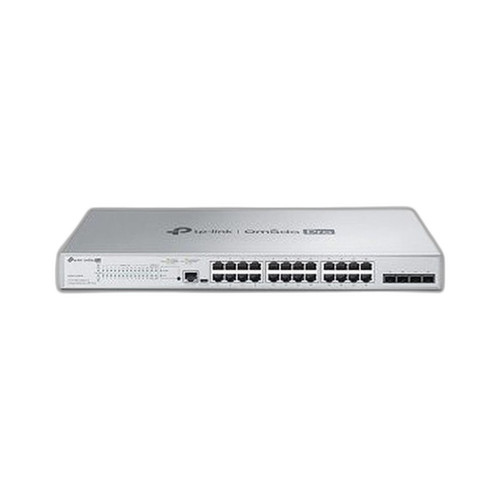
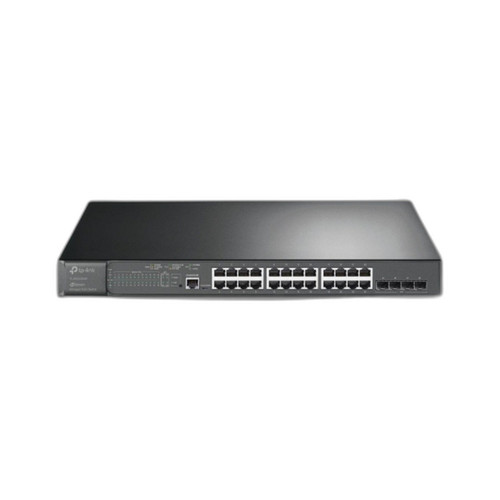
Both products are TP-Link 28-port Gigabit L2+ Managed switches with 24 copper PoE ports and 4 SFP uplink slots — a standard form factor for IP security camera deployments and SMB wiring closets. The comparison turns on three critical axes for physical-security installers: PoE standard and per-port wattage ceiling, total PoE power budget, and management platform. The S5500-24GP4F sits in the Omada Pro tier with 802.3bt PoE++; the SG3428MP is a JetStream unit with 802.3at PoE+ and a substantially larger total power budget.
In This Guide
- Which switch delivers higher per-port PoE wattage for power-hungry endpoints?
- Which switch can sustain more total PoE load across all 24 ports simultaneously?
- How do the two switches differ in management platform, protocol support, and L2+ feature sets?
- Which should you choose: the S5500-24GP4F or the SG3428MP?
- Side-by-Side Specs
- FAQ
Which switch delivers higher per-port PoE wattage for power-hungry endpoints?
The S5500-24GP4F supports 802.3bt PoE++ on all 24 copper ports, with a per-port ceiling of up to 95 W per port as stated in the product bullets. This matters when connecting PTZ cameras with integrated heaters/blowers, multi-radio Wi-Fi 6E access points, or 90 W digital displays that require the full 802.3bt envelope.
The SG3428MP supports 802.3at PoE+ on its 24 copper ports. 802.3at caps per-port delivery at 30 W. For standard IP cameras (typically 5–15 W), IR bullet or dome cameras with heaters (15–25 W), and most access control readers, PoE+ is fully sufficient. However, the SG3428MP cannot power any single device that exceeds the 30 W 802.3at ceiling — a hard constraint when specifying PTZ cameras rated above 30 W or next-generation 802.3bt-only endpoints.
Summary: the S5500-24GP4F wins on per-port ceiling (up to 95 W vs 30 W) and is the only option of the two for any 802.3bt endpoint.
Which switch can sustain more total PoE load across all 24 ports simultaneously?
The SG3428MP carries a 384 W total PoE budget — more than six times the S5500-24GP4F's stated 58 W budget. Dividing 384 W across 24 ports yields an average of 16 W per active port, which aligns precisely with the Card Bullet claim of 'powers 30 cameras at 12–15 W each.' In practice, a 24-camera deployment drawing 13 W each consumes 312 W, well within the 384 W envelope.
The S5500-24GP4F lists a total power consumption of 58 W and a PoE budget of 58 W. This figure is unusually low for a 24-port PoE++ switch and may represent a base system power figure rather than the full PoE delivery capacity; however, only the provided spec value can be cited here. At 58 W total, the switch cannot simultaneously power more than one or two high-wattage 802.3bt devices without exhausting its budget — even at a modest 8 W per camera, only 7 ports could be loaded simultaneously within 58 W.
Summary: the SG3428MP's 384 W budget is decisively larger and supports dense real-world camera deployments. The S5500-24GP4F's 58 W figure, as specified, imposes a severe aggregate constraint regardless of its per-port 802.3bt ceiling.
How do the two switches differ in management platform, protocol support, and L2+ feature sets?
The S5500-24GP4F is classified under the Omada Pro product line, indicating it is designed to integrate with TP-Link's Omada SDN controller ecosystem. Its specified operating modes include 802.1Q VLAN, STP/RSTP/MSTP, IGMP Snooping, 802.1p/DSCP QoS, ACL, LACP, CLI, SNMP, and Dual Image firmware. Authentication is documented as 802.1x with RADIUS/TACACS+ support — directly relevant to enterprise or government deployments requiring network access control. Dual Image provides a firmware redundancy mechanism.
The SG3428MP is a JetStream L2+ Managed switch. The provided specs confirm L2+ management and PoE capability but do not enumerate specific protocol support, QoS mechanisms, authentication methods, or firmware redundancy features. The spec sheet lists USB connectivity and a ceiling-mount type, though no additional management detail is given in the supplied data.
Summary: on documented management features, the S5500-24GP4F provides more enumerated capabilities (TACACS+, SNMP, Dual Image, ACL, LACP, CLI). The SG3428MP's feature set is not fully characterized by the provided specs and cannot be assumed to be equivalent or inferior beyond what is stated.
Which should you choose: the S5500-24GP4F or the SG3428MP?
Our take: The SG3428MP is the stronger choice when the deployment priority is powering a full complement of 24 standard IP cameras simultaneously, because its 384 W PoE budget — 6.6× larger than the S5500-24GP4F's specified 58 W — is the dominant constraint in any dense camera installation. The S5500-24GP4F's 802.3bt PoE++ ceiling of up to 95 W per port is a meaningful advantage only when individual endpoints demand more than 30 W; if no such endpoints are in the design, that capability goes unused. On management, the S5500-24GP4F's Omada Pro platform with documented TACACS+, SNMP, Dual Image, and ACL support offers richer enterprise integration. Choose the S5500-24GP4F when you need 802.3bt per-port power or Omada SDN controller integration with advanced L2+ features and can work within the 58 W aggregate budget. Choose the SG3428MP for standard PoE+ camera deployments where aggregate budget capacity is the governing requirement.
Side-by-Side Comparison
Spec-for-spec, from manufacturer data.
| Specification | TP-Link S5500-24GP4F | TP-Link SG3428MP |
|---|---|---|
| MPN | S5500-24GP4F | SG3428MP |
| Product Line | Omada Pro | JetStream |
| Total Ports | 28 | 28 |
| Copper PoE Ports | 24 Gigabit | 24 Gigabit |
| SFP Uplink Slots | 4 Gigabit SFP | 4 SFP |
| PoE Standard | 802.3bt (PoE++) | 802.3at (PoE+) |
| Max Per-Port PoE | Up to 95 W | Up to 30 W |
| Total PoE Budget | 58 W | 384 W |
| Management Tier | L2+ Managed | L2+ Managed |
| VLAN Support | 802.1Q VLAN | — |
| Spanning Tree | STP / RSTP / MSTP | — |
| QoS | 802.1p / DSCP | — |
| Authentication | 802.1x; RADIUS / TACACS+ | — |
| LACP | Yes | — |
| SNMP | Yes | — |
| Dual Image Firmware | Yes | — |
| Operating Temperature | 0°C to 40°C | — |
| Fiber Type | Single-mode or multi-mode (SFP) | SFP (type not specified) |
Frequently Asked Questions
Which should you choose: the S5500-24GP4F or the SG3428MP?
The SG3428MP is the stronger choice when the deployment priority is powering a full complement of 24 standard IP cameras simultaneously, because its 384 W PoE budget — 6.6× larger than the S5500-24GP4F's specified 58 W — is the dominant constraint in any dense camera installation. The S5500-24GP4F's 802.3bt PoE++ ceiling of up to 95 W per port is a meaningful advantage only when individual endpoints demand more than 30 W; if no such endpoints are in the design, that capability goes unused. On management, the S5500-24GP4F's Omada Pro platform with documented TACACS+, SNMP, Dual Image, and ACL support offers richer enterprise integration. Choose the S5500-24GP4F when you need 802.3bt per-port power or Omada SDN controller integration with advanced L2+ features and can work within the 58 W aggregate budget. Choose the SG3428MP for standard PoE+ camera deployments where aggregate budget capacity is the governing requirement.
Can either switch power a PTZ camera that requires more than 30 W?
Only the S5500-24GP4F supports 802.3bt PoE++, which covers endpoints up to 95 W per port. The SG3428MP is limited to 802.3at PoE+ at a maximum of 30 W per port. Any PTZ camera or other device requiring more than 30 W must be connected to the S5500-24GP4F or a separate 802.3bt-capable injector.
Which switch handles a 24-camera installation drawing roughly 13 W per camera?
The SG3428MP is better suited. Twenty-four cameras at 13 W each draw 312 W, which is within its 384 W PoE budget. The S5500-24GP4F specifies a total PoE budget of 58 W, which would be exhausted at fewer than five cameras at that draw rate.
Does the S5500-24GP4F support RADIUS and TACACS+ for network access control?
Yes. The S5500-24GP4F's provided specs list 802.1x authentication with both RADIUS and TACACS+ support. The SG3428MP's provided specs do not document authentication protocol support, so a direct comparison on this point cannot be made from the available data.
More Network Switch Comparisons
- TP-Link S5500-24GP4F vs Transition Networks SM24DP4XA-NA
- TP-Link S5500-24GP4F vs Comnet CWX28F4T24MPB
- TP-Link SG3428MP vs Transition Networks SM24DP4XA-NA
- TP-Link SG3428MP vs Comnet CWX28F4T24MPB
- Transition Networks SM24DP4XA-NA vs Comnet CWX28F4T24MPB
Network Switch Buying Guides
Get a Second Opinion on Your Camera Choice
Share your site layout, coverage goals, and budget. Our team will validate the camera selection, flag anything we would change, and recommend products that match the use case.