
TP-Link SG3428MP vs Comnet CWX28F4T24MPB: Specification Comparison
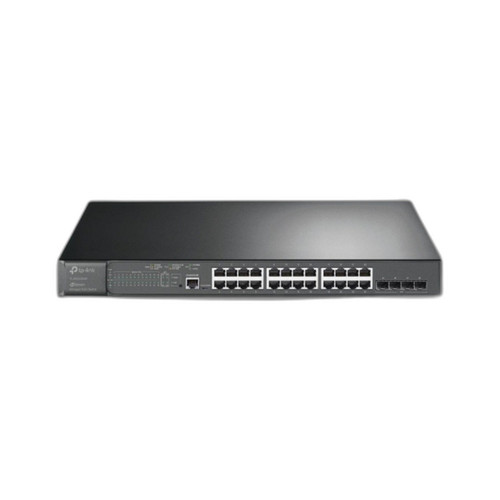
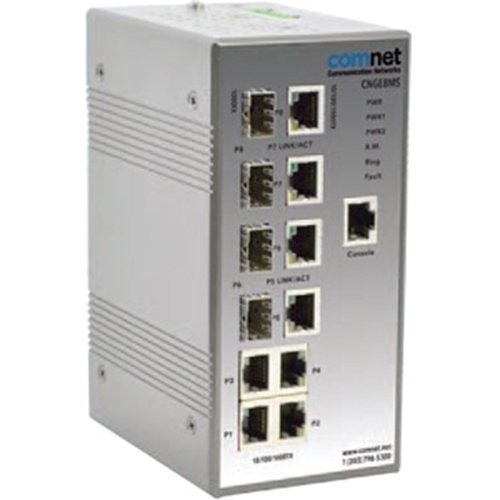
The TP-Link SG3428MP and Comnet CWX28F4T24MPB are both 28-port Gigabit L2+ managed PoE switches aimed at commercial IP surveillance and enterprise edge deployments. Each ships with 24 copper RJ45 ports and 4 fiber uplink slots. The comparison centers on three dimensions that drive purchase decisions in this class: PoE architecture and budget, compliance and warranty posture, and port speed and uplink throughput — all derived strictly from the submitted specifications.
In This Guide
- Which switch delivers more usable PoE power and at what per-port standard?
- Which switch is better positioned for government, federal, or regulated-site deployments?
- How do the uplink speeds and management tiers compare for backbone and network integration?
- Which should you choose: the SG3428MP or the CWX28F4T24MPB?
- Side-by-Side Specs
- FAQ
Which switch delivers more usable PoE power and at what per-port standard?
The SG3428MP provides a 384 W total PoE budget across its 24 copper ports, with all ports rated to the 802.3at (PoE+) standard, meaning each port can supply up to 30 W. At the vendor's own illustration of 12–15 W per camera, that budget supports roughly 25–32 camera loads simultaneously before throttling.
The CWX28F4T24MPB carries a higher total PoE budget of 540 W across its 24 copper ports, and its per-port rating is specified at 90 W — consistent with 802.3bt (PoE++) class support, though the standard designation is not explicitly stated in the provided specs. That headroom is meaningful for high-draw endpoints such as PTZ cameras with integrated heaters, multi-sensor units, or access-control panels with electric strikes.
Net delta: the Comnet unit offers 156 W more total budget (540 W vs 384 W) and a substantially higher per-port ceiling (90 W vs 30 W). Buyers powering PoE++ devices or running dense high-wattage loads should weight this heavily.
Which switch is better positioned for government, federal, or regulated-site deployments?
The Comnet CWX28F4T24MPB carries explicit TAA (Trade Agreements Act) and NDAA (National Defense Authorization Act) compliance designations per the provided specifications. These certifications are mandatory for federal procurement, many state/local government contracts, and any site subject to Section 889 restrictions on covered equipment.
The TP-Link SG3428MP specifications as submitted contain no TAA or NDAA compliance declaration. TP-Link's parent company structure has been subject to regulatory scrutiny in this area; the absence of a compliance claim in the spec sheet means this unit cannot be assumed compliant and should not be specified for federally funded or regulated projects without independent legal verification.
The Comnet unit also carries a stated 5-Year Limited Warranty. No warranty term is present in the TP-Link SG3428MP specifications as provided. Integrators pricing lifecycle cost should treat the warranty gap as an unknown risk on the TP-Link side.
How do the uplink speeds and management tiers compare for backbone and network integration?
Both switches provide 4 fiber uplink slots. The CWX28F4T24MPB specifies a Maximum Speed of 10,000 Mbps (10 Gbps), indicating its fiber uplinks are 10GbE-capable. The SG3428MP spec lists Fiber Type as SFP and Speed as Gigabit, implying standard 1 GbE SFP uplinks — no 10 GbE claim is present in the provided data.
On the copper side, both switches deliver 1000 Mbps (Gigabit) on all 24 TX ports. The CWX28F4T24MPB explicitly states 1000 Mbps as Maximum Copper Speed; the SG3428MP is listed as Gigabit throughout, consistent with 1 GbE copper.
Management depth: the SG3428MP is classified L2+ Managed (TP-Link JetStream), which typically includes static routing, VLAN, QoS, IGMP snooping, and a web/CLI/SNMP interface. The CWX28F4T24MPB is listed as Managed Switch but no management tier label (L2, L2+, L3) or specific feature set is declared in the provided specs. Buyers requiring verified L2+ or L3 feature sets on the Comnet unit should consult the full datasheet.
Which should you choose: the SG3428MP or the CWX28F4T24MPB?
Our take: The CWX28F4T24MPB is the stronger choice when the deployment demands higher PoE headroom, 10 GbE fiber uplinks, or compliance with TAA/NDAA purchasing requirements. Concretely: it delivers 540 W of PoE budget versus 384 W on the SG3428MP — a 41% increase — enabling denser high-wattage endpoint loads; its per-port ceiling of 90 W versus 30 W supports 802.3bt-class devices the TP-Link cannot power; and its fiber uplinks reach 10 Gbps versus the SG3428MP's 1 Gbps SFP ceiling, a meaningful backbone advantage in larger installations. It also carries an explicit 5-Year Limited Warranty and TAA/NDAA compliance that the SG3428MP does not claim. The SG3428MP may be appropriate for cost-sensitive commercial sites running standard PoE+ cameras where federal compliance is not required and 1 GbE uplinks suffice, and where L2+ management features are explicitly documented — but no warranty term or compliance status is available from the provided specs to confirm its suitability beyond that scenario.
Side-by-Side Comparison
Spec-for-spec, from manufacturer data.
| Specification | TP-Link SG3428MP | Comnet CWX28F4T24MPB |
|---|---|---|
| Product Class | L2+ Managed Switch | Managed Switch |
| Total Ports | 28 | 28 |
| Copper PoE Ports | 24 | 24 |
| Fiber Uplink Slots | 4 (SFP) | 4 |
| Copper Port Speed | 1 Gbps | 1 Gbps |
| Max Uplink Speed | 1 Gbps (SFP) | 10 Gbps |
| PoE Standard | 802.3at (PoE+) | Not stated in specs |
| Max Per-Port PoE | 30 W | 90 W |
| Total PoE Budget | 384 W | 540 W |
| Management Level | L2+ | Managed (tier not stated) |
| TAA Compliant | Not stated | Yes |
| NDAA Compliant | Not stated | Yes |
| Warranty | Not stated in specs | 5-Year Limited |
| Rack Mount | Not stated in specs | 19" rack |
| Equipment Grade | Not stated in specs | Commercial |
| Connector Type | RJ45 | Not stated in specs |
Frequently Asked Questions
Which should you choose: the SG3428MP or the CWX28F4T24MPB?
The CWX28F4T24MPB is the stronger choice when the deployment demands higher PoE headroom, 10 GbE fiber uplinks, or compliance with TAA/NDAA purchasing requirements. Concretely: it delivers 540 W of PoE budget versus 384 W on the SG3428MP — a 41% increase — enabling denser high-wattage endpoint loads; its per-port ceiling of 90 W versus 30 W supports 802.3bt-class devices the TP-Link cannot power; and its fiber uplinks reach 10 Gbps versus the SG3428MP's 1 Gbps SFP ceiling, a meaningful backbone advantage in larger installations. It also carries an explicit 5-Year Limited Warranty and TAA/NDAA compliance that the SG3428MP does not claim. The SG3428MP may be appropriate for cost-sensitive commercial sites running standard PoE+ cameras where federal compliance is not required and 1 GbE uplinks suffice, and where L2+ management features are explicitly documented — but no warranty term or compliance status is available from the provided specs to confirm its suitability beyond that scenario.
Can either switch power high-wattage PTZ cameras or multi-sensor units with integrated heaters?
The CWX28F4T24MPB specifies a 90 W per-port ceiling and a 540 W total budget, making it capable of powering high-draw endpoints such as PTZ cameras with heaters or multi-sensor domes that exceed the 30 W PoE+ limit. The SG3428MP is rated at PoE+ (802.3at), with a 30 W per-port maximum and 384 W total — sufficient for standard IP cameras but not for devices requiring 802.3bt (PoE++) power levels.
Is either switch approved for use on federal or government-funded surveillance projects?
The CWX28F4T24MPB explicitly carries TAA and NDAA compliance per the provided specifications, making it eligible for federal and regulated-site procurement. The SG3428MP specifications as submitted contain no TAA or NDAA compliance claim; it should not be specified for federally funded or Section 889-restricted projects without independent verification.
Which switch is better suited for connecting to a 10 GbE core or distribution layer?
The CWX28F4T24MPB specifies a Maximum Speed of 10,000 Mbps, indicating 10 GbE-capable fiber uplinks. The SG3428MP is specified with SFP slots rated at Gigabit speed — no 10 GbE uplink claim appears in its provided specs. For deployments requiring high-bandwidth backbone connectivity to a 10 GbE core switch or NVR, the Comnet unit has a documented advantage.
More Network Switch Comparisons
- TP-Link S5500-24GP4F vs Transition Networks SM24DP4XA-NA
- TP-Link S5500-24GP4F vs Comnet CWX28F4T24MPB
- TP-Link S5500-24GP4F vs TP-Link SG3428MP
- TP-Link SG3428MP vs Transition Networks SM24DP4XA-NA
- Transition Networks SM24DP4XA-NA vs Comnet CWX28F4T24MPB
Network Switch Buying Guides
Get a Second Opinion on Your Camera Choice
Share your site layout, coverage goals, and budget. Our team will validate the camera selection, flag anything we would change, and recommend products that match the use case.