
TP-Link DS105GP vs Ubiquiti USW-FLEX-2.5G-5: Specification Comparison
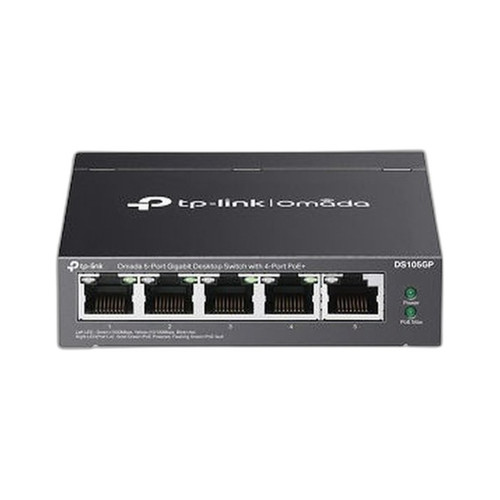
Both the TP-Link DS105GP and the Ubiquiti USW-FLEX-2.5G-5 are 5-port compact desktop switches, but they serve meaningfully different buyer profiles. The DS105GP is an unmanaged Gigabit switch with a 65 W PoE+ budget designed to power IP cameras and access points directly. The USW-FLEX-2.5G-5 is a managed 2.5G switch with Layer 2+ controls, 256 VLANs, and flexible USB-C or PoE input power — but it provides no PoE output to downstream devices. This comparison evaluates port speed and throughput, power architecture, and management capability.

In This Guide
Which switch delivers more port speed and switching throughput?
The USW-FLEX-2.5G-5 runs all five ports at 2.5 Gbps (with auto-fallback to 1G/100M/10M), yielding a switching capacity of 25 Gbps and a non-blocking forwarding throughput of 12.5 Gbps at 19 Mpps. This makes it well-suited for NAS-attached workstations, Wi-Fi 6/6E APs, and 2.5G-capable cameras or edge devices where bandwidth headroom matters.
The DS105GP provides five 10/100/1000 Mbps Gigabit ports with a switching capacity of 10 Gbps. All ports support auto-negotiation and auto-MDI/MDIX. For standard IP camera deployments where individual streams top out at 8–25 Mbps, Gigabit bandwidth is rarely a bottleneck, but the 2.5× throughput gap becomes relevant in aggregation or uplink scenarios.
How does each switch handle power — both for itself and for downstream devices?
The DS105GP operates on 12V DC input and delivers up to 65 W of PoE+ (802.3at) across its ports. This allows it to power IP cameras, access points, or VoIP phones directly — a critical capability for edge deployments where a PoE injector or separate power supply per device is impractical. The spec states a max operating range of 100 m over standard Ethernet.
The USW-FLEX-2.5G-5 accepts power via USB Type-C (5V DC, 1A) or PoE input (802.3af), consuming 5 W from AC/DC input or 6.4 W from PoE input. The specified voltage range is 4.8–5.2V DC/USB. Critically, no PoE output budget is listed in the provided specifications — the switch appears to be a PoE-powered consumer rather than a PoE provider. Buyers who need the switch to power cameras or APs must supply separate power to each downstream device.
What management and network-control capabilities does each switch offer?
The USW-FLEX-2.5G-5 is a Layer 2+ managed switch supporting 256 VLANs and a 4,000-entry MAC address table. Its management interface is specified as Ethernet. It is NDAA compliant and carries CE, FCC, IC, and Anatel certifications — relevant for federal or government-adjacent deployments. VLAN segmentation allows camera traffic, guest Wi-Fi, and corporate LAN to be isolated on a single physical switch.
The DS105GP is unmanaged. There is no VLAN support, no management interface, no MAC table size listed, and no NDAA compliance noted in the provided specifications. Configuration is plug-and-play only. For small sites needing a dedicated, zero-administration PoE drop switch, this is a feature, not a limitation. For any deployment requiring traffic segmentation or remote monitoring, the absence of management is a hard constraint.
Which should you choose: the DS105GP or the USW-FLEX-2.5G-5?
Our take: The DS105GP is the stronger choice when the primary requirement is powering IP cameras or PoE devices without a separate managed infrastructure. Its 65 W PoE+ budget directly feeds 2–4 cameras at 15–16 W each, requires no management overhead, and runs on 12V DC from a simple adapter. The USW-FLEX-2.5G-5 wins on every network-control dimension: 25 Gbps vs. 10 Gbps switching capacity, 2.5G port speed vs. 1G, and 256 VLANs vs. none. However, no PoE output budget is specified for the Ubiquiti unit, making it unsuitable as a camera-powering edge switch without supplemental injectors. Choose the DS105GP for unmanaged PoE camera drops; choose the USW-FLEX-2.5G-5 for managed edge aggregation with 2.5G uplinks where downstream devices supply their own power.
Side-by-Side Comparison
Spec-for-spec, from manufacturer data.
| Specification | TP-Link DS105GP | Ubiquiti USW-FLEX-2.5G-5 |
|---|---|---|
| Product Type | Unmanaged desktop switch | Managed desktop switch |
| Port Count | 5 | 5 |
| Port Speed | 10/100/1000 Mbps (Gigabit) | 2.5G / 1G / 100M / 10M (multi-speed) |
| Switching Capacity | 10 Gbps | 25 Gbps |
| Non-Blocking Throughput | — | 12.5 Gbps |
| Forwarding Rate | — | 19 Mpps |
| PoE Output | 65 W PoE+ (802.3at) | — (not specified) |
| PoE Input | — | 802.3af (powers the switch) |
| Input Power | 12V DC | 5V DC / USB Type-C (4.8–5.2V); or PoE in |
| Power Consumption | — | 5 W (AC/DC); 6.4 W (PoE input) |
| VLAN Support | None | 256 VLANs |
| Management | Unmanaged | Layer 2+ Managed (Ethernet) |
| MAC Address Table | — | 4,000 entries |
| Operating Temp | 0 to 40 °C (32 to 104 °F) | −20 to 45 °C (−4 to 113 °F) |
| NDAA Compliant | — | Yes |
| Dimensions (mm) | 99.8 × 98 × 25 | 117.1 × 90 × 21.2 |
Frequently Asked Questions
Which should you choose: the DS105GP or the USW-FLEX-2.5G-5?
The DS105GP is the stronger choice when the primary requirement is powering IP cameras or PoE devices without a separate managed infrastructure. Its 65 W PoE+ budget directly feeds 2–4 cameras at 15–16 W each, requires no management overhead, and runs on 12V DC from a simple adapter. The USW-FLEX-2.5G-5 wins on every network-control dimension: 25 Gbps vs. 10 Gbps switching capacity, 2.5G port speed vs. 1G, and 256 VLANs vs. none. However, no PoE output budget is specified for the Ubiquiti unit, making it unsuitable as a camera-powering edge switch without supplemental injectors. Choose the DS105GP for unmanaged PoE camera drops; choose the USW-FLEX-2.5G-5 for managed edge aggregation with 2.5G uplinks where downstream devices supply their own power.
Can the USW-FLEX-2.5G-5 power IP cameras the way the DS105GP does?
Based on the provided specifications, the USW-FLEX-2.5G-5 has no listed PoE output power budget. It accepts PoE input (802.3af) to power itself but no PoE output capability is specified. The DS105GP, by contrast, provides a 65 W PoE+ (802.3at) output budget across its ports. If powering cameras directly from the switch is required, the DS105GP is the specified choice; the Ubiquiti unit's PoE output capability is not documented in the supplied specs.
Is the DS105GP or USW-FLEX-2.5G-5 better for a deployment that needs VLAN segmentation?
The USW-FLEX-2.5G-5 supports 256 VLANs and is a Layer 2+ managed switch, making it suitable for separating camera, IoT, and corporate traffic on a single device. The DS105GP is unmanaged with no VLAN support listed in its specifications. For any site requiring traffic isolation or network policy enforcement, the USW-FLEX-2.5G-5 is the only option of the two.
Which switch is rated for harsher operating environments?
The USW-FLEX-2.5G-5 is rated for −20 to 45 °C (−4 to 113 °F). The DS105GP is rated for 0 to 40 °C (32 to 104 °F). The Ubiquiti unit has a 20 °C wider cold-end tolerance, making it more suitable for unheated enclosures, outdoor cabinets, or cold-climate deployments. For storage, the DS105GP is rated to −40 °C, but that is a non-operational rating.
More Network Switch Comparisons
- TP-Link SG2005P-PD vs Ubiquiti USW-FLEX-2.5G-5
- TP-Link SG2005P-PD vs TP-Link ES205G
- TP-Link SG2005P-PD vs TP-Link DS105G
- TP-Link ES205G vs Ubiquiti USW-FLEX-2.5G-5
- TP-Link ES205G vs TP-Link DS105G
- Ubiquiti USW-FLEX-2.5G-5 vs TP-Link DS105G
Network Switch Buying Guides
Get a Second Opinion on Your Camera Choice
Share your site layout, coverage goals, and budget. Our team will validate the camera selection, flag anything we would change, and recommend products that match the use case.