
TP-Link DS1024G vs Ubiquiti USW-24: Specification Comparison
The TP-Link DS1024G and Ubiquiti USW-24 are both 1U rack-mount, 24-port Gigabit Ethernet switches targeting enterprise and prosumer LAN infrastructure. Neither unit provides PoE budget on its RJ-45 ports in a standard downlink-PoE sense per the governing specs here. Buyers evaluating either model are typically building structured cabling backbones, segmenting IP camera VLANs, or aggregating access-layer uplinks in small-to-mid enterprise, education, or multi-site security deployments. This comparison evaluates switching performance, environmental and power specifications, and management and integration capabilities.
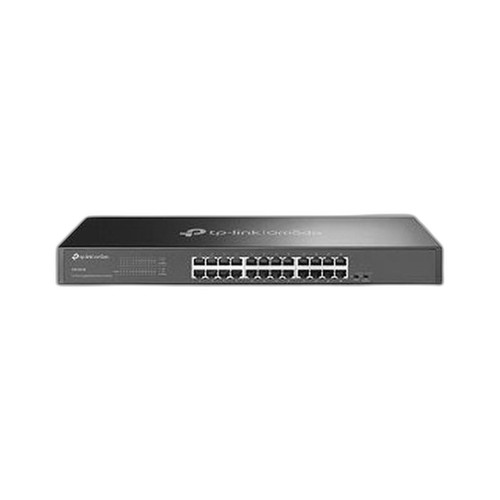
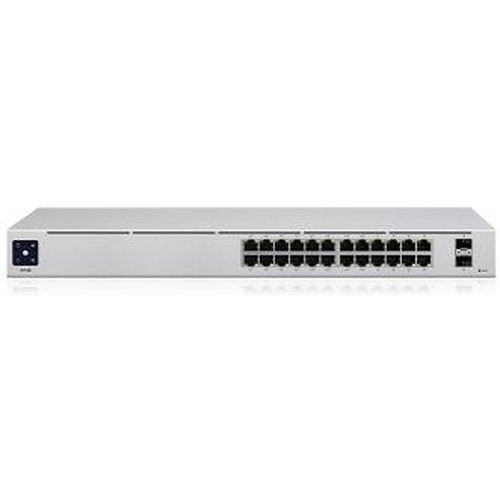
In This Guide
- Which switch delivers more headroom for port-density and throughput?
- How do power consumption and operating environment compare between the two?
- Which switch offers stronger management and ecosystem integration for a structured deployment?
- Which should you choose: the DS1024G or the USW-24?
- Side-by-Side Specs
- FAQ
Which switch delivers more headroom for port-density and throughput?
The USW-24 leads on raw fabric: 52 Gbps switching capacity versus the DS1024G's 48 Gbps, and a forwarding rate of 39 Mpps against the DS1024G's 35.7 Mpps. Both figures matter in dense deployments where multiple ports simultaneously push full-rate traffic — the USW-24's 8.3% wider fabric and 9.2% higher packet-forwarding rate provide measurable headroom for bursty IP camera or AP traffic.
The DS1024G spec sheet states 48 Gbps switching capacity and 35.7 Mpps packet forwarding. It also documents an 8K MAC address table. The USW-24 spec sheet does not state a MAC address table size. For environments with very large Layer 2 domains requiring extensive ARP/MAC learning, the DS1024G's documented 8K MAC table is a concrete known; the USW-24's equivalent figure is absent from the provided specifications.
Port speed on both units is identical: 24 × 10/100/1000 Mbps RJ-45, with Cat 5e supporting the full 100 m reach on both. Neither spec set documents dedicated uplink or SFP ports.
How do power consumption and operating environment compare between the two?
Power consumption diverges meaningfully: the DS1024G is rated at 13.46 W maximum, while the USW-24 draws 25 W typical (with an internal 36 W power supply). For multi-switch deployments or constrained rack PDU budgets, the DS1024G's lower draw is a concrete advantage — roughly half the power per unit.
Operating temperature range also differs. The USW-24 is specified from -5 to 45°C (23–113°F), giving it a 5°C lower cold-start floor and a 5°C higher upper limit compared to the DS1024G's 0–40°C (32–104°F) range. In unconditioned or semi-outdoor enclosures where ambient temperatures stray outside 0–40°C, the USW-24's broader envelope is the governing factor.
Both units accept 100–240 VAC, 50/60 Hz universal input. Enclosure material is documented only for the USW-24 (SGCC steel). The DS1024G's enclosure material is not stated in the provided specifications. Weight is documented only for the USW-24 at 2.7 kg; the DS1024G weight is absent from provided specs.
Which switch offers stronger management and ecosystem integration for a structured deployment?
The USW-24 is a full UniFi managed switch with documented support for up to 1,000 VLANs, integrating natively into the UniFi Controller (Network Application) ecosystem for centralized configuration, monitoring, and topology mapping. This enables per-zone VLAN isolation — a standard requirement in multi-tenant, healthcare, or segmented IP camera deployments — without per-port CLI work.
The DS1024G's management posture is internally contradictory in the provided specifications: the product type field is listed as both 'Managed' and 'Unmanaged Rackmount Switch,' and the managed field is listed as both 'Yes' and 'Unmanaged.' The spec sheet does document Isolation Mode (ports 1–22) and Loop Prevention (ports 1–24), and notes Omada ecosystem compatibility ('Compatible With: enterprise'). However, the VLAN count and controller integration depth are not stated in the provided specifications, making a direct management-capability comparison against the USW-24's documented 1,000-VLAN support impossible from available data.
On certifications, the DS1024G carries FCC, CE, and RoHS. The USW-24 carries CE, FCC, IC, and Anatel. NDAA compliance is documented only for the USW-24 (Yes); the DS1024G's NDAA status is not stated in the provided specifications — relevant for federally funded or government-adjacent installations.
Which should you choose: the DS1024G or the USW-24?
Our take: The USW-24 is the stronger choice when management depth, VLAN segmentation scale, a wider operating temperature range, and NDAA compliance are the primary decision criteria. Concretely: the USW-24 provides 52 Gbps fabric versus 48 Gbps, supports a documented 1,000 VLANs versus a figure not stated for the DS1024G, and operates from -5 to 45°C versus 0–40°C — a meaningful advantage in non-climate-controlled spaces. The DS1024G counters with a maximum power draw of 13.46 W against the USW-24's 25 W typical, making it significantly more efficient in power-constrained racks. The DS1024G is the stronger choice when minimizing per-switch power consumption and cost are paramount and the deployment is already in or planned for a TP-Link Omada environment. Buyers standardizing on Ubiquiti UniFi infrastructure should select the USW-24; those building Omada-managed or power-sensitive backbones where the DS1024G's management contradictions can be resolved against its actual datasheet should verify managed capabilities before committing.
Side-by-Side Comparison
Spec-for-spec, from manufacturer data.
| Specification | TP-Link DS1024G | Ubiquiti USW-24 |
|---|---|---|
| Port Count | 24 × RJ-45 | 24 × RJ-45 |
| Port Speed | 10/100/1000 Mbps | 10/100/1000 Mbps (1G) |
| Switching Capacity | 48 Gbps | 52 Gbps |
| Forwarding Rate | 35.7 Mpps | 39 Mpps |
| Non-Blocking Throughput | — | 26 Gbps |
| MAC Address Table | 8K | — |
| VLAN Support | — | Up to 1,000 |
| Max Power Consumption | 13.46 W | 25 W typical |
| Internal PSU Rating | — | 36 W |
| AC Input | 100–240 VAC, 50/60 Hz | 100–240 VAC, 50/60 Hz |
| Operating Temperature | 0–40°C (32–104°F) | -5 to 45°C (23–113°F) |
| Form Factor | 1U Rack Mount | 1U Rack Mount |
| Dimensions (mm) | 440 × 140 × 44 | 442 × 200 × 44 |
| Enclosure Material | — | SGCC steel |
| Certifications | FCC, CE, RoHS | CE, FCC, IC, Anatel |
| NDAA Compliant | — | Yes |
Frequently Asked Questions
Which should you choose: the DS1024G or the USW-24?
The USW-24 is the stronger choice when management depth, VLAN segmentation scale, a wider operating temperature range, and NDAA compliance are the primary decision criteria. Concretely: the USW-24 provides 52 Gbps fabric versus 48 Gbps, supports a documented 1,000 VLANs versus a figure not stated for the DS1024G, and operates from -5 to 45°C versus 0–40°C — a meaningful advantage in non-climate-controlled spaces. The DS1024G counters with a maximum power draw of 13.46 W against the USW-24's 25 W typical, making it significantly more efficient in power-constrained racks. The DS1024G is the stronger choice when minimizing per-switch power consumption and cost are paramount and the deployment is already in or planned for a TP-Link Omada environment. Buyers standardizing on Ubiquiti UniFi infrastructure should select the USW-24; those building Omada-managed or power-sensitive backbones where the DS1024G's management contradictions can be resolved against its actual datasheet should verify managed capabilities before committing.
Is the USW-24 or DS1024G better for a multi-VLAN IP camera deployment?
Based on provided specifications, the USW-24 has a documented VLAN capacity of 1,000 and integrates into the UniFi Controller for centralized VLAN management — both are concrete, stated figures. The DS1024G's VLAN support count is not stated in the provided specifications, and its management mode is listed inconsistently (both 'Managed' and 'Unmanaged') across its spec fields. Until that discrepancy is resolved against the product's actual datasheet, the USW-24 is the lower-risk choice for VLAN-segmented camera deployments.
Which switch runs cooler and uses less power in a fully loaded rack?
The DS1024G is rated at 13.46 W maximum. The USW-24 draws 25 W typical, with a 36 W internal supply. The DS1024G consumes roughly half the power of the USW-24 under load, making it the clear choice where PDU capacity or heat dissipation budgets are constrained.
Does either switch qualify for federally funded or NDAA-sensitive installations?
NDAA compliance is documented as 'Yes' for the USW-24 in the provided specifications. The DS1024G's NDAA status is not stated in the provided specifications. For installations requiring NDAA compliance — such as those funded under federal security grants or government contracts — the USW-24 is the only unit of the two with a documented compliance claim; the DS1024G cannot be confirmed compliant from available spec data alone.
More Network Switch Comparisons
- TP-Link S5500-24GP4XF vs NETGEAR GS728TP-300NAS
- TP-Link S5500-24GP4XF vs Comnet CNGE24FX12TX12MSPOE
- TP-Link S5500-24GP4XF vs Ubiquiti USW-24
- TP-Link S5500-24GP4XF vs Ubiquiti USW-ENTERPRISEXG-24
- TP-Link S5500-24GP4XF vs TP-Link SL2428P
- TP-Link S5500-24GP4XF vs TP-Link SG3428XPP-M2
Network Switch Buying Guides
Get a Second Opinion on Your Camera Choice
Share your site layout, coverage goals, and budget. Our team will validate the camera selection, flag anything we would change, and recommend products that match the use case.