
Sato WWCLP3D01-NAR vs Brother TJ4520TN: Specification Comparison
Both the Sato CL4NX Plus (WWCLP3D01-NAR) and the Brother TJ4520TN are industrial-grade thermal transfer label printers targeting high-volume barcode and compliance labeling environments. Buyers in manufacturing, warehousing, and supply-chain operations routinely cross-shop these two form factors when evaluating resolution requirements, RFID encoding needs, print width, connectivity, and total cost of ownership. This comparison evaluates them across the three axes most relevant to industrial label printer procurement: print performance and resolution, media handling and hardware capacity, and connectivity plus special features.
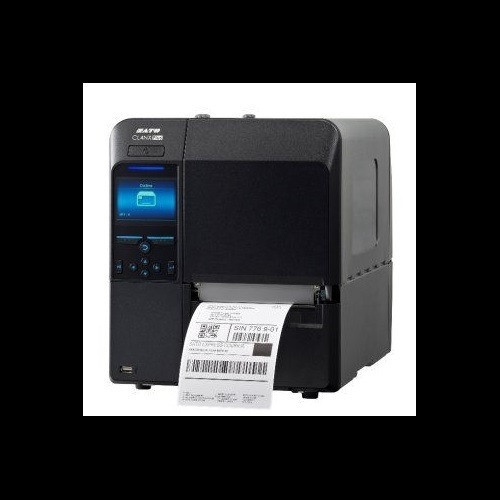
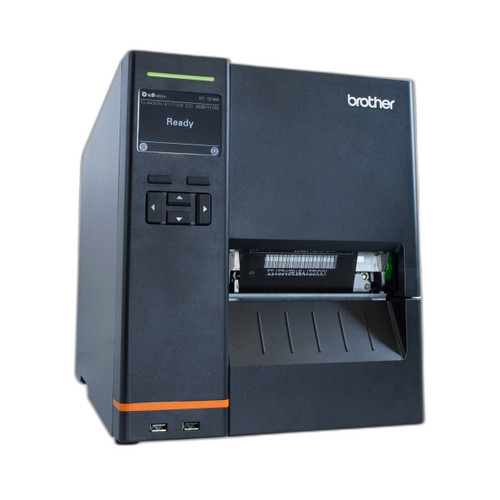
In This Guide
- Which printer delivers higher resolution and faster throughput for barcode-dense label runs?
- How do the two printers compare on media width, roll capacity, memory, and operator interface?
- Which printer offers broader connectivity and what special capabilities differentiate them?
- Which should you choose: the WWCLP3D01-NAR or the TJ4520TN?
- Side-by-Side Specs
- FAQ
Which printer delivers higher resolution and faster throughput for barcode-dense label runs?
The Sato WWCLP3D01-NAR prints at 609 dpi and 14 ips, making it the higher-resolution, faster option between the two. At 609 dpi, it can produce fine-detail barcodes, small human-readable text, and compliance labels that must pass strict scanner-grade verification without upscaling. The 14 ips speed provides a meaningful throughput advantage in sustained high-volume runs.
The Brother TJ4520TN operates at 300 dpi and 12 ips. For standard 1D and 2D barcodes at typical label sizes, 300 dpi is a widely accepted industrial baseline and satisfies most ISO barcode quality grades. The 12 ips speed is competitive for general warehouse labeling but trails the Sato by 2 ips. Buyers with strict resolution mandates—pharmaceutical serialization, small-pitch QR codes, or fine-pitch 2D matrices—will find the Sato's 609 dpi specification directly relevant. For bulk shipping labels and general compliance work, the Brother's 300 dpi is typically sufficient.
How do the two printers compare on media width, roll capacity, memory, and operator interface?
The Brother TJ4520TN supports a wider maximum print width of 4.5 inches versus the Sato's 4.09 inches—an advantage for wide-format labels, pallet tags, or document-style compliance labels. The Sato's minimum media width is specified at 0.87 inches, and its maximum media width (including liner) is 5.04 inches; the Brother's minimum media width is not provided in the available specifications.
The Sato WWCLP3D01-NAR specifies a maximum roll diameter of 10 inches and supports ribbon lengths up to 1,968 ft (600 m), enabling long unattended print runs. Neither roll diameter nor maximum ribbon length is provided for the Brother TJ4520TN in the available specifications, which limits a direct comparison on those points.
On operator interface, the Sato features a 3.5-inch full-color LCD touchscreen with 2 GB Flash and 256 MB SDRAM plus 100 MB user storage—a substantial onboard resource for storing forms, fonts, and label templates locally. The Brother lists a color HVGA LCD touchscreen; memory specifications are not provided in the available data, so a direct memory comparison cannot be made.
Which printer offers broader connectivity and what special capabilities differentiate them?
Connectivity profiles differ in one key area: the Brother TJ4520TN includes Bluetooth (as a standard or optional module per the spec data) and RS232C serial in addition to Ethernet and USB, while the Sato WWCLP3D01-NAR lists Ethernet, Wi-Fi, and USB. The Brother's RS232C serial port directly serves legacy PLC and industrial controller integrations that are common in older manufacturing lines. The Sato's Wi-Fi is listed as standard; the Brother's Wi-Fi and Bluetooth are described in one spec field as optional modules.
The Sato WWCLP3D01-NAR's most significant differentiator is its integrated HF (13.56 MHz) RFID encoder with NFC compatibility. This allows simultaneous printing and encoding of HF RFID inlays—a requirement in pharmaceutical, asset-tracking, and retail supply-chain programs that mandate RFID labeling. The Brother TJ4520TN has no RFID capability listed in the available specifications.
On warranty, the Sato carries a 1-year warranty per the provided specs. The Brother TJ4520TN's spec data references a '2-year Premier Limited with printhead coverage,' which is a more comprehensive coverage term if the buyer's procurement criteria weight post-sale support costs. Physical footprint also differs: the Sato weighs 33 lbs (15 kg) with dimensions of 10.66" x 17.99" x 12.63"; the Brother's physical dimensions and weight are not provided in the available specifications.
Which should you choose: the WWCLP3D01-NAR or the TJ4520TN?
Our take: The WWCLP3D01-NAR is the stronger choice when the deployment requires RFID encoding, higher print resolution, or faster throughput. Its 609 dpi resolution doubles the Brother's 300 dpi, its 14 ips speed exceeds the TJ4520TN's 12 ips, and its integrated HF (13.56 MHz) / NFC RFID encoder is a capability the Brother entirely lacks per available specifications. The Sato also carries substantially more onboard memory (2 GB Flash + 256 MB SDRAM) for template-intensive environments. The TJ4520TN earns consideration when wider label stock is required—its 4.5-inch print width versus the Sato's 4.09 inches—or when RS232C serial connectivity to legacy equipment is mandatory, or when the 2-year Premier Limited warranty with printhead coverage is a procurement priority. For general-purpose high-volume barcode labeling without RFID, the Brother is a viable, simpler platform; for regulated, RFID-mandated, or resolution-critical supply-chain labeling, the Sato is the specified choice.
Side-by-Side Comparison
Spec-for-spec, from manufacturer data.
| Specification | Sato WWCLP3D01-NAR | Brother TJ4520TN |
|---|---|---|
| Print Method | Direct Thermal / Thermal Transfer | Thermal Transfer |
| Print Resolution | 609 dpi | 300 dpi |
| Print Speed | 14 ips | 12 ips |
| Max Print Width | 4.09" | 4.5" |
| Display | 3.5" Full-Color LCD Touchscreen | Color HVGA LCD Touchscreen |
| Connectivity (Standard) | Ethernet, Wi-Fi, USB | Ethernet, USB 2.0, RS232C Serial |
| Bluetooth | — | Optional module |
| Wi-Fi | Standard | Optional module |
| RFID Capability | HF 13.56 MHz / NFC | — |
| Flash Memory | 2 GB | — |
| SDRAM | 256 MB | — |
| User Storage | 100 MB | — |
| Max Roll Diameter | 10" | — |
| Max Ribbon Length | 1,968 ft (600 m) | — |
| Weight | 33 lbs (15 kg) | — |
| Warranty | 1 year | 2-year Premier Limited (printhead included) |
Frequently Asked Questions
Which should you choose: the WWCLP3D01-NAR or the TJ4520TN?
The WWCLP3D01-NAR is the stronger choice when the deployment requires RFID encoding, higher print resolution, or faster throughput. Its 609 dpi resolution doubles the Brother's 300 dpi, its 14 ips speed exceeds the TJ4520TN's 12 ips, and its integrated HF (13.56 MHz) / NFC RFID encoder is a capability the Brother entirely lacks per available specifications. The Sato also carries substantially more onboard memory (2 GB Flash + 256 MB SDRAM) for template-intensive environments. The TJ4520TN earns consideration when wider label stock is required—its 4.5-inch print width versus the Sato's 4.09 inches—or when RS232C serial connectivity to legacy equipment is mandatory, or when the 2-year Premier Limited warranty with printhead coverage is a procurement priority. For general-purpose high-volume barcode labeling without RFID, the Brother is a viable, simpler platform; for regulated, RFID-mandated, or resolution-critical supply-chain labeling, the Sato is the specified choice.
Is the WWCLP3D01-NAR or the TJ4520TN better for RFID label encoding?
The WWCLP3D01-NAR is the only option here with RFID capability. It includes an integrated HF (13.56 MHz) encoder with NFC compatibility for simultaneous print-and-encode workflows. The TJ4520TN has no RFID functionality listed in its available specifications, so it cannot be used for RFID label programs.
Which printer handles wider label stock?
The Brother TJ4520TN supports a 4.5-inch print width, compared to the Sato WWCLP3D01-NAR's 4.09-inch maximum print width. If your label format requires stock wider than approximately 4.1 inches printed area, the TJ4520TN has the edge on this dimension.
Which printer has the better warranty coverage?
Based on the provided specifications, the Brother TJ4520TN lists a 2-year Premier Limited warranty that includes printhead coverage. The Sato WWCLP3D01-NAR lists a 1-year warranty. The Brother's longer term and explicit printhead inclusion represent a lower anticipated service cost over the coverage period, though full warranty terms should be confirmed with the respective manufacturer.
More Label Printer Comparisons
- Honeywell PX940 vs Sato WWCLP3B01-WAR
- Honeywell PX940 vs Sato WWCLP3801-NAR
- Honeywell PX940 vs Sato WWCLP3801-WAR
- Honeywell PX940 vs Wasp WPL408
- Honeywell PX940 vs Honeywell PX4654-020
- Honeywell PX940 vs Honeywell PX6654-000
Label Printer Buying Guides
Get a Second Opinion on Your Camera Choice
Share your site layout, coverage goals, and budget. Our team will validate the camera selection, flag anything we would change, and recommend products that match the use case.