
Sato WWCLP3801-NAR vs Wasp WPL408: Specification Comparison
Both the Sato CL4NX Plus (WWCLP3801-NAR) and the Wasp WPL408 are industrial-grade label printers supporting thermal transfer and direct thermal printing, targeting mid-to-high-volume label and barcode production environments. The comparison centers on print resolution and speed, RFID capability, connectivity, memory, and physical footprint — the axes that most directly determine fit for asset tracking, warehouse, and compliance labeling deployments.
In This Guide
- Which printer delivers better resolution and throughput for your label volume?
- Which printer better supports RFID encoding and multi-protocol connectivity?
- Which printer is better suited to demanding physical environments and on-printer storage needs?
- Which should you choose: the WWCLP3801-NAR or the WPL408?
- Side-by-Side Specs
- FAQ
Which printer delivers better resolution and throughput for your label volume?
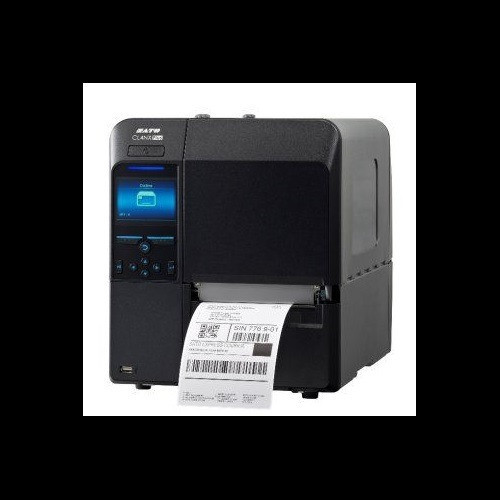
The Sato WWCLP3801-NAR prints at 609 dpi at 14 ips, making it the higher-resolution, higher-speed unit of the two. Its 4.09-inch maximum print width accommodates standard industrial label stock. The 609 dpi output is suited to fine-pitch barcodes, small text, and high-density 2D codes where print clarity is critical.
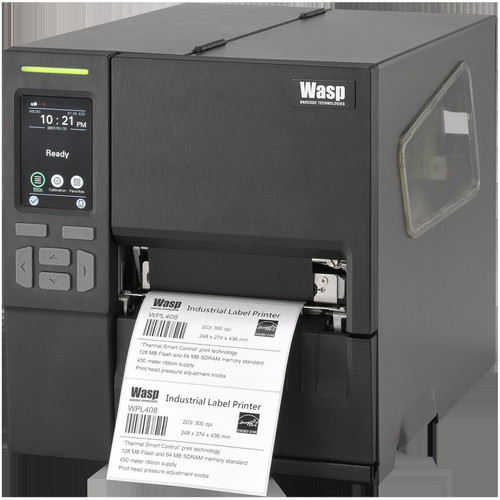
The Wasp WPL408 prints at 203 dpi at 10 ips with a slightly wider 4.25-inch maximum print width and a paper width range of 1.6 to 4.3 inches. At 203 dpi and 10 ips, it is positioned for standard barcode and text label runs where ultra-fine resolution is not a requirement. The WPL408's minimum media width spec (1.6 inches) is not directly stated for the Sato; the Sato lists a minimum media width of 0.87 inches, giving it broader media flexibility on the narrow end.
Ribbon capacity also differs: the Sato supports up to 1,968 feet (600 m) of ribbon versus the Wasp's 1,474 feet, meaning fewer ribbon changes per shift on the Sato in high-volume runs.
Which printer better supports RFID encoding and multi-protocol connectivity?
The Sato WWCLP3801-NAR includes integrated HF RFID encoding at 13.56 MHz with auto-optimization — a factory-built capability for smart label production. This makes it directly applicable to asset tracking, healthcare, retail EPC, and access-card inlay encoding workflows without an external encoder or module.
The Wasp WPL408 has no RFID capability listed in its specifications. Buyers requiring RFID encoding cannot fulfill that requirement with the WPL408 as specced.
On connectivity, both units provide USB, Ethernet, and Wi-Fi. The WPL408 adds an RS-232 serial port (listed as USB 2.0, RS-232, Ethernet 10/100 Mbps, USB host, WiFi slot), which is relevant for legacy PLC or host system integration. The Sato's connectivity spec lists Ethernet, Wi-Fi, and USB without a serial port noted. The WPL408's Ethernet rate is explicitly stated as 10/100 Mbps; the Sato's Ethernet rate is not specified in the provided data.
Which printer is better suited to demanding physical environments and on-printer storage needs?
The Sato CL4NX Plus carries 2 GB Flash, 256 MB SDRAM, and 100 MB user storage. It supports 10-inch maximum roll diameter and operates from 41°F to 104°F (5°C to 40°C). Its weight is 33 lbs and its footprint is 10.66 × 17.99 × 12.63 inches.
The Wasp WPL408 specifies 128 MB Flash and 128 MB SDRAM with no separate user storage figure provided. Its storage temperature range is listed as -40°F to 140°F (-40°C to 60°C), though its operating temperature range is not explicitly stated in the provided specs. The WPL408 weighs 20.28 lbs and measures 9.76 × 10.79 × 17.17 inches — lighter and with a smaller width footprint than the Sato.
The Sato's 2 GB Flash versus the WPL408's 128 MB Flash is a significant difference for deployments that require large on-printer font libraries, format storage, or firmware resilience. The WPL408's 32-bit RISC CPU is the only processor specification present; no CPU spec is provided for the Sato. Both units carry a 3.5-inch color LCD touchscreen display.
Which should you choose: the WWCLP3801-NAR or the WPL408?
Our take: The WWCLP3801-NAR is the stronger choice when RFID smart label encoding, higher print resolution, and greater on-printer storage are required. The Sato's 609 dpi at 14 ips versus the WPL408's 203 dpi at 10 ips represents a 3× resolution advantage and 40% faster throughput — meaningful for fine-pitch barcodes or high-volume shifts. Its integrated 13.56 MHz HF RFID encoder is absent entirely from the WPL408, making the Sato the only viable option for RFID label workflows. The Sato also provides 2 GB Flash versus 128 MB on the WPL408, supporting larger format and font libraries. The WPL408 is appropriate where RFID is not needed, budgets favor a lighter unit, RS-232 legacy connectivity is required, or a wider 4.25-inch print width is preferred. Both share the same display size and dual thermal modes; the WPL408's lighter weight (20.28 lbs vs. 33 lbs) may matter in space-constrained or frequently relocated deployments.
Side-by-Side Comparison
Spec-for-spec, from manufacturer data.
| Specification | Sato WWCLP3801-NAR | Wasp WPL408 |
|---|---|---|
| Print Method | Direct Thermal / Thermal Transfer | Thermal Transfer / Direct Thermal |
| Resolution (dpi) | 609 dpi | 203 dpi |
| Print Speed (ips) | 14 ips | 10 ips |
| Max Print Width | 4.09" | 4.25" |
| Min Media Width | 0.87" | 1.6" |
| Max Roll Diameter | 10" | — |
| Max Ribbon Length | 1,968 ft (600 m) | 1,474 ft |
| RFID | HF 13.56 MHz (integrated) | — |
| Connectivity | Ethernet, Wi-Fi, USB | USB 2.0, RS-232, Ethernet 10/100, USB host, WiFi slot |
| Display | 3.5" color LCD touchscreen | 3.5" color LCD touchscreen HVGA, 6 buttons |
| Flash Memory | 2 GB | 128 MB |
| SDRAM | 256 MB | 128 MB |
| User Storage | 100 MB | — |
| Processor | — | 32-bit RISC CPU |
| Weight | 33 lbs (15 kg) | 20.28 lbs |
| Dimensions (W x H x D) | 10.66" x 12.63" x 17.99" | 9.76" x 10.79" x 17.17" |
| Operating Temperature | 41°F–104°F (5°C–40°C) | — |
| Power | AC 100–240V, 50/60Hz | — |
| Warranty | 1-year | — |
Frequently Asked Questions
Which should you choose: the WWCLP3801-NAR or the WPL408?
The WWCLP3801-NAR is the stronger choice when RFID smart label encoding, higher print resolution, and greater on-printer storage are required. The Sato's 609 dpi at 14 ips versus the WPL408's 203 dpi at 10 ips represents a 3× resolution advantage and 40% faster throughput — meaningful for fine-pitch barcodes or high-volume shifts. Its integrated 13.56 MHz HF RFID encoder is absent entirely from the WPL408, making the Sato the only viable option for RFID label workflows. The Sato also provides 2 GB Flash versus 128 MB on the WPL408, supporting larger format and font libraries. The WPL408 is appropriate where RFID is not needed, budgets favor a lighter unit, RS-232 legacy connectivity is required, or a wider 4.25-inch print width is preferred. Both share the same display size and dual thermal modes; the WPL408's lighter weight (20.28 lbs vs. 33 lbs) may matter in space-constrained or frequently relocated deployments.
Is the WWCLP3801-NAR or WPL408 better for RFID smart label printing?
The WWCLP3801-NAR is the only option of the two with built-in RFID encoding. It supports HF 13.56 MHz encoding with auto-optimization as specified. The WPL408 has no RFID capability listed in its provided specifications, so it cannot be used for RFID label encoding without an external device.
Which printer is faster and produces sharper barcodes?
The Sato WWCLP3801-NAR prints at 609 dpi and 14 ips. The Wasp WPL408 prints at 203 dpi and 10 ips. The Sato is both higher resolution and faster based on the provided specifications, making it the stronger performer for fine-pitch or high-density label content and higher-throughput environments.
Does the WPL408 support serial (RS-232) connectivity that the Sato lacks?
Yes. The Wasp WPL408 interface specification includes RS-232 serial alongside USB 2.0, Ethernet 10/100 Mbps, USB host, and a WiFi slot. The Sato WWCLP3801-NAR connectivity specification lists Ethernet, Wi-Fi, and USB; no RS-232 port is noted in the provided specs. Buyers integrating with legacy host systems via serial should verify the Sato's interface options against its full datasheet before specifying.
More Label Printer Comparisons
- Honeywell PX940 vs Sato WWCLP3B01-WAR
- Honeywell PX940 vs Sato WWCLP3801-NAR
- Honeywell PX940 vs Sato WWCLP3801-WAR
- Honeywell PX940 vs Wasp WPL408
- Honeywell PX940 vs Honeywell PX4654-020
- Honeywell PX940 vs Honeywell PX6654-000
Label Printer Buying Guides
Get a Second Opinion on Your Camera Choice
Share your site layout, coverage goals, and budget. Our team will validate the camera selection, flag anything we would change, and recommend products that match the use case.