
NETGEAR GS116EP-100NAS vs TP-Link SL1218MP: Specification Comparison
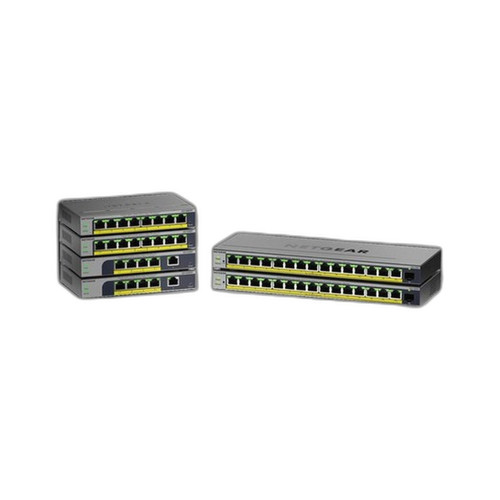
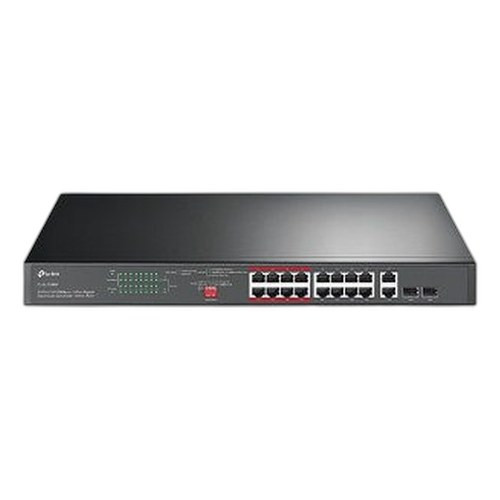
Both the NETGEAR GS116EP-100NAS and the TP-Link TL-SL1218MP are 16-port unmanaged PoE+ switches targeting small-to-mid-scale surveillance and wireless AP deployments. Each delivers 802.3at PoE+ across 16 access ports, operates in the same temperature band, and requires no management overhead. The key differentiators lie in access-port speed (all-Gigabit vs. 10/100 with Gigabit uplinks), total PoE power budget, switching capacity, form factor, and supplementary operating modes — all of which carry real consequence in camera-dense or bandwidth-intensive installations.
In This Guide
- Which switch delivers more bandwidth to connected devices?
- Which switch provides more PoE headroom and how do their power and environmental specs compare?
- What management features, operating modes, and integration capabilities does each switch offer?
- Which should you choose: the GS116EP-100NAS or the SL1218MP?
- Side-by-Side Specs
- FAQ
Which switch delivers more bandwidth to connected devices?
The NETGEAR GS116EP-100NAS equips all 16 access ports with Gigabit (1000 Mbps) speed. Bandwidth figures listed in the spec data range from 10 Gbps to 32 Gbps across multiple references; because the spec set contains duplicate and inconsistent bandwidth values without a single authoritative switching-capacity figure, no definitive switching-capacity number can be cited from the provided evidence. Buyers should confirm throughput from the published datasheet at /content/product-datasheets/GS116EP-100NAS.pdf.
The TP-Link TL-SL1218MP provides 16 access ports at 10/100 Mbps (100 Mbps maximum per port) plus 2 dedicated Gigabit uplink ports. Its switching capacity is specified at 7.2 Gbps. This architecture is common in cost-sensitive surveillance builds where cameras stream at sub-100 Mbps, but it becomes a bottleneck if endpoints require Gigabit throughput — for example, multi-sensor or 4K-plus cameras, NAS units, or servers connected on access ports.
For any device that benefits from or requires Gigabit access — high-resolution cameras, PoE NVRs, or dual-purpose data/surveillance endpoints — the GS116EP-100NAS provides tenfold the per-port ceiling (1000 Mbps vs. 100 Mbps). The TL-SL1218MP's Gigabit capacity is confined to its 2 uplink ports, making it suitable primarily for 10/100 endpoints feeding a Gigabit aggregation layer.
Which switch provides more PoE headroom and how do their power and environmental specs compare?
The TP-Link TL-SL1218MP specifies a total PoE budget of 192 W across its 16 PoE+ ports, with up to 30 W per port (802.3af/at). Its power supply accepts 100–240 V AC at 50/60 Hz, and it is cooled by 2 fans. The operating temperature range is 0°C–40°C (32°F–104°F), with storage rated to -40°C–70°C (-40°F–158°F). Physical dimensions are 17.3 × 7.1 × 1.7 in. (440 × 180 × 44 mm), and the mount type is rack.
The NETGEAR GS116EP-100NAS is rated at up to 30 W per port (802.3at) on all 16 ports. However, total PoE power budget is not specified in the provided evidence for this model. Buyers must consult the manufacturer datasheet before sizing a deployment where aggregate PoE draw is a design constraint. Its operating temperature range is 32–104°F (0°C–40°C), matching the TP-Link. Mount type is wall; physical dimensions are not provided in the spec data.
With a documented 192 W total budget, the TL-SL1218MP gives installers a concrete planning figure: 192 W shared across 16 ports averages 12 W per port simultaneously, which comfortably drives standard PoE cameras (typically 5–15 W) but requires load-balancing for full-watt 802.3at devices on every port. The GS116EP-100NAS's aggregate budget is unknown from the supplied specs, introducing planning risk in dense deployments. The TL-SL1218MP's rack mount suits 19-inch enclosures; the GS116EP-100NAS's wall mount suits distributed wiring-closet or on-wall installation.
What management features, operating modes, and integration capabilities does each switch offer?
Both switches are unmanaged — neither requires nor supports CLI, SNMP, web-GUI, or VLAN configuration. Traffic forwarding begins immediately on power-up with no setup. This simplifies deployment but eliminates per-port power scheduling, traffic prioritization policies, or remote diagnostics.
The TP-Link TL-SL1218MP adds two hardware-selectable operating modes absent from the NETGEAR's spec data: Priority Mode (ports 1–8 receive elevated forwarding priority, useful for mixing cameras and lower-priority endpoints) and Extend Mode (extends PoE reach to 250 m on ports 1–8, beyond the 802.3af/at standard 100 m limit). These modes are engaged via physical switch, not software. Additionally, 2 Gigabit combo SFP slots are specified, enabling fiber uplink for building-to-building or IDF-to-MDF runs. Fiber type noted is Single Mode.
The NETGEAR GS116EP-100NAS also lists Single Mode fiber in its spec data, but does not list SFP or combo port count in the provided evidence. The presence or absence of fiber uplink capability cannot be confirmed from the supplied specs alone — consult the datasheet. Neither switch lists specific VMS or NVR platform certifications in the provided evidence.
Which should you choose: the GS116EP-100NAS or the SL1218MP?
Our take: The GS116EP-100NAS is the stronger choice when connected endpoints require Gigabit access-port throughput — its 16 all-Gigabit PoE+ ports provide up to 1000 Mbps per device versus the TL-SL1218MP's 100 Mbps access-port ceiling. Conversely, the TL-SL1218MP specifies a documented 192 W total PoE budget (the GS116EP-100NAS's aggregate budget is absent from the provided evidence), a 250 m Extend Mode for long cable runs, Priority Mode for mixed-traffic environments, and 2 Gigabit SFP combo slots for fiber uplink — none of which appear in the NETGEAR's spec set. Choose the GS116EP-100NAS for Gigabit-capable cameras, NVRs, or APs on every port in a wall-mount scenario. Choose the TL-SL1218MP for 10/100 camera-only surveillance runs where a rack-mount form, a confirmed power budget, extended cable reach, or fiber uplink is required.
Side-by-Side Comparison
Spec-for-spec, from manufacturer data.
| Specification | NETGEAR GS116EP-100NAS | TP-Link SL1218MP |
|---|---|---|
| Product Type | Unmanaged PoE+ Switch | Unmanaged PoE+ Switch |
| Total Access Ports | 16 | 16 |
| Access Port Speed | 1000 Mbps (Gigabit) | 10/100 Mbps |
| Uplink Ports | Not specified in evidence | 2× Gigabit |
| SFP / Fiber Uplink | Not confirmed in evidence | 2× Gigabit combo SFP (Single Mode) |
| PoE Standard | 802.3at (PoE+) | 802.3af/at (PoE+) |
| PoE Per Port (max) | 30 W | 30 W |
| Total PoE Budget | — | 192 W |
| Switching Capacity | Not confirmed in evidence | 7.2 Gbps |
| Operating Temp | 32°F–104°F (0°C–40°C) | 32°F–104°F (0°C–40°C) |
| Storage Temp | — | -40°F–158°F (-40°C–70°C) |
| Power Supply | Not specified in evidence | 100–240 V AC, 50/60 Hz |
| Cooling | Not specified in evidence | 2 fans |
| Mount Type | Wall | Rack |
| Dimensions | — | 17.3 × 7.1 × 1.7 in. (440 × 180 × 44 mm) |
| Special Operating Modes | — | Priority Mode (ports 1–8); Extend Mode 250 m (ports 1–8) |
Frequently Asked Questions
Which should you choose: the GS116EP-100NAS or the SL1218MP?
The GS116EP-100NAS is the stronger choice when connected endpoints require Gigabit access-port throughput — its 16 all-Gigabit PoE+ ports provide up to 1000 Mbps per device versus the TL-SL1218MP's 100 Mbps access-port ceiling. Conversely, the TL-SL1218MP specifies a documented 192 W total PoE budget (the GS116EP-100NAS's aggregate budget is absent from the provided evidence), a 250 m Extend Mode for long cable runs, Priority Mode for mixed-traffic environments, and 2 Gigabit SFP combo slots for fiber uplink — none of which appear in the NETGEAR's spec set. Choose the GS116EP-100NAS for Gigabit-capable cameras, NVRs, or APs on every port in a wall-mount scenario. Choose the TL-SL1218MP for 10/100 camera-only surveillance runs where a rack-mount form, a confirmed power budget, extended cable reach, or fiber uplink is required.
Can I power full 30 W PoE+ devices on every port of both switches simultaneously?
The TL-SL1218MP specifies 30 W per port but a 192 W total budget, meaning all 16 ports cannot draw 30 W simultaneously — actual simultaneous capacity averages roughly 12 W per port. The GS116EP-100NAS also lists 30 W per port, but its total PoE budget is not provided in the available spec data, so the same simultaneous-load question cannot be answered without consulting the NETGEAR datasheet.
Which switch is better for running cable runs longer than 100 meters to outdoor cameras?
The TL-SL1218MP specifies an Extend Mode on ports 1–8 that stretches PoE reach to 250 m, beyond the 802.3af/at standard 100 m limit (at reduced speed). The GS116EP-100NAS does not list an equivalent extended-range mode in the provided specifications.
Does either switch support fiber uplinks to connect to a core switch or IDF in another building?
The TL-SL1218MP explicitly specifies 2× Gigabit combo SFP slots supporting Single Mode fiber. The GS116EP-100NAS lists Single Mode fiber in its spec data but does not confirm SFP port count or combo-port availability in the provided evidence — verify against the manufacturer datasheet before assuming fiber uplink support.
More Network Switch Comparisons
- Vivotek GEL-205A-260 vs TP-Link SL1218MP
- Vivotek GEL-205A-260 vs Allied Telesis AT-x530L-18GHXm-10
- Vivotek GEL-205A-260 vs Ubiquiti USW-LITE-16-POE
- Vivotek GEL-205A-260 vs Ubiquiti USW-16-POE
- TP-Link SL1218MP vs Allied Telesis AT-x530L-18GHXm-10
- TP-Link SL1218MP vs Ubiquiti USW-LITE-16-POE
Network Switch Buying Guides
Get a Second Opinion on Your Camera Choice
Share your site layout, coverage goals, and budget. Our team will validate the camera selection, flag anything we would change, and recommend products that match the use case.