
Epson C490 vs Epson S1000II-NW: Specification Comparison
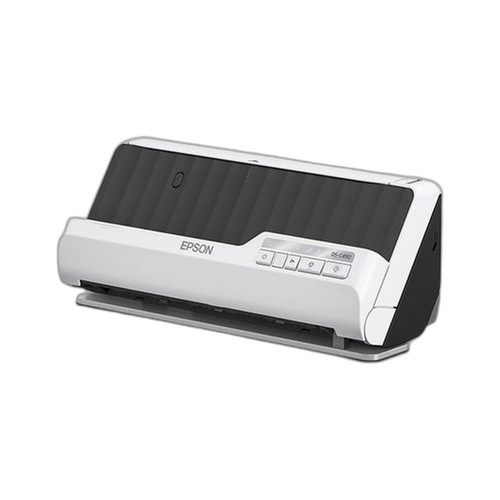
Both the Epson DS-C490 (B11B271201) and the Epson S1000II-NW (A41CL16012) are desktop document scanners equipped with Automatic Document Feeders, targeting office document digitization workflows. The C490 is a compact, USB-only sheetfed unit aimed at individual or small-workgroup use, while the S1000II-NW adds Gigabit Ethernet network connectivity and higher throughput specifications, positioning it for shared or departmental deployments. This comparison covers throughput and resolution, physical footprint and connectivity, and software and compliance characteristics.
In This Guide
Which scanner delivers higher throughput and resolution for your document volume?
The DS-C490 is specified at 600 dpi optical resolution with a 10-bit input / 8-bit output per color depth, and a rated daily duty cycle of 4,500 scans per day. Scan speed in pages per minute is not stated in the provided specifications.
The S1000II-NW is specified at 200 dpi resolution (per Card_Bullet_2) with a rated scan speed of 60 dpm single-pass and 50 ipm ADF color throughput. A daily duty cycle figure is not provided in the supplied specifications.
For resolution-sensitive tasks such as OCR on fine print or compliance archiving requiring high fidelity, the C490's 600 dpi optical resolution is substantially higher than the S1000II-NW's stated 200 dpi. For raw throughput in pages-per-minute terms, the S1000II-NW's 60 dpm / 50 ipm figures are provided, while equivalent ppm data for the C490 is absent from the supplied specs.
Which scanner fits your workspace and network infrastructure?
The DS-C490 measures 11.7" x 4.2" x 4.9" and weighs 6.4 lb, making it one of the smaller desktop scanner profiles. It connects exclusively via USB 2.0, meaning it must be directly tethered to a host PC and cannot be placed on a shared network segment without a print/scan server intermediary.
The S1000II-NW measures 17.8" x 11.8" x 9.9" — a significantly larger desktop footprint — and connects via both USB 2.0 and Gigabit Ethernet (RJ-45). The Gigabit LAN interface allows the unit to be placed anywhere on a network and accessed by multiple users without requiring a dedicated host computer.
The C490 is the right fit where desk space is constrained and a single user owns the scanner. The S1000II-NW requires considerably more desk real estate but enables true network-shared scanning, which is a fundamental architectural difference for multi-user environments. Country of origin is Indonesia for the C490 and China for the S1000II-NW; both are desktop-mount units.
Which scanner offers broader software compatibility and compliance certifications?
The DS-C490 outputs PDF, TIFF, and JPEG formats and carries an ENERGY STAR certification. Driver and software compatibility details beyond these output formats are not enumerated in the provided specifications.
The S1000II-NW ships with TWAIN and ISIS drivers, explicitly covering Windows 10, Windows 10 IoT Enterprise, and Windows 11, and is RoHS compliant. The package includes a USB cable, SAC cable, AC adapter, and Setup Guide. Output format support is not explicitly listed in the provided specifications.
For environments already standardized on TWAIN/ISIS-dependent document management platforms (common in legal, healthcare, and financial workflows), the S1000II-NW's explicit driver declarations are an integration advantage. The C490's ENERGY STAR certification is a relevant credential for organizations with sustainability or facilities procurement requirements; the S1000II-NW's RoHS compliance addresses materials/environmental standards. Neither model's software ecosystem is fully specified, limiting a complete comparison.
Which should you choose: the C490 or the S1000II-NW?
Our take: The S1000II-NW is the stronger choice when the scanner must serve multiple users over a network, given its Gigabit Ethernet interface — a capability entirely absent on the C490. Three concrete spec deltas define the trade-off: (1) resolution — the C490 delivers 600 dpi optical versus the S1000II-NW's stated 200 dpi, a 3× advantage for high-fidelity OCR or fine-document archiving; (2) throughput — the S1000II-NW specifies 60 dpm single-pass and 50 ipm ADF color while the C490 provides no ppm figure, making direct throughput comparison impossible from supplied data; (3) footprint — the C490 at 11.7" x 4.2" x 4.9" and 6.4 lb is far smaller than the S1000II-NW at 17.8" x 11.8" x 9.9". Buyers prioritizing resolution and compact form for a single USB-connected workstation should evaluate the C490; buyers requiring shared network access and TWAIN/ISIS driver compatibility for departmental deployments should favor the S1000II-NW.
Side-by-Side Comparison
Spec-for-spec, from manufacturer data.
| Specification | Epson C490 | Epson S1000II-NW |
|---|---|---|
| Product Type | Sheetfed Scanner | Document Scanner |
| Form Factor | Compact Desktop | Desktop |
| Optical Resolution | 600 dpi | 200 dpi |
| Scan Speed (ADF Color) | — | 50 ipm |
| Single-Pass Speed | — | 60 dpm |
| Daily Duty Cycle | 4,500 scans/day | — |
| Connectivity | USB 2.0 | USB 2.0, Gigabit Ethernet (RJ-45) |
| Color Depth | 10-bit input / 8-bit output per color | Full-color (bit depth not specified) |
| ADF | Yes | Yes |
| Output Formats | PDF, TIFF, JPEG | — |
| Driver Support | — | TWAIN, ISIS; Windows 10 / 10 IoT Enterprise / 11 |
| Dimensions (W x D x H) | 11.7" x 4.2" x 4.9" | 17.8" x 11.8" x 9.9" |
| Weight | 6.4 lb | — |
| Certifications | ENERGY STAR | RoHS |
| Warranty | 1-year limited | 1-year limited (2-year in U.S. and Canada per media spec field) |
| Country of Origin | Indonesia | China |
Frequently Asked Questions
Which should you choose: the C490 or the S1000II-NW?
The S1000II-NW is the stronger choice when the scanner must serve multiple users over a network, given its Gigabit Ethernet interface — a capability entirely absent on the C490. Three concrete spec deltas define the trade-off: (1) resolution — the C490 delivers 600 dpi optical versus the S1000II-NW's stated 200 dpi, a 3× advantage for high-fidelity OCR or fine-document archiving; (2) throughput — the S1000II-NW specifies 60 dpm single-pass and 50 ipm ADF color while the C490 provides no ppm figure, making direct throughput comparison impossible from supplied data; (3) footprint — the C490 at 11.7" x 4.2" x 4.9" and 6.4 lb is far smaller than the S1000II-NW at 17.8" x 11.8" x 9.9". Buyers prioritizing resolution and compact form for a single USB-connected workstation should evaluate the C490; buyers requiring shared network access and TWAIN/ISIS driver compatibility for departmental deployments should favor the S1000II-NW.
Can the S1000II-NW be shared across multiple workstations without a dedicated PC?
Yes. The S1000II-NW includes a Gigabit Ethernet (RJ-45) interface, allowing it to connect directly to a network switch and be accessed by multiple users. The DS-C490 offers only USB 2.0 connectivity, so it must be physically connected to a single host computer; network sharing would require third-party software or a scan server.
Which scanner is better suited for high-resolution OCR and compliance archiving?
The DS-C490 specifies 600 dpi optical resolution with 10-bit input depth, which is significantly higher than the S1000II-NW's stated 200 dpi. For workflows that depend on fine-detail capture — such as OCR on small fonts, legal documents, or regulated archiving — the C490's resolution specification is the stronger of the two based on supplied data.
Is the DS-C490 or S1000II-NW a better fit for an existing TWAIN/ISIS document management system?
The S1000II-NW explicitly ships with TWAIN and ISIS drivers and lists Windows 10, Windows 10 IoT Enterprise, and Windows 11 compatibility. The DS-C490's driver and software compatibility details are not enumerated in the provided specifications, so buyers integrating with TWAIN/ISIS-dependent platforms should verify C490 driver support independently before purchasing.
More Barcode Scanner Comparisons
- Zebra DS8108-SR vs Zebra DS8108-SR
- Zebra DS8108-SR vs Zebra DS8108-HC
- Datalogic 931061345 vs Datalogic 931024111-00053
- Datalogic 931061335 vs Datalogic 931061345
- Datalogic 931061335 vs Datalogic 931024111-00053
- Datalogic 957022201-00053 vs Datalogic 931061345
Barcode Scanner Buying Guides
Get a Second Opinion on Your Camera Choice
Share your site layout, coverage goals, and budget. Our team will validate the camera selection, flag anything we would change, and recommend products that match the use case.