
Zebra DS8108-SR vs Zebra DS8108-HC: Specification Comparison
Both the Zebra DS8108-SR and DS8108-HC are handheld 1D/2D imager barcode scanners built on the same DS8108 platform, each available in corded and cordless configurations. The SR variant is a standard-use model suited for general retail and light industrial environments, while the HC (Healthcare) variant is purpose-built for clinical settings with a shielded USB cable and disinfectant-ready housing. This comparison evaluates scan performance, physical durability and environmental ratings, and interface/compliance differences to help buyers select the right unit for their deployment.
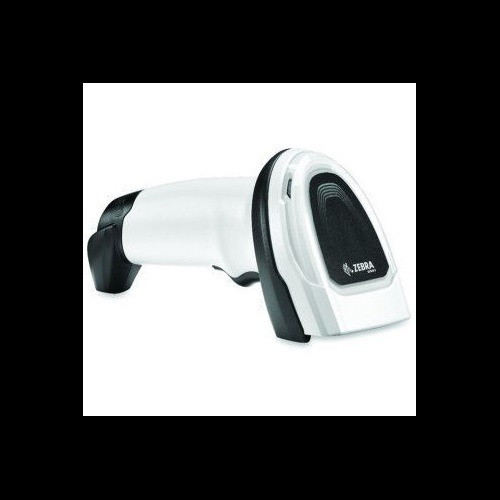
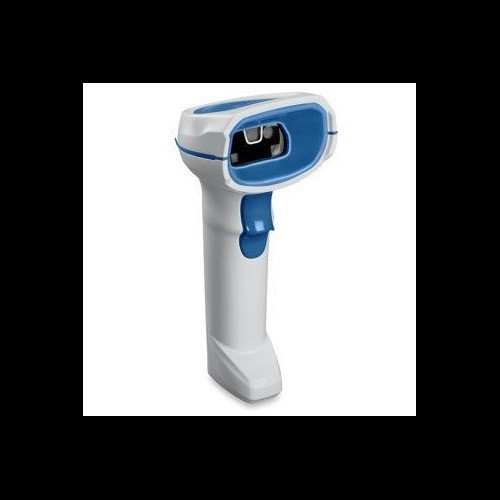
In This Guide
- How do the DS8108-SR and DS8108-HC compare on scan range, resolution, and symbology breadth?
- Are there meaningful differences in physical ruggedness, sealing, and operating environment between the two models?
- How do the two scanners differ in host interface support, electrical safety certifications, and wireless specifications?
- Which should you choose: the DS8108-SR or the DS8108-HC?
- Side-by-Side Specs
- FAQ
How do the DS8108-SR and DS8108-HC compare on scan range, resolution, and symbology breadth?
Both scanners share the same 1,280 × 960 pixel image sensor and a minimum print contrast of 16%. At the 3 mil Code 39 density, both achieve an identical decode range of 2.2 in. to 5.0 in. (5.6–12.7 cm), and at 3 mil Code 128 both read from 2.6 in. to 4.5 in. (6.6–11.4 cm). PDF 417 at 5 mil is likewise matched at 2.3–6.4 in. (5.8–16.3 cm) on both units.
Where the SR specification provides substantially more depth: it documents additional decode ranges at wider bar densities — Code 39 at 20 mil reaches out to 36.8 in. (93.5 cm), Code 128 at 15 mil to 27.1 in. (68.8 cm), and PDF 417 at 6.7 mil to 8.5 in. (21.6 cm). The HC spec lists only the narrow-density ranges, and no extended-range figures are published for it. Whether the HC hardware is capable of equivalent long-range reads cannot be confirmed from the provided specifications.
The SR spec also explicitly lists minimum resolution figures: 3.0 mil for Code 39 and Code 128, 6.0 mil for Data Matrix and QR Code, and 5.0 mil for PDF. The HC spec does not publish these minimums. The SR additionally documents Digimarc digital watermark support and a named 1D symbology list (Code 39, Code 128, Code 93, Codabar/NW7, Code 11, MSI Plessey, UPC/EAN, I 2 of 5, Korean 3 of 5, GS1 DataBar, Base 32); the HC spec does not enumerate supported symbologies beyond calling the unit a '1D/2D Imager.' The HC spec uniquely states a processor speed of 800 MHz; the SR spec does not publish this figure.
Are there meaningful differences in physical ruggedness, sealing, and operating environment between the two models?
On the core durability metrics, the two scanners are spec-identical: 6.0 ft./1.8 m drop to concrete, 2,000 tumbles at 1.5 ft./0.5 m, IP42 sealing, and ESD discharge ratings of ±15 KV Air / ±8 KV Direct / ±8 KV Indirect. Ambient light immunity is equivalent — the SR states 0–96,840 Lux (also expressed as 0–9,000 foot candles) and the HC states up to 96,840 Lux.
Operating temperature is identical on both: 32° to 122° F (0° to 50° C). Storage temperature is also identical: −40° to 158° F (−40° to 70° C). Humidity tolerance is the same: 5%–95% RH, non-condensing. Charging temperature (32°–104° F / 0°–40° C) is specified for the SR but not published in the HC spec.
The HC variant's designation as a healthcare scanner implies disinfectant-ready housing materials, but no chemical resistance specification (e.g., specific cleaning agents or immersion ratings) is present in the supplied HC spec data. Buyers requiring documented chemical compatibility for clinical cleaning protocols should obtain the HC's full environmental specification sheet from Zebra.
How do the two scanners differ in host interface support, electrical safety certifications, and wireless specifications?
Both units share Bluetooth 4.0 with BLE, Class 1 range of 330 ft. (100 m), a 2,500 mAh Li-Ion battery, 65,000 scans per charge, 83 hours operating time, and 7 hr 45 min USB charge time. Corded input voltage is 4.5–5.5 VDC on both.
The SR specification documents a broader set of supported host interfaces: USB, RS232, Keyboard Wedge, and RS485, with support for over 90 international keyboard layouts. The HC spec does not list supported host interfaces beyond the USB kit configuration implied by the SKU. Buyers needing RS232 or RS485 connectivity cannot confirm HC support from the provided spec.
On electrical safety certifications, the SR lists EN 60950-1, IEC 60950-1, UL 60950-1, and CAN/CSA-C22.2 No. 60950-1-07. The HC lists EN 60950-1, IEC 60950-1, and UL 60950-1, but does not include the Canadian CSA standard in the provided spec. Both share identical EMC certifications (EN 55022 Class B, EN 55032 Class B, EN 55024, 47 CFR Part 15 Subpart B Class B, ICES-003 Issue 6 Class B). The SR additionally documents harmonic current emissions (EN 61000-3-2) and voltage fluctuation/flicker (EN 61000-3-3) compliance; the HC spec does not include these. The HC spec also lists cordless cradle dimensions and presentation cradle weight — these are absent from the SR provided spec, though the SR does list both cradle weight figures.
Which should you choose: the DS8108-SR or the DS8108-HC?
Our take: The DS8108-SR is the stronger choice when extended decode range, full symbology breadth, and multi-interface flexibility are priorities; the DS8108-HC is the correct choice for clinical and regulated healthcare environments. On scan performance, the SR specification documents long-range reads the HC spec does not publish — Code 39 at 20 mil reaches 36.8 in. versus no equivalent HC figure. On interfaces, the SR explicitly supports USB, RS232, Keyboard Wedge, and RS485, while the HC spec confirms only USB. On compliance, the SR adds CAN/CSA-C22.2 No. 60950-1-07 and EN 61000-3-2/3-3 certifications not listed in the HC spec. However, the HC is purpose-built for healthcare: its shielded USB cable and healthcare-grade housing are the deciding factors for patient-area or OR deployments where infection-control protocols and EMI shielding are mandated. Buyers outside healthcare should default to the SR for its richer documented specification; healthcare procurement should select the HC regardless of the SR's broader interface list.
Side-by-Side Comparison
Spec-for-spec, from manufacturer data.
| Specification | Zebra DS8108-SR | Zebra DS8108-HC |
|---|---|---|
| Scanner Type | 1D/2D Imager | 1D/2D Imager |
| Image Sensor Resolution | 1,280 x 960 pixels | 1,280 x 960 pixels |
| Processor Speed | — | 800 MHz |
| Corded Scanner Dimensions (H x W x D) | 6.6 x 2.6 x 4.2 in. | 6.6 x 2.6 x 4.2 in. |
| Corded Scanner Weight | 5.4 oz. / 154 g | 5.4 oz. / 154 g |
| Cordless Scanner Weight | 8.3 oz. / 235.3 g | 8.3 oz. / 235.3 g |
| Drop Specification | 6.0 ft. / 1.8 m to concrete | 6.0 ft. / 1.8 m to concrete |
| Tumble Specification | 2,000 tumbles at 1.5 ft. / 0.5 m | 2,000 tumbles at 1.5 ft. / 0.5 m |
| IP Sealing | IP42 | IP42 |
| Bluetooth | v4.0 with BLE, Class 1 — 330 ft. / 100 m | v4.0 with BLE, Class 1 — 330 ft. / 100 m |
| Battery / Scans Per Charge / Operating Time | 2,500 mAh Li-Ion / 65,000 scans / 83 hrs | 2,500 mAh Li-Ion / 65,000 scans / 83 hrs |
| Charge Time (USB) | 7 hrs 45 min | 7 hrs 45 min |
| Supported Host Interfaces | USB, RS232, Keyboard Wedge, RS485 | — |
| Decode Range Code 39 — 3 mil / 20 mil | 2.2–5.0 in. / 0–36.8 in. | 2.2–5.0 in. / — |
| Decode Range Code 128 — 3 mil / 15 mil | 2.6–4.5 in. / 0–27.1 in. | 2.6–4.5 in. / — |
| Electrical Safety Certifications | EN 60950-1, IEC 60950-1, UL 60950-1, CAN/CSA-C22.2 No. 60950-1-07 | EN 60950-1, IEC 60950-1, UL 60950-1 |
Frequently Asked Questions
Which should you choose: the DS8108-SR or the DS8108-HC?
The DS8108-SR is the stronger choice when extended decode range, full symbology breadth, and multi-interface flexibility are priorities; the DS8108-HC is the correct choice for clinical and regulated healthcare environments. On scan performance, the SR specification documents long-range reads the HC spec does not publish — Code 39 at 20 mil reaches 36.8 in. versus no equivalent HC figure. On interfaces, the SR explicitly supports USB, RS232, Keyboard Wedge, and RS485, while the HC spec confirms only USB. On compliance, the SR adds CAN/CSA-C22.2 No. 60950-1-07 and EN 61000-3-2/3-3 certifications not listed in the HC spec. However, the HC is purpose-built for healthcare: its shielded USB cable and healthcare-grade housing are the deciding factors for patient-area or OR deployments where infection-control protocols and EMI shielding are mandated. Buyers outside healthcare should default to the SR for its richer documented specification; healthcare procurement should select the HC regardless of the SR's broader interface list.
Is the DS8108-SR or DS8108-HC better for warehouse or retail deployments?
Based on the provided specifications, the DS8108-SR is the better-documented choice for warehouse and retail use. It explicitly lists RS232, RS232, Keyboard Wedge, and RS485 host interfaces alongside USB, supports over 90 international keyboard layouts, and publishes long-range decode figures (e.g., Code 39 at 20 mil reads to 36.8 in./93.5 cm) that the HC spec does not include. The HC is optimized for healthcare environments and its spec does not confirm these interface or extended-range capabilities.
Do both scanners have the same battery life and wireless range?
Yes, on the specs provided. Both the DS8108-SR and DS8108-HC use a 2,500 mAh Li-Ion battery rated at 65,000 scans per charge and 83 hours of operating time, with a charge time of 7 hours 45 minutes via USB. Both use Bluetooth 4.0 with BLE and share a Class 1 wireless range of 330 ft. (100 m).
Is the DS8108-HC more rugged or better sealed than the DS8108-SR?
No, based on the provided specifications. Both models carry identical drop ratings (6.0 ft./1.8 m to concrete), tumble ratings (2,000 tumbles at 1.5 ft./0.5 m), IP42 sealing, and ESD discharge ratings (±15 KV Air, ±8 KV Direct, ±8 KV Indirect). The HC's healthcare designation relates to its disinfectant-ready housing and shielded cable rather than superior mechanical or ingress-protection ratings versus the SR.
More Barcode Scanner Comparisons
- Zebra DS8108-SR vs Zebra DS8108-SR
- Datalogic 931061345 vs Datalogic 931024111-00053
- Datalogic 931061335 vs Datalogic 931061345
- Datalogic 931061335 vs Datalogic 931024111-00053
- Datalogic 957022201-00053 vs Datalogic 931061345
- Zebra DS9308-SR vs Datalogic 931061335
Barcode Scanner Buying Guides
Get a Second Opinion on Your Camera Choice
Share your site layout, coverage goals, and budget. Our team will validate the camera selection, flag anything we would change, and recommend products that match the use case.