
Best Barcode Scanners for Healthcare
Scanners for healthcare and bedside scanning — disinfectant-ready housings, 2D imaging for tiny UDI and vial labels, and cordless mobility.
Karl Wilson
Warehouse & Mobile Computing Specialist · Working integrator
Bottom line
Healthcare barcode scanning demands more than standard retail-grade gear: disinfectant-ready housings that survive repeated wipe-downs with harsh quaternary ammonium and bleach solutions, 2D area imaging capable of resolving tiny UDI DataMatrix and vial label codes, and cordless or cabled mobility that fits nursing workflows without creating infection vectors. Every scanner in this guide is a 2D area imager — the minimum viable technology for GS1 UDI compliance, medication barcodes, and patient wristbands — and each has been selected for spec-fit against healthcare environmental and regulatory demands.
What This Setup Needs
Choosing a barcode scanner for clinical and bedside use is a different exercise than picking a retail or warehouse scanner. The physical environment, regulatory requirements, and workflow constraints are all more demanding. Here are the factors that actually separate the right tool from the wrong one in healthcare settings.
- Disinfectant-ready (DR) housing: Standard ABS plastics and gasket materials degrade rapidly when exposed to hospital-grade disinfectants — quaternary ammonium compounds (quats), bleach solutions, and isopropyl alcohol wipes. Look explicitly for DR-rated housings with sealed seams, coated exteriors, and gaskets certified for repeated chemical exposure. This is non-negotiable in any patient-contact zone.
- 2D area imaging (not laser): Laser scanners cannot read 2D symbologies — DataMatrix, PDF417, QR — which are the formats used for GS1 UDI on medical devices, lot/expiry codes on IV bags and vials, and patient wristbands. A 2D area imager is the minimum viable technology for any FDA UDI-compliance workflow or medication administration process.
- Density capability for small labels: UDI DataMatrix codes on surgical instruments and vials are often printed at high density in very small physical sizes. Standard 2D imagers optimized for standard-density retail labels will fail on these. For dedicated small-label or HD (high-density) code work — think instrument labels and syringe barcodes — verify the scanner's minimum element size specification.
- IP / ingress protection rating: Healthcare environments involve fluid exposure, frequent cleaning, and drops onto hard floors. IP52 provides dust and limited liquid splash resistance adequate for most bedside carts; IP65 provides full dust-exclusion and sustained water-jet resistance, making it better suited for OR, pharmacy compounding, or any zone with direct fluid exposure risk.
- Cordless vs. corded workflow fit: Corded scanners eliminate battery management and charging logistics — a real operational burden in large facilities — but tether the clinician to a workstation. Bluetooth cordless scanners enable bedside, at-chair, or roaming workflows without a cable infection-control concern, but require a disciplined charging program. Consider whether your EHR workstations are on carts (mobile) or fixed terminals before defaulting to either.
- Interface and EMR/EHR integration: Most hospital IT environments expect USB HID (keyboard wedge) output — a scanner that appears as a keyboard and requires zero driver integration. RS-232 serial is occasionally required for legacy ADT or pharmacy systems. Confirm your interface before purchasing, especially for scanners going into pharmacy dispensing or lab environments where the receiving system may not tolerate unexpected characters from a misconfigured scanner suffix.
- Ergonomics and shift-length comfort: Nurses and pharmacy techs scan hundreds of codes per shift. Grip angle, trigger placement, and cable strain relief on corded units all affect fatigue and scan error rates over an 8- or 12-hour shift. Pistol-grip and handheld form factors serve different workflow contexts — a flat, palm-held sled form factor suits tablet-paired mobile workflows, while a traditional pistol grip suits fixed-workstation scanning.
Our Picks
Selected from our catalog by spec-fit. All channel-direct and factory-new — not ranked by price.
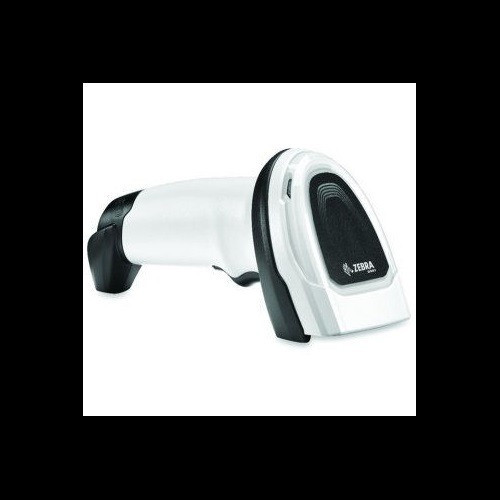
Zebra DS8108
Corded 2D
The Zebra DS8108 is a corded 2D area imager well-suited for general-purpose clinical workstations — nursing stations, patient registration, and pharmacy counters — where a lightweight, ergonomic pistol-grip scanner needs to handle patient wristbands, medication labels, and standard retail barcodes across a 32°–122°F operating range. Its operating temperature specification makes it a reliable choice for environments ranging from cold storage adjacency to standard ward temperatures.
View product →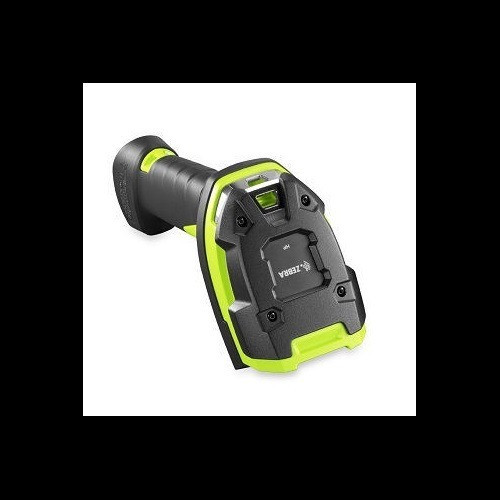
Zebra DS3608
Corded 2D
The Zebra DS3608 in High Density configuration is a strong fit when the scanning target is small, densely printed codes — UDI DataMatrix on surgical instruments, syringe barrel labels, or implant packaging where standard imagers struggle. The rugged corded industrial housing suits environments where the scanner may be set down hard or exposed to rough handling, such as OR supply rooms or sterile processing.
View product →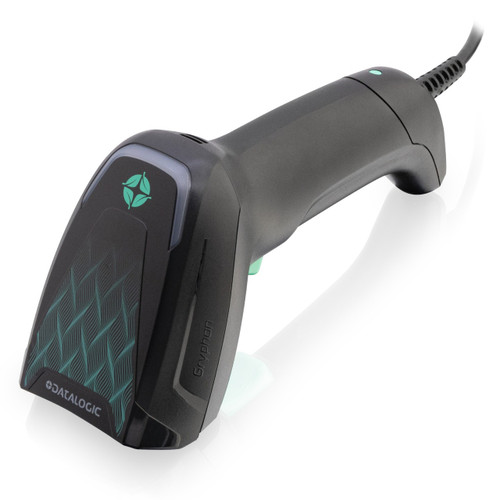
Datalogic GBT4600-HC-BTK1-HP
Corded 2D
The Datalogic GBT4600-HC is purpose-built for healthcare, combining an IP52-rated disinfectant-ready housing with Bluetooth 5.2 connectivity — making it a well-suited choice for bedside medication administration and roaming nursing workflows where a cordless, wipe-clean scanner needs to pair reliably with a workstation or mobile cart without a trailing cable. The USB and RS-232 interface options provide flexibility for both modern and legacy EHR terminal environments.
View product →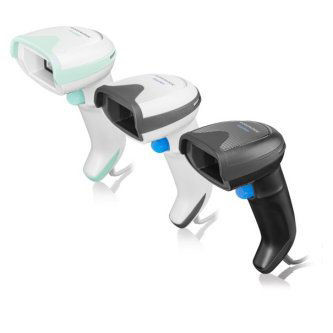
Datalogic GD4590-HCK10-HDR-B
Corded 2D
The Datalogic GD4590-HC in HDR (High Dynamic Range) configuration with an IP52 healthcare housing is a strong fit for pharmacy and lab environments where barcodes appear on highly reflective surfaces — glass vials, foil pouches, or glossy medication packaging — and where the scanner will be regularly wiped down with disinfectants. Bluetooth 4.0 cordless operation suits point-of-care and dispensing workflows that benefit from freedom of movement.
View product →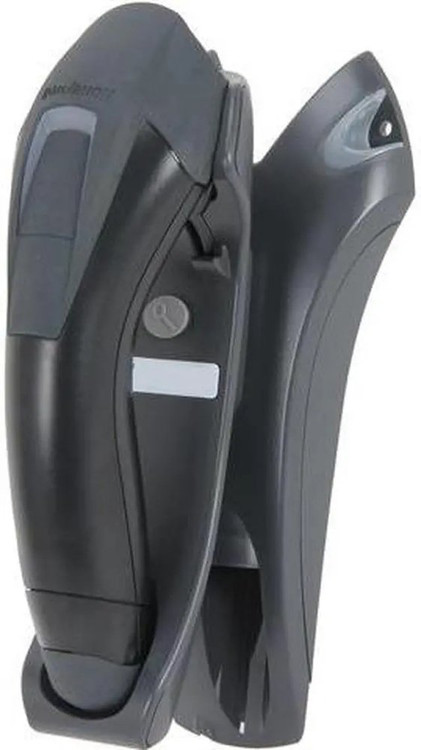
Honeywell 1202G-2USB-5BF-N
Corded 2D
The Honeywell Xenon 1202G with an IP65 rating is well-suited for higher-exposure clinical zones — OR, emergency department, or pharmacy compounding areas — where full dust exclusion and resistance to sustained liquid exposure are required and where Bluetooth 4.2 cordless operation supports scanning away from a fixed base. The IP65 rating represents a meaningful step up in ingress protection over IP52 units for environments with active fluid exposure risk.
View product →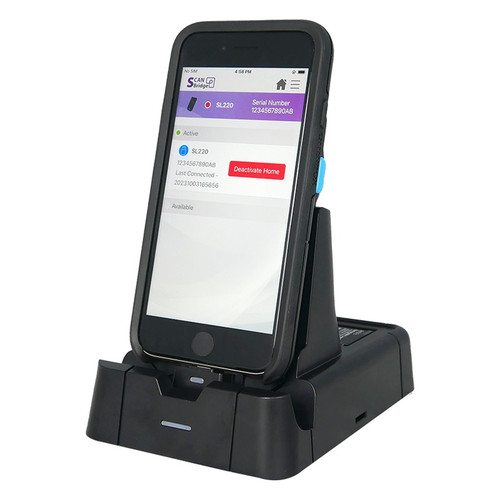
Unitech SL220-YMU0G0-SG-AZ3
Corded 2D
The Unitech SL220 is a strong fit for facilities standardized on iOS or tablet-based EHR at the point of care: its IP65-rated sled form factor supports USB-C, standard USB, and Apple Lightning MFi connectivity, allowing it to attach directly to an iPad or mobile workstation without a separate Bluetooth pairing step. This makes it particularly practical for home health, infusion, or rounding workflows where clinicians carry a tablet rather than work from a fixed terminal.
View product →Frequently Asked Questions
Do I really need a disinfectant-ready scanner, or can I just wipe any scanner with alcohol?
Repeated exposure to isopropyl alcohol, quaternary ammonium wipes, or bleach solutions will degrade standard scanner housings over time — seals crack, plastics haze, and labels peel, eventually compromising both function and hygiene. Disinfectant-ready (DR) scanners are built with coated housings and chemically resistant gaskets rated for the specific agents used in clinical settings. For any patient-contact or high-touch zone, DR-rated hardware is the correct specification — not an optional upgrade.
What barcode symbologies do healthcare scanners need to read?
At minimum, a clinical scanner must read 1D linear symbologies (Code 128, Code 39, ITF-14) for legacy labels and retail packaging, plus 2D symbologies including DataMatrix (the dominant format for FDA UDI on medical devices and implants), PDF417 (used on some patient ID documents and driver's licenses for registration), and QR codes. This is why 2D area imagers are required — laser scanners are physically incapable of reading DataMatrix or any 2D format.
What is the difference between IP52 and IP65 for healthcare scanning?
The IP (Ingress Protection) rating has two digits: the first covers particulate/dust exclusion and the second covers liquid ingress. IP52 means protection against dust in quantities that would interfere with operation, and protection against low-pressure water spray from any direction — adequate for bedside carts, nursing stations, and pharmacy counters where cleaning involves wipes rather than spray. IP65 adds full dust exclusion (no ingress whatsoever) and protection against sustained, direct water jets, making it the better specification for OR environments, instrument processing areas, or any setting with active fluid exposure.
Should I choose a Bluetooth cordless scanner or a corded scanner for a hospital cart environment?
On a mobile workstation-on-wheels (WOW) that moves with the clinician, a corded scanner tethered to the cart often provides the simplest, lowest-maintenance solution — no battery charging logistics, no pairing management, and no range limitations. Bluetooth becomes the stronger choice when the workflow requires scanning away from the cart — at the bedside, in a medication room, or while moving between fixed and mobile workstations — where dragging a cable creates both a tripping hazard and a potential infection-control concern. Factor in your facility's battery charging program maturity before committing to cordless at scale.
Can these scanners integrate directly with Epic, Cerner, or other EHR systems?
All of these scanners output decoded barcode data as standard USB HID (keyboard wedge) input, which means they present to the host computer as a USB keyboard — no drivers, no SDK, no EHR-specific integration work required. The EHR application simply receives the scanned string as if the operator typed it, followed by a configurable suffix (typically Enter or Tab). This is the standard integration method accepted by Epic, Cerner, Meditech, and virtually every other major EHR platform. If your legacy pharmacy or ADT system requires RS-232 serial input, verify the specific SKU's interface options before purchasing.
What does 'high density' mean on a scanner, and when do I need it?
High density (HD) refers to the scanner's ability to resolve barcodes with very small minimum element sizes — typically below 5 mils (0.005 inches) per bar or module. Standard 2D imagers are optimized for codes printed on standard shipping labels or retail packaging, where elements are 7.5–10 mils or larger. UDI DataMatrix codes laser-etched onto surgical instruments, printed on syringe barrel labels, or marked on small-format implant packaging are often printed at 3–5 mil density. If your workflow includes scanning these small, high-density codes, an HD-rated imager is the correct tool; a standard-density imager will produce frequent read failures on the same codes.
Related Resources
- Barcode Scanner comparisons — head-to-head spec matchups
- Barcode Scanner Buying Guide
- Best Barcode Scanners for Warehouse Receiving
- Best Barcode Scanners for Retail POS
- All product comparisons
Speccing this for a project?
Send us your requirements and our senior specialists will confirm specs, compatibility, availability and pricing — free, usually within one business day. Channel-direct, factory-new, serving commercial integrators since 2014.
Get a Free QuoteComparing for a project?
Send us the models you are weighing and our team will confirm specs, compatibility, availability, and pricing — free, usually within one business day.