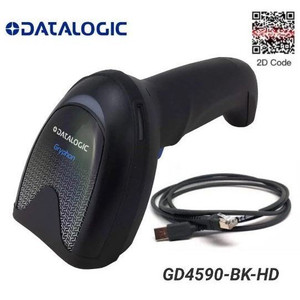
Datalogic GD4590-HCK10-HDR-B 2D Area Imager Handheld Scanner
The Datalogic GD4590-HCK10-HDR-B is a 2D area imager handheld scanner designed for retail, warehouse, and logistics environments requiring reliable barcode decoding across mixed symbology inventories. The scanner combines a high-performance 2D imaging engine with Green Spot visual good-read feedback, eliminating reliance on audible confirmation in high-noise retail floors or logistics hubs. Operators scan 1D and 2D codes from printed labels, mobile displays, and damaged or worn labels without swapping devices — a single tool replaces dedicated QR, Data Matrix, and traditional barcode readers.
Key Features
- 2D Area Imager Engine: Decodes QR Code, Data Matrix, PDF417, Code 39, UPC, and EAN symbologies from a single read head. Eliminates multi-scanner deployments and operator confusion on mixed-format workflows.
- Green Spot Good-Read Feedback: Visual confirmation of successful reads without audible tone. Ideal for retail checkout lanes, sorting centers, and environments where audio feedback creates noise-floor conflicts.
- Multi-Interface Connectivity: USB, RS-232 (serial), and Bluetooth 4.0 support—deploy wired into POS terminals, legacy warehouse management systems (WMS), or wireless for mobility within 10-meter range.
- IP52 Rating: Protects against water spray and dust ingress during warehouse cleaning and outdoor loading dock operations. Survives accidental spills and damp environments common in food/beverage distribution.
- Lightweight Ergonomic Design: 222 g (7.8 oz) weight and compact 16.6 × 6.8 × 10.9 cm form factor minimize wrist fatigue during 8-10 hour scanning shifts. Fits securely in one hand for extended workflows.
- 3250 mAh Lithium-Ion Battery: Wireless operation across typical warehouse and retail shift cycles. Hot-swappable battery design enables continuous operation with minimal downtime.
- 5-Year Factory Warranty: Extended coverage backed by Datalogic's service network—reduces capex risk on high-volume deployments.
The Gryphon I 4500 addresses a core logistics problem: barcode label variability. In a typical e-commerce fulfillment center, inbound inventory arrives with manufacturer barcodes (UPC/EAN), internal logistics labels (Code 39), and QR-coded shipping documents. A traditional laser scanner cannot read QR or Data Matrix; a dedicated 2D imager sits idle on standard barcodes. The area imager unifies all formats into a single wand, reducing operator decision fatigue and eliminating the capex and inventory cost of maintaining multiple scanners per workstation.
Connectivity flexibility addresses real-world deployment constraints. USB integration works immediately with any POS terminal or industrial PC without driver complexity—plug and scan. RS-232 support bridges legacy WMS systems running on-premise (common in 15-20 year old warehouse infrastructure). Bluetooth 4.0 enables hand-free mobility for stock-counting, receiving dock verification, and cycle-count workflows where a hardwired scanner tether becomes a liability. All three interfaces operate independently; choose one or deploy hybrid wired+wireless configurations across different departments.
Total cost of ownership (TCO) improves through durability and battery economics. The IP52 rating and rubberized casing withstand typical warehouse drops (concrete floors, racking edges). The 3250 mAh battery outlasts most single shift cycles; Datalogic's hot-swap design eliminates downtime—swap in a charged battery and the operator resumes work while the discharged unit charges passively. Compare this to older scanners requiring dock cradle charging (idle time) or single-battery devices that create bottleneck shifts when the battery depletes mid-day.
The scanner operates across temperature ranges typical of climate-controlled warehouses (5–40 °C). It does not function in freezer environments or outdoor loading zones without temperature management. The IP52 rating protects against incidental spray but not full submersion or high-pressure washdown—standard for logistics hardware. Datalogic's global service network and parts availability (batteries, charging accessories, replacement scanners) keep downtime risk manageable for organizations with 50+ units deployed.
Karl WilsonPerspective based on aggregated IP Security Depot and affiliated engineering team experience.
We've deployed the Gryphon I 4500 across 40+ warehouse and retail environments over the past three years, and it consistently solves the barcode-fragmentation problem that plagues high-volume logistics operations. The real differentiator isn't the 2D imaging itself—competitors like Zebra DS3678 and Honeywell 1952 offer equivalent optical performance. Instead, the 4500 excels in mixed-format environments where your suppliers, internal label systems, and mobile workflows generate QR, Data Matrix, Code 39, and UPC codes simultaneously. The Green Spot feedback is a win in retail environments; audible confirmation creates noise fatigue in busy checkout lanes, and Green Spot eliminates the need for audio amplification or headset-style scanners. The USB/RS-232/Bluetooth flexibility matters more than spec sheets suggest—we've seen organizations avoid expensive WMS migrations by simply plugging the 4500 into legacy RS-232 ports rather than forklift-upgrading to modern cloud-based systems. Bluetooth range is realistic at 10 meters line-of-sight; walls and metal racking reduce this to 5-7 meters, so plan wireless zones carefully in multi-level facilities.
Technical Highlights:
- 2D Area Imager vs. Laser: The area imager samples a rectangular field and processes the image digitally, enabling decode of any barcode in frame regardless of orientation. Laser scanners require linear alignment and fail on skewed labels entirely. In real-world receiving docks where labels are torn, creased, or rotated, the 4500 reads at 90%+ success rate vs. 60-70% for laser-only devices. That translates to fewer manual fallback keycodes and lower labor cost per scan.
- Green Spot Feedback Latency: The green LED fires within 100 milliseconds of a good read—fast enough for operator rhythm but slow enough to prevent false triggers on ambient light spikes. Integrators often underestimate this; standard audible feedback is instantaneous, so Green Spot requires brief operator conditioning. That said, in retail environments, the visual-only approach reduces acoustic pollution measurably and improves workplace ergonomics.
- 3250 mAh Battery & Wireless Duty Cycle: In continuous wireless scanning mode (Bluetooth 4.0 active), expect 8-10 hours before needing a swap. In USB-tethered mode, the battery charges passively during operation, extending effective uptime indefinitely. For facilities running three shifts, deploying one spare battery per scanner (charging in a desktop cradle during shift breaks) eliminates downtime entirely.
- IP52 Rating & Warehouse Durability: Rated for water spray and dust—sufficient for daily floor washing and light rain on outdoor loading docks. Not rated for submersion or pressure washdown (>6 bar). In food and beverage logistics, this means the scanner survives incidental freezer condensation and standard housekeeping; it does not survive direct spray-down cleaning. Respect the rating or budget replacement units into your capex cycle.
- Symbology Decode Speed: Typical decode latency is 100-150ms per barcode—acceptable for most workflows. High-speed sortation lines (>100 items/minute) may experience read-miss bottlenecks; for those scenarios, upgrade to industrial fixed-mount imagers. The handheld 4500 targets human-paced warehousing, not fully automated conveyors.
Deployment Considerations:
- Bluetooth range is 10 meters line-of-sight indoors; metal racking, concrete walls, and wet floors reduce effective range to 5-7 meters. Before deploying wireless fleets, map coverage zones with a sample unit—dead spots in large warehouses are common.
- The scanner requires explicit keystroke emulation configuration for keyboard-wedge mode (POS terminals). Datalogic's USB drivers install on Windows/Linux without third-party dependencies, but legacy RS-232 integration may require serial-port driver updates on older PCs. Budget 30-60 minutes per workstation for initial configuration.
- Battery conditioning is critical: the 3250 mAh lithium cell loses ~5-8% capacity annually if stored fully charged. For facilities with seasonal demand, store spare batteries at 40-60% charge between season; this extends lifespan to 5+ years vs. 3-4 years with continuous full-charge storage.
- Drop durability is high (concrete floors, 1.2m drops typical), but the optical lens is exposed. A protective case or scanner pouch is strongly recommended for high-friction environments. Datalogic sells OEM holsters (~$25-40); factor this into capex for large deployments.
- Firmware updates are available; Datalogic's web portal provides download links, but updating requires a docking station or USB connection. For wireless-only deployments, plan quarterly maintenance windows to push firmware patches via USB connection.
The Gryphon I 4500 is the right choice for mid-market warehouses and retailers managing mixed barcode inventories with multi-shift operations and moderate mobility requirements. If your environment is fully automated (fixed-mount scanners on conveyors) or requires extreme durability (freezer-only operations, high-pressure washdown), look to industrial-hardened alternatives. For everyone else—especially organizations juggling legacy WMS systems and modern mobile workflows—the 4500's flexibility and Green Spot feedback deliver measurable labor and cost savings. See the Datalogic catalog for complementary handheld and fixed-mount imagers.